Schütte Ursel M E, Cadieux Sarah B, Hemmerich Chris, Pratt Lisa M, White Jeffrey R
Integrated Program in the Environment, Indiana University, BloomingtonIN, USA; Institute of Arctic Biology, University of Alaska Fairbanks, FairbanksAK, USA.
Department of Geological Sciences, Indiana University, BloomingtonIN, USA; University of Illinois at Chicago, ChicagoIL, USA.
Front Microbiol. 2016 Jul 5;7:1035. doi: 10.3389/fmicb.2016.01035. eCollection 2016.
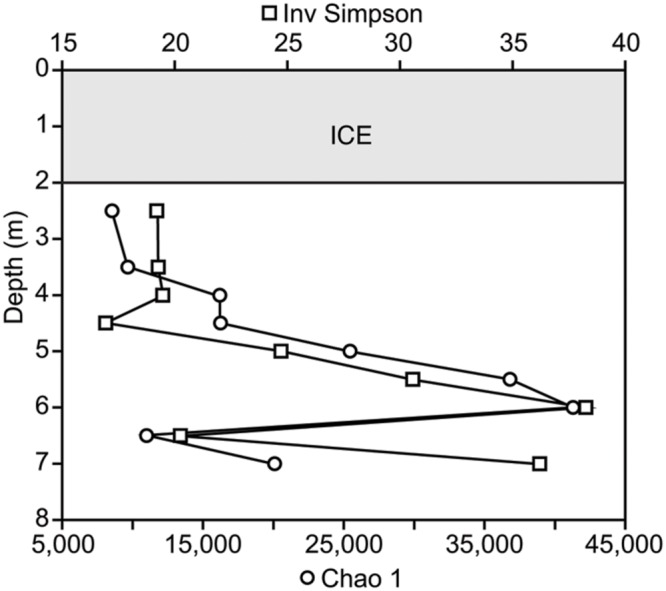
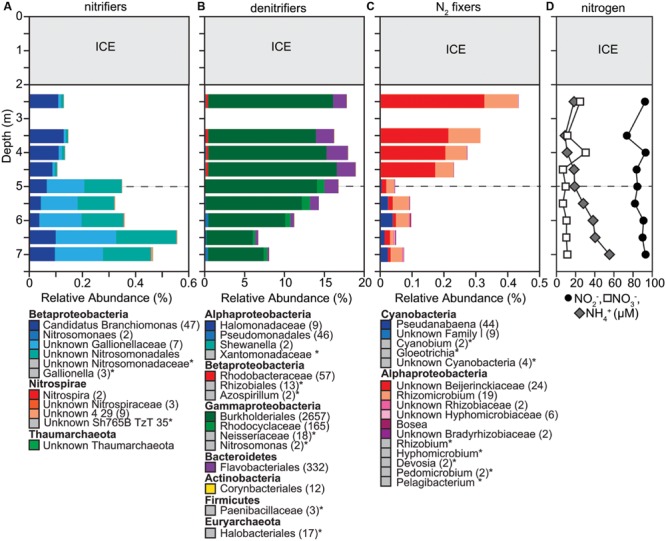
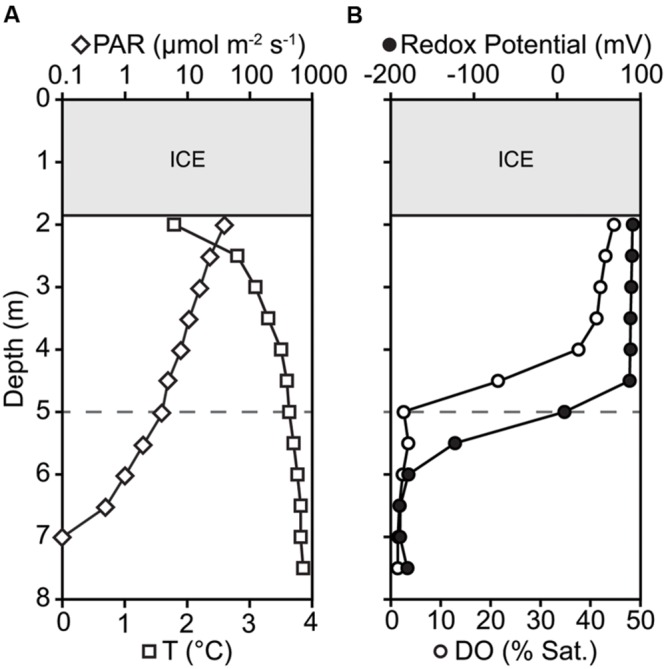
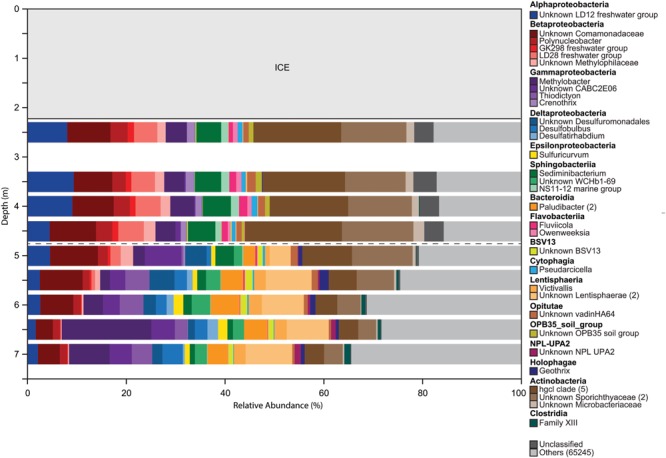
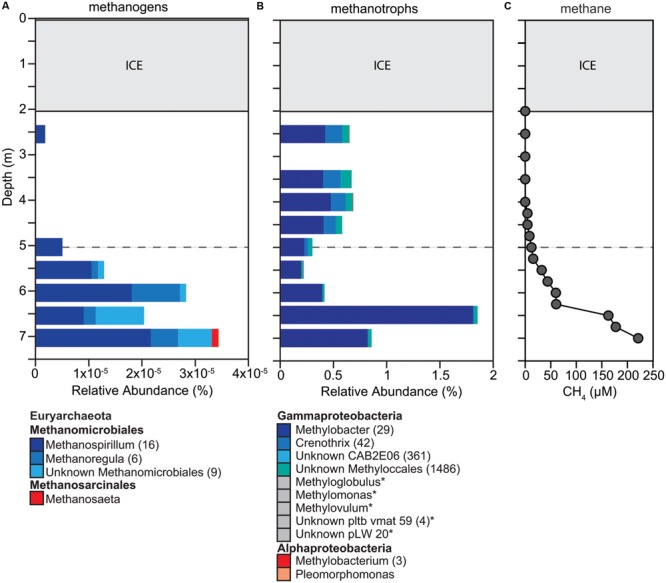
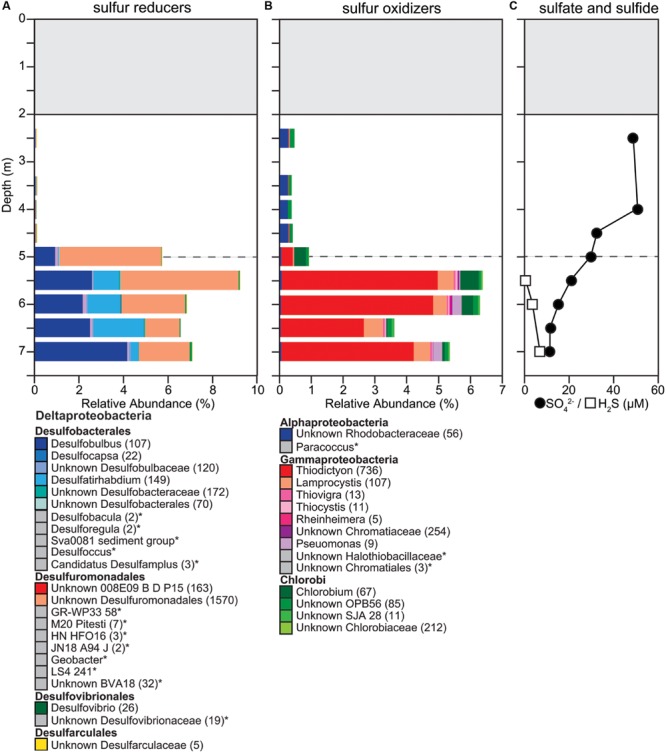
Despite most lakes in the Arctic being perennially or seasonally frozen for at least 40% of the year, little is known about microbial communities and nutrient cycling under ice cover. We assessed the vertical microbial community distribution and geochemical composition in early spring under ice in a seasonally ice-covered lake in southwest Greenland using amplicon-based sequencing that targeted 16S rRNA genes and using a combination of field and laboratory aqueous geochemical methods. Microbial communities changed consistently with changes in geochemistry. Composition of the abundant members responded strongly to redox conditions, shifting downward from a predominantly heterotrophic aerobic community in the suboxic waters to a heterotrophic anaerobic community in the anoxic waters. Operational taxonomic units (OTUs) of Sporichthyaceae, Comamonadaceae, and the SAR11 Clade had higher relative abundances above the oxycline and OTUs within the genus Methylobacter, the phylum Lentisphaerae, and purple sulfur bacteria (PSB) below the oxycline. Notably, a 13-fold increase in sulfide at the oxycline was reflected in an increase and change in community composition of potential sulfur oxidizers. Purple non-sulfur bacteria were present above the oxycline and green sulfur bacteria and PSB coexisted below the oxycline, however, PSB were most abundant. For the first time we show the importance of PSB as potential sulfur oxidizers in an Arctic dimictic lake.
尽管北极地区的大多数湖泊常年或季节性结冰,一年中至少有40%的时间处于冰封状态,但对于冰盖下的微生物群落和养分循环却知之甚少。我们利用针对16S rRNA基因的扩增子测序技术,并结合现场和实验室水地球化学方法,评估了格陵兰西南部一个季节性冰封湖泊早春冰下的垂直微生物群落分布和地球化学组成。微生物群落随着地球化学变化而持续变化。优势成员的组成对氧化还原条件反应强烈,从亚oxic水域中以异养需氧群落为主,向下转变为缺氧水域中的异养厌氧群落。芽孢杆菌科、丛毛单胞菌科和SAR11进化枝的操作分类单元(OTUs)在氧化跃层以上具有较高的相对丰度,而甲基杆菌属、浮霉菌门和紫色硫细菌(PSB)的OTUs在氧化跃层以下具有较高的相对丰度。值得注意的是,氧化跃层处硫化物增加了13倍,这反映在潜在硫氧化剂群落组成的增加和变化上。紫色非硫细菌存在于氧化跃层以上,绿色硫细菌和PSB共存于氧化跃层以下,然而,PSB最为丰富。我们首次证明了PSB作为北极双季湖潜在硫氧化剂的重要性。