Verma Shailendra K, Batra Lalit, Tuteja Urmil
Microbiology Division, Defence Research & Development Establishment, Gwalior India.
Front Microbiol. 2016 Jul 5;7:1053. doi: 10.3389/fmicb.2016.01053. eCollection 2016.
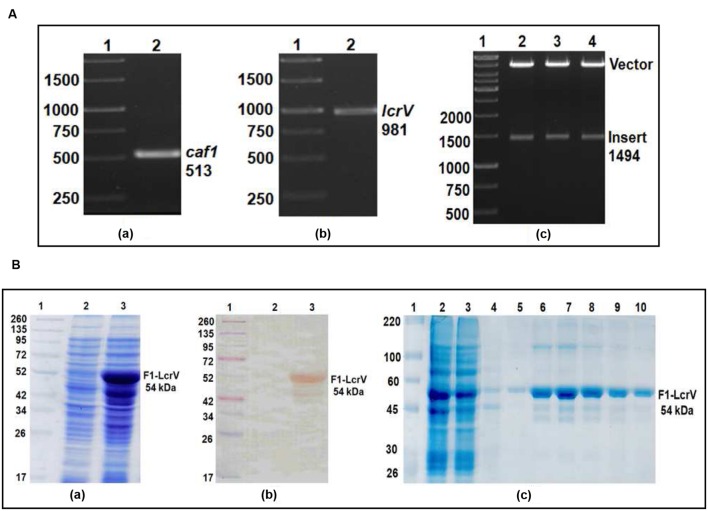
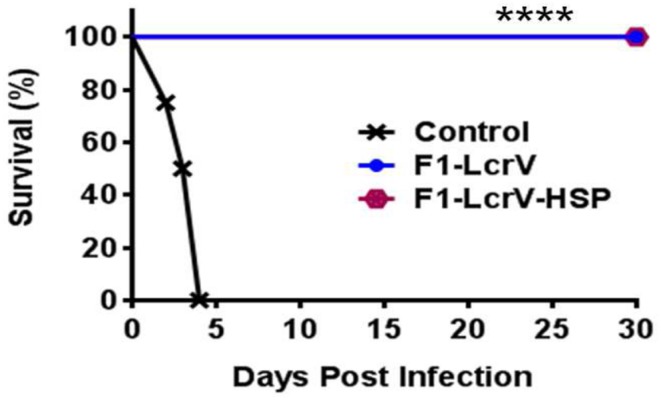
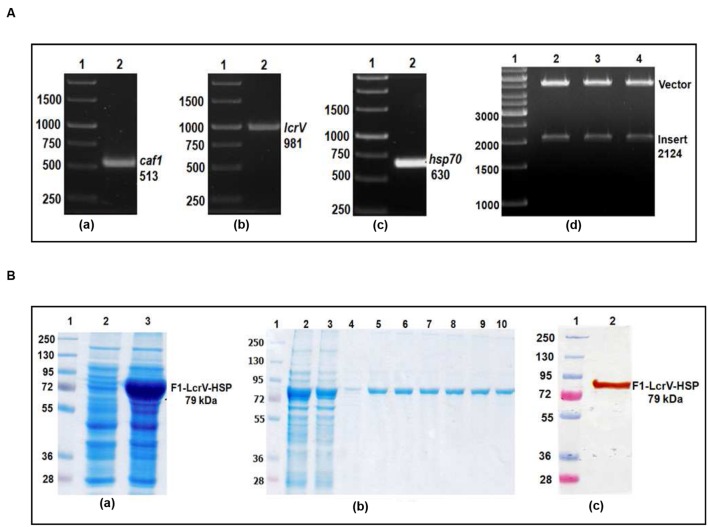
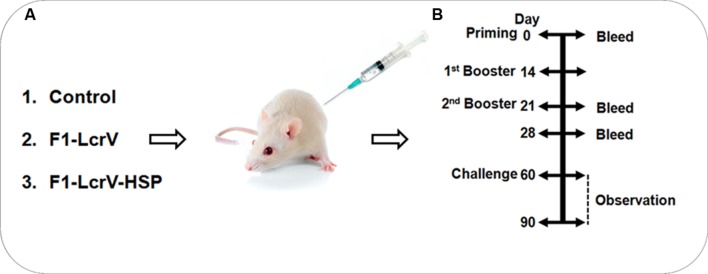
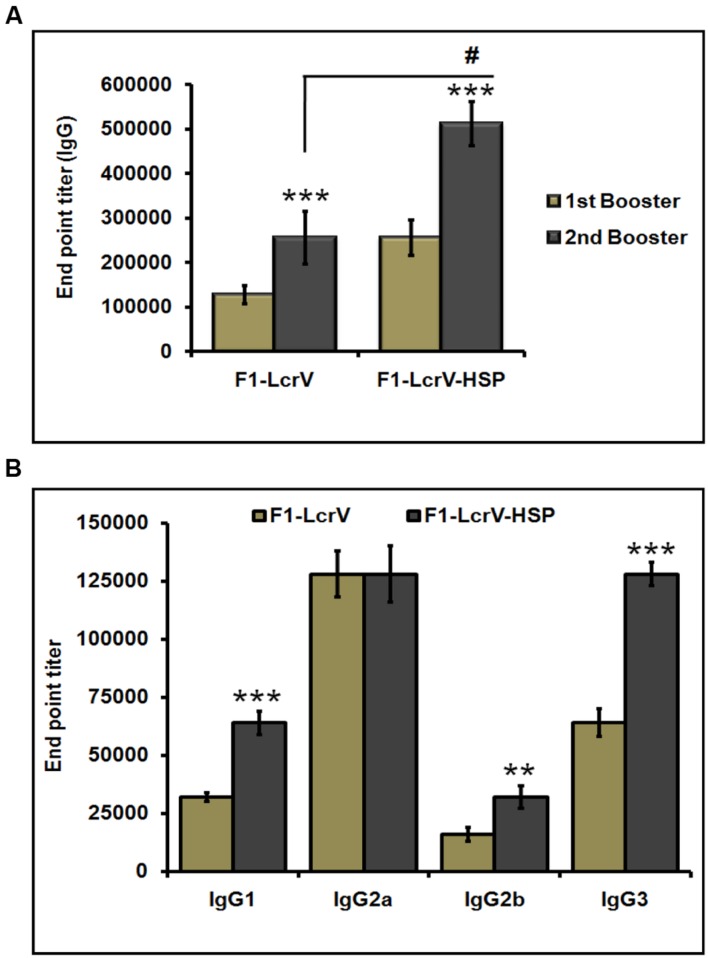
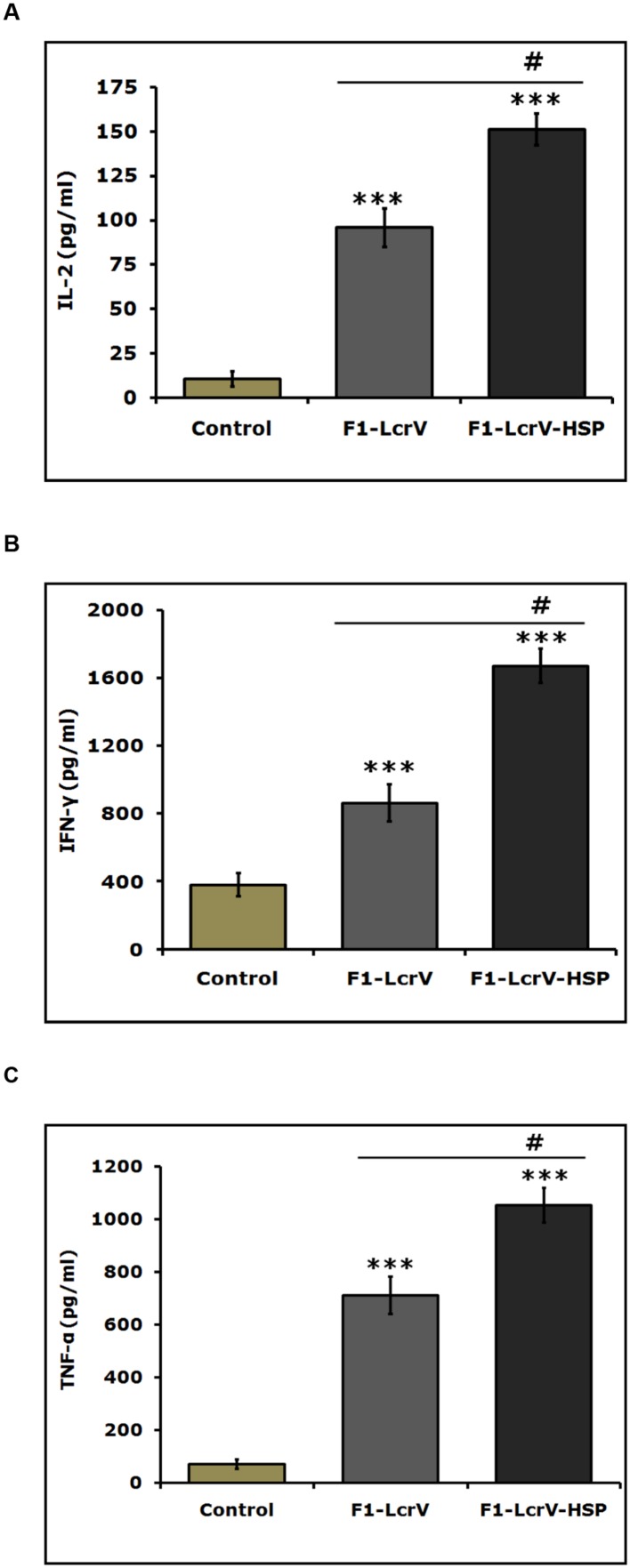
Plague is one of the most dangerous infections in humans caused by Yersinia pestis, a Gram-negative bacterium. Despite of an overwhelming research success, no ideal vaccine against plague is available yet. It is well established that F1/LcrV based vaccine requires a strong cellular immune response for complete protection against plague. In our earlier study, we demonstrated that HSP70(II) of Mycobacterium tuberculosis modulates the humoral and cellular immunity of F1/LcrV vaccine candidates individually as well as in combinations in a mouse model. Here, we made two recombinant constructs caf1-lcrV and caf1-lcrV-hsp70(II). The caf1 and lcrV genes of Y. pestis and hsp70 domain II of M. tuberculosis were amplified by polymerase chain reaction. Both the recombinant constructs caf1-lcrV and caf1-lcrV-hsp70(II) were cloned in pET28a vector and expressed in Escherichia coli. The recombinant fusion proteins F1-LcrV and F1-LcrV-HSP70(II) were purified using Ni-NTA columns and formulated with alum to evaluate the humoral and cell mediated immune responses in mice. The protective efficacies of F1-LcrV and F1-LcrV-HSP70(II) were determined following challenge of immunized mice with 100 LD50 of Y. pestis through intraperitoneal route. Significant differences were noticed in the titers of IgG and it's isotypes, i.e., IgG1, IgG2b, and IgG3 in anti- F1-LcrV-HSP70(II) sera in comparison to anti-F1-LcrV sera. Similarly, significant differences were also noticed in the expression levels of IL-2, IFN-γ and TNF-α in splenocytes of F1-LcrV-HSP(II) immunized mice in comparison to F1-LcrV. Both F1-LcrV and F1-LcrV-HSP70(II) provided 100% protection. Our research findings suggest that F1-LcrV fused with HSP70 domain II of M. tuberculosis significantly enhanced the humoral and cellular immune responses in mouse model.
鼠疫是由革兰氏阴性菌鼠疫耶尔森菌引起的人类最危险的感染之一。尽管在研究上取得了巨大成功,但目前仍没有理想的鼠疫疫苗。众所周知,基于F1/LcrV的疫苗需要强大的细胞免疫反应才能完全预防鼠疫。在我们早期的研究中,我们证明了结核分枝杆菌的HSP70(II)在小鼠模型中单独或联合调节F1/LcrV候选疫苗的体液免疫和细胞免疫。在此,我们构建了两种重组体caf1-lcrV和caf1-lcrV-hsp70(II)。通过聚合酶链反应扩增鼠疫耶尔森菌的caf1和lcrV基因以及结核分枝杆菌的hsp70结构域II。将重组体caf1-lcrV和caf1-lcrV-hsp70(II)克隆到pET28a载体中并在大肠杆菌中表达。使用Ni-NTA柱纯化重组融合蛋白F1-LcrV和F1-LcrV-HSP70(II),并用明矾配制以评估小鼠的体液免疫和细胞介导的免疫反应。通过腹腔途径用100 LD50的鼠疫耶尔森菌攻击免疫小鼠后,测定F1-LcrV和F1-LcrV-HSP70(II)的保护效力。与抗F1-LcrV血清相比,抗F1-LcrV-HSP70(II)血清中IgG及其亚型IgG1、IgG2b和IgG3的滴度存在显著差异。同样,与F1-LcrV相比,F1-LcrV-HSP(II)免疫小鼠脾细胞中IL-2、IFN-γ和TNF-α的表达水平也存在显著差异。F1-LcrV和F1-LcrV-HSP70(II)均提供了100%的保护。我们的研究结果表明,与结核分枝杆菌的HSP70结构域II融合的F1-LcrV在小鼠模型中显著增强了体液免疫和细胞免疫反应。