Di Battista Alex P, Rhind Shawn G, Richards Doug, Churchill Nathan, Baker Andrew J, Hutchison Michael G
Institute of Medical Science, University of Toronto, Toronto ON, Canada.
Defence Research and Development Canada, Toronto Research Centre, Toronto, ON, Canada.
PLoS One. 2016 Jul 26;11(7):e0159929. doi: 10.1371/journal.pone.0159929. eCollection 2016.
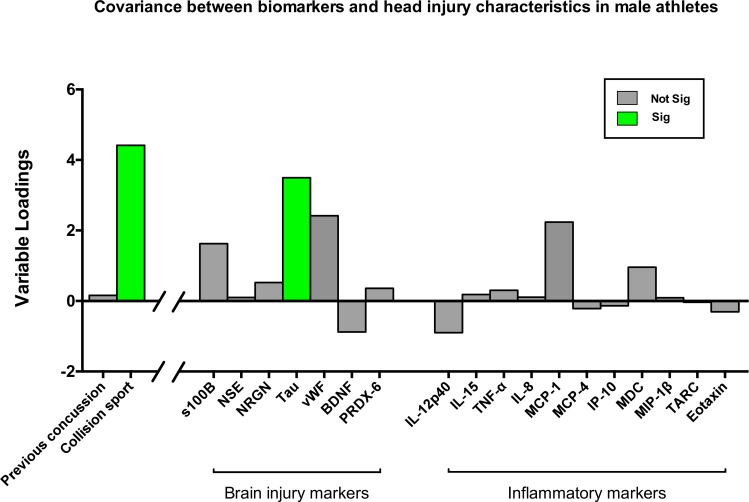
The long-term health effects of concussion and sub-concussive impacts in sport are unknown. Growing evidence suggests both inflammation and neurodegeneration are pivotal to secondary injury processes and the etiology of neurodegenerative diseases. In the present study we characterized circulating brain injury and inflammatory mediators in healthy male and female athletes according to concussion history and collision sport participation. Eighty-seven university level athletes (male, n = 60; female, n = 27) were recruited before the start of the competitive season. Athletes were healthy at the time of the study (no medications, illness, concussion or musculoskeletal injuries). Dependent variables included 29 inflammatory and 10 neurological injury analytes assessed in the peripheral blood by immunoassay. Biomarkers were statistically evaluated using partial least squares multivariate analysis to identify possible relationships to self-reported previous concussion history, number of previous concussions and collision sport participation in male and female athletes. Multiple concussions were associated with increases in peripheral MCP-1 in females, and MCP-4 in males. Collision sport participation was associated with increases in tau levels in males. These results are consistent with previous experimental and clinical findings that suggest ongoing inflammatory and cerebral injury processes after repetitive mild head trauma. However, further validation is needed to correlate systemic biomarkers to repetitive brain impacts, as opposed to the extracranial effects common to an athletic population such as exercise and muscle damage.
运动中脑震荡和亚脑震荡撞击对健康的长期影响尚不清楚。越来越多的证据表明,炎症和神经退行性变对于继发性损伤过程以及神经退行性疾病的病因学至关重要。在本研究中,我们根据脑震荡病史和参与碰撞性运动的情况,对健康男女运动员循环中的脑损伤和炎症介质进行了特征分析。在竞技赛季开始前招募了87名大学水平的运动员(男性,n = 60;女性,n = 27)。在研究时,运动员均健康(未服用药物、未患病、无脑震荡或肌肉骨骼损伤)。因变量包括通过免疫测定在外周血中评估的29种炎症分析物和10种神经损伤分析物。使用偏最小二乘多元分析对生物标志物进行统计学评估,以确定与自我报告的既往脑震荡病史、既往脑震荡次数以及男女运动员参与碰撞性运动之间的可能关系。多次脑震荡与女性外周血中MCP-1升高以及男性外周血中MCP-4升高有关。参与碰撞性运动与男性tau水平升高有关。这些结果与先前的实验和临床研究结果一致,表明反复轻度头部创伤后存在持续的炎症和脑损伤过程。然而,需要进一步验证以将全身生物标志物与反复的脑撞击相关联,而非与运动员群体常见的颅外效应(如运动和肌肉损伤)相关联。