Anderson Anna J, Andrew Ruth, Homer Natalie Z, Jones Gregory C, Smith Kenneth, Livingstone Dawn E, Walker Brian R, Stimson Roland H
University/British Heart Foundation Centre for Cardiovascular Science (A.J.A., R.A., N.Z.H., G.C.J., K.S., D.E.L., B.R.W., R.H.S), University of Edinburgh, Edinburgh EH16 4TJ, Scotland, United Kingdom; Diabetes Centre, Gartnavel General Hospital (G.C.J.), Glasgow, Scotland, United Kingdom; and Division of Medical Sciences and Graduate Entry Medicine (K.S.), School of Medicine, University of Nottingham, Royal Derby Hospital Centre, Derby, United Kingdom.
J Clin Endocrinol Metab. 2016 Oct;101(10):3787-3793. doi: 10.1210/jc.2016-2069. Epub 2016 Jul 26.
The mechanism of action of metformin remains unclear. Given the regulation of the cortisol-regenerating enzyme 11βhydroxysteroid dehydrogenase 1 (11βHSD1) by insulin and the limited efficacy of selective 11βHSD1 inhibitors to lower blood glucose when co-prescribed with metformin, we hypothesized that metformin reduces 11βHSD1 activity.
To determine whether metformin regulates 11βHSD1 activity in vivo in obese men with and without type 2 diabetes mellitus.
Double-blind, randomized, placebo-controlled, crossover study.
A hospital clinical research facility.
Eight obese nondiabetic (OND) men and eight obese men with type 2 diabetes (ODM).
Participants received 28 days of metformin (1 g twice daily), placebo, or (in the ODM group) gliclazide (80 mg twice daily) in random order. A deuterated cortisol infusion at the end of each phase measured cortisol regeneration by 11βHSD1. Oral cortisone was given to measure hepatic 11βHSD1 activity in the ODM group. The effect of metformin on 11βHSD1 was also assessed in human hepatocytes and Simpson-Golabi-Behmel syndrome adipocytes.
The effect of metformin on whole-body and hepatic 11βHSD1 activity.
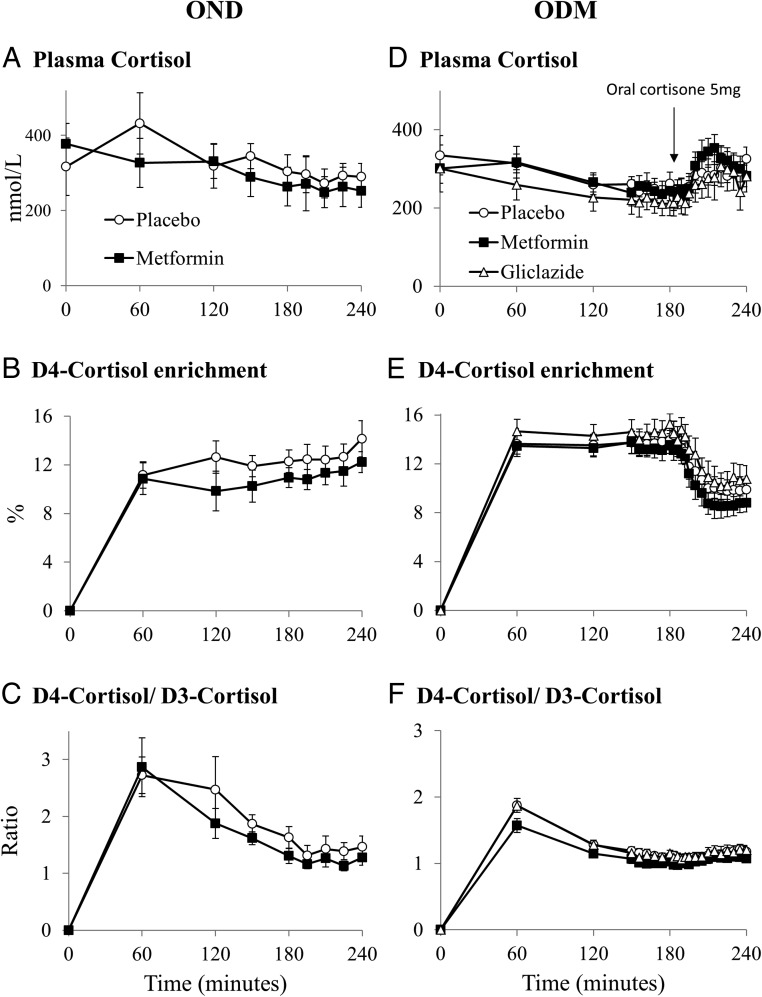
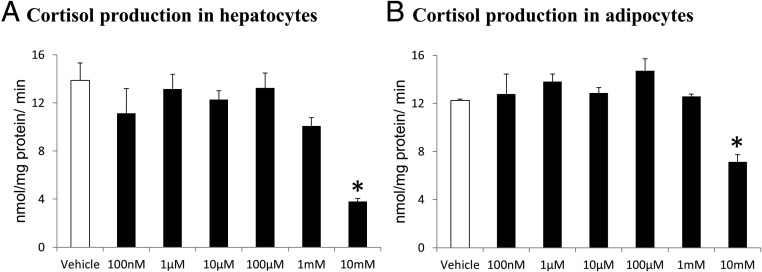
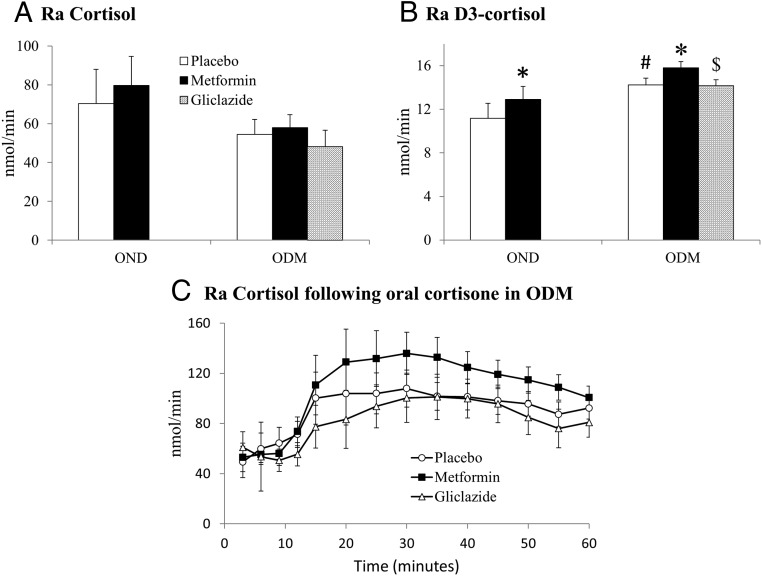
Whole-body 11βHSD1 activity was approximately 25% higher in the ODM group than the OND group. Metformin increased whole-body cortisol regeneration by 11βHSD1 in both groups compared with placebo and gliclazide and tended to increase hepatic 11βHSD1 activity. In vitro, metformin did not increase 11βHSD1 activity in hepatocytes or adipocytes.
Metformin increases whole-body cortisol generation by 11βHSD1 probably through an indirect mechanism, potentially offsetting other metabolic benefits of metformin. Co-prescription with metformin should provide a greater target for selective 11βHSD1 inhibitors.
二甲双胍的作用机制尚不清楚。鉴于胰岛素对皮质醇再生酶11β-羟基类固醇脱氢酶1(11βHSD1)的调节作用,以及选择性11βHSD1抑制剂与二甲双胍合用时降低血糖的疗效有限,我们推测二甲双胍可降低11βHSD1活性。
确定二甲双胍是否能在患有和未患2型糖尿病的肥胖男性体内调节11βHSD1活性。
双盲、随机、安慰剂对照、交叉研究。
医院临床研究机构。
8名肥胖非糖尿病(OND)男性和8名肥胖2型糖尿病(ODM)男性。
参与者按随机顺序接受28天的二甲双胍(每日两次,每次1克)、安慰剂,或(在ODM组)格列齐特(每日两次,每次80毫克)。在每个阶段结束时静脉输注氘代皮质醇,以测量11βHSD1介导的皮质醇再生。在ODM组中给予口服可的松以测量肝脏11βHSD1活性。还在人肝细胞和辛普森-戈拉比-贝梅尔综合征脂肪细胞中评估了二甲双胍对11βHSD1的影响。
二甲双胍对全身和肝脏11βHSD1活性的影响。
ODM组的全身11βHSD1活性比OND组高约25%。与安慰剂和格列齐特相比,二甲双胍使两组中11βHSD1介导的全身皮质醇再生增加,并倾向于增加肝脏11βHSD1活性。在体外,二甲双胍并未增加肝细胞或脂肪细胞中的11βHSD1活性。
二甲双胍可能通过间接机制增加11βHSD1介导的全身皮质醇生成,这可能抵消了二甲双胍的其他代谢益处。与二甲双胍合用时,应成为选择性11βHSD1抑制剂的更大靶点。