Posso Margarita, Carles Misericòrdia, Rué Montserrat, Puig Teresa, Bonfill Xavier
Service of Clinical Epidemiology and Public Health, Biomedical Research Institute Sant Pau (IIB Sant Pau), Barcelona, Spain.
Economics Department, Universitat Rovira i Virgili, Reus, Spain.
PLoS One. 2016 Jul 26;11(7):e0159806. doi: 10.1371/journal.pone.0159806. eCollection 2016.
The usual practice in breast cancer screening programmes for mammogram interpretation is to perform double reading. However, little is known about its cost-effectiveness in the context of digital mammography. Our purpose was to evaluate the cost-effectiveness of double reading versus single reading of digital mammograms in a population-based breast cancer screening programme.
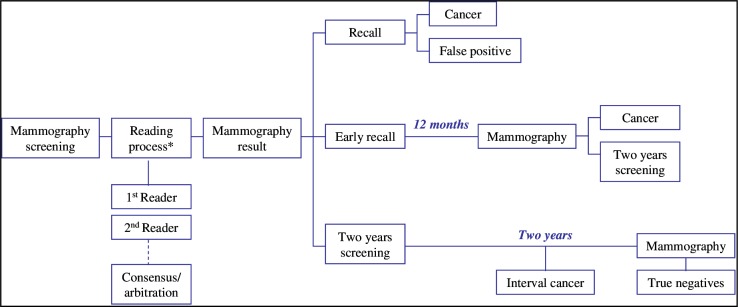
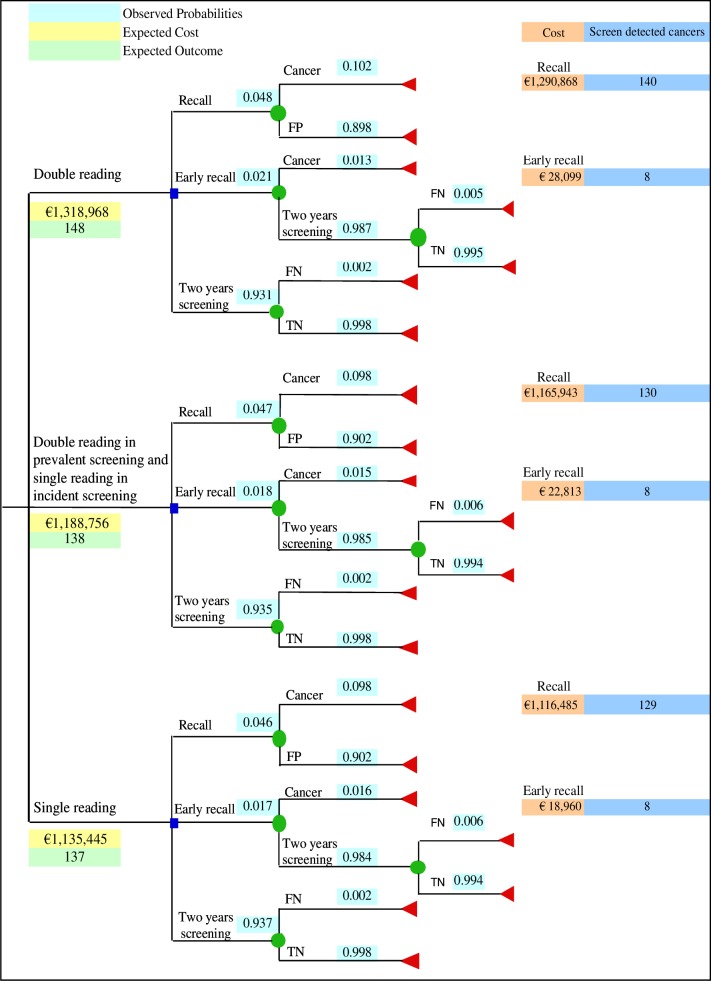
Data from 28,636 screened women was used to establish a decision-tree model and to compare three strategies: 1) double reading; 2) double reading for women in their first participation and single reading for women in their subsequent participations; and 3) single reading. We calculated the incremental cost-effectiveness ratio (ICER), which was defined as the expected cost per one additionally detected cancer. We performed a deterministic sensitivity analysis to test the robustness of the ICER.
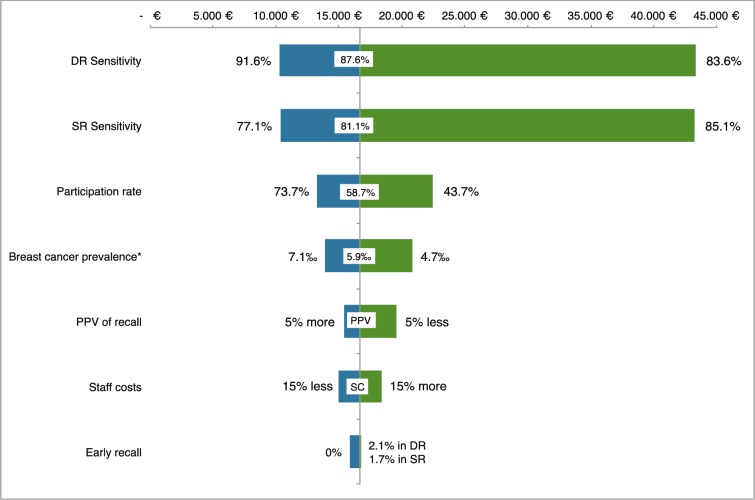
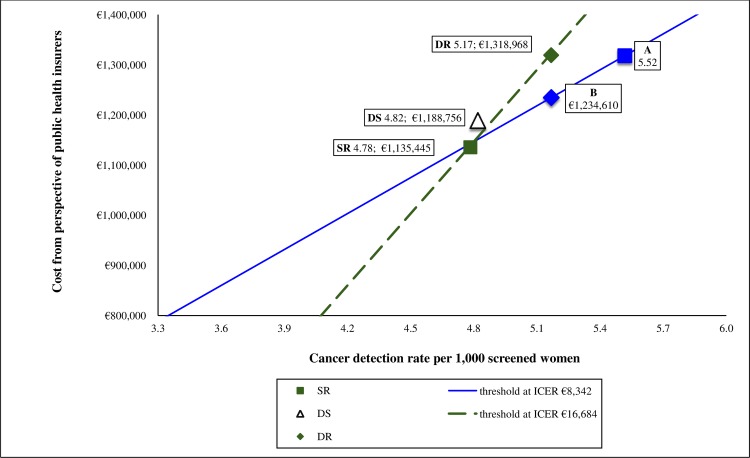
The detection rate of double reading (5.17‰) was similar to that of single reading (4.78‰; P = .768). The mean cost of each detected cancer was €8,912 for double reading and €8,287 for single reading. The ICER of double reading versus single reading was €16,684. The sensitivity analysis showed variations in the ICER according to the sensitivity of reading strategies. The strategy that combines double reading in first participation with single reading in subsequent participations was ruled out due to extended dominance.
From our results, double reading appears not to be a cost-effective strategy in the context of digital mammography. Double reading would eventually be challenged in screening programmes, as single reading might entail important net savings without significantly changing the cancer detection rate. These results are not conclusive and should be confirmed in prospective studies that investigate long-term outcomes like quality adjusted life years (QALYs).
在乳腺癌筛查项目中,乳房X光检查解读的常规做法是进行双人阅片。然而,在数字乳腺摄影的背景下,其成本效益鲜为人知。我们的目的是评估在基于人群的乳腺癌筛查项目中,数字乳腺摄影双人阅片与单人阅片的成本效益。
使用来自28636名接受筛查女性的数据建立决策树模型,并比较三种策略:1)双人阅片;2)首次参与筛查的女性进行双人阅片,后续参与筛查的女性进行单人阅片;3)单人阅片。我们计算了增量成本效益比(ICER),其定义为每多检测出一例癌症的预期成本。我们进行了确定性敏感性分析以检验ICER的稳健性。
双人阅片的检出率(5.17‰)与单人阅片的检出率(4.78‰;P = 0.768)相似。双人阅片每例检测出癌症的平均成本为8912欧元,单人阅片为8287欧元。双人阅片与单人阅片的ICER为16684欧元。敏感性分析表明,ICER根据阅片策略的敏感性而有所变化。由于优势范围扩大,首次参与筛查时进行双人阅片与后续参与筛查时进行单人阅片相结合的策略被排除。
根据我们的研究结果,在数字乳腺摄影的背景下,双人阅片似乎不是一种具有成本效益的策略。在筛查项目中,双人阅片最终可能会受到挑战,因为单人阅片可能会带来可观的净节省,而不会显著改变癌症检出率。这些结果并非定论,应在前瞻性研究中得到证实,这些研究调查诸如质量调整生命年(QALY)等长期结果。