Health Service Research and Policy Department, London School of Hygiene and Tropical Medicine, London, UK.
BMC Health Serv Res. 2011 Jan 17;11:11. doi: 10.1186/1472-6963-11-11.
Single reading with computer aided detection (CAD) is an alternative to double reading for detecting cancer in screening mammograms. The aim of this study is to investigate whether the use of a single reader with CAD is more cost-effective than double reading.
Based on data from the CADET II study, the cost-effectiveness of single reading with CAD versus double reading was measured in terms of cost per cancer detected. Cost (Pound (£), year 2007/08) of single reading with CAD versus double reading was estimated assuming a health and social service perspective and a 7 year time horizon. As the equipment cost varies according to the unit size a separate analysis was conducted for high, average and low volume screening units. One-way sensitivity analyses were performed by varying the reading time, equipment and assessment cost, recall rate and reader qualification.
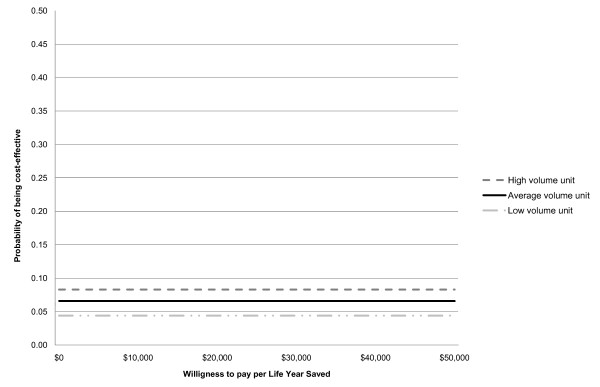
CAD is cost increasing for all sizes of screening unit. The introduction of CAD is cost-increasing compared to double reading because the cost of CAD equipment, staff training and the higher assessment cost associated with CAD are greater than the saving in reading costs. The introduction of single reading with CAD, in place of double reading, would produce an additional cost of £227 and £253 per 1,000 women screened in high and average volume units respectively. In low volume screening units, the high cost of purchasing the equipment will results in an additional cost of £590 per 1,000 women screened.One-way sensitivity analysis showed that the factors having the greatest effect on the cost-effectiveness of CAD with single reading compared with double reading were the reading time and the reader's professional qualification (radiologist versus advanced practitioner).
Without improvements in CAD effectiveness (e.g. a decrease in the recall rate) CAD is unlikely to be a cost effective alternative to double reading for mammography screening in UK. This study provides updated estimates of CAD costs in a full-field digital system and assessment cost for women who are re-called after initial screening. However, the model is highly sensitive to various parameters e.g. reading time, reader qualification, and equipment cost.
在筛查性乳房 X 光片中,计算机辅助检测(CAD)的单读是双读的替代方法,用于检测癌症。本研究旨在探讨使用单读 CAD 是否比双读更具成本效益。
基于 CADET II 研究的数据,从卫生和社会服务的角度并采用 7 年时间范围,以每例检出癌症的成本为指标,衡量使用 CAD 的单读与双读的成本效益。假设高、中、低容量筛查单位,分别对 CAD 与双读的单读成本进行了估算(2007/08 年的英镑)。由于设备成本根据单位规模而异,因此还进行了单独的分析。通过改变阅读时间、设备和评估成本、召回率和读者资质,进行了单向敏感性分析。
CAD 对所有规模的筛查单位来说都是增加成本的。与双读相比,引入 CAD 会增加成本,因为 CAD 设备、员工培训以及与 CAD 相关的更高评估成本大于阅读成本的节省。用单读 CAD 代替双读,高、中容量筛查单位的每 1000 名女性筛查会分别增加 227 英镑和 253 英镑的额外成本。在低容量筛查单位中,购买设备的高成本将导致每 1000 名女性筛查的额外成本为 590 英镑。单向敏感性分析表明,与双读相比,单读 CAD 的成本效益对阅读时间和读者专业资质(放射科医师与高级执业医师)的影响最大。
在 CAD 效果没有改善的情况下(例如,召回率降低),CAD 不太可能成为英国乳房 X 光筛查中双读的一种具有成本效益的替代方法。本研究提供了全数字化系统中 CAD 成本的最新估算以及初始筛查后被召回的女性的评估成本。然而,该模型对各种参数高度敏感,例如阅读时间、读者资质和设备成本。