Metz Claudia, Döger Remziye, Riquelme Elizabeth, Cortés Priscilla, Holmes Christopher, Shaughnessy Ronan, Oyanadel Claudia, Grabowski Catalina, González Alfonso, Soza Andrea
Departamento de Inmunología Clínica y Reumatología, Facultad de Medicina, Pontificia Universidad Católica de Chile, Av. Libertador Bernardo O'Higgins 340, 8331010, Santiago, Chile.
Centro de Envejecimiento y Regeneración, Departamento de Biología Celular y Molecular, Facultad de Ciencias Biológicas, Pontificia Universidad Católica de Chile, Av. Libertador Bernardo O'Higgins 340, 8331010, Santiago, Chile.
Biol Res. 2016 Jul 27;49(1):33. doi: 10.1186/s40659-016-0091-6.
Glioblastoma is one of the most aggressive cancers of the brain. Malignant traits of glioblastoma cells include elevated migration, proliferation and survival capabilities. Galectins are unconventionally secreted glycan-binding proteins that modulate processes of cell adhesion, migration, proliferation and apoptosis by interacting with beta-galactosides of cell surface glycoproteins and the extracellular matrix. Galectin-8 is one of the galectins highly expressed in glioblastoma cells. It has a unique selectivity for terminally sialylated glycans recently found enhanced in these highly malignant cells. A previous study in glioblastoma cell lines reported that Gal-8 coating a plastic surface stimulates two-dimensional motility. Because in other cells Gal-8 arrests proliferation and induces apoptosis, here we extend its study by analyzing all of these processes in a U87 glioblastoma cell model.
We used immunoblot and RT-PCR for Gal-8 expression analysis, recombinant Gal-8 produced in a bacteria system for Gal-8 treatment of the cells, and shRNA in lentivirus transduction for Gal-8 silencing. Cell migration as assessed in transwell filters. Cell proliferation, cell cycle and apoptosis were analyzed by FACS.
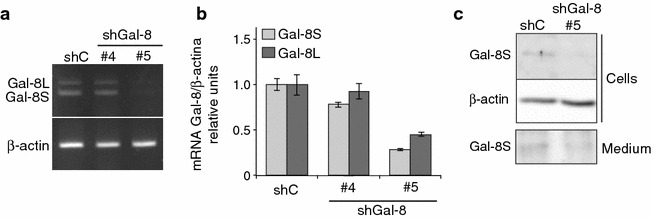
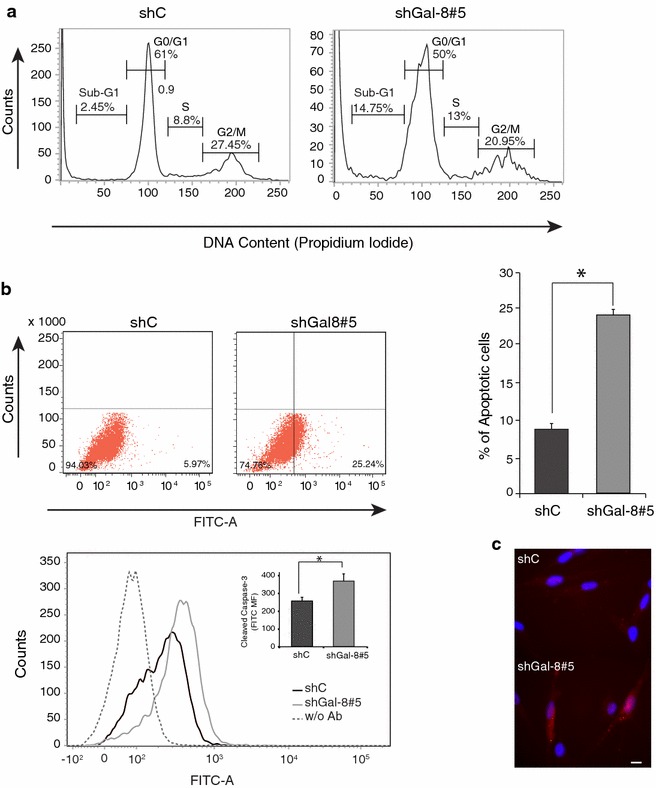
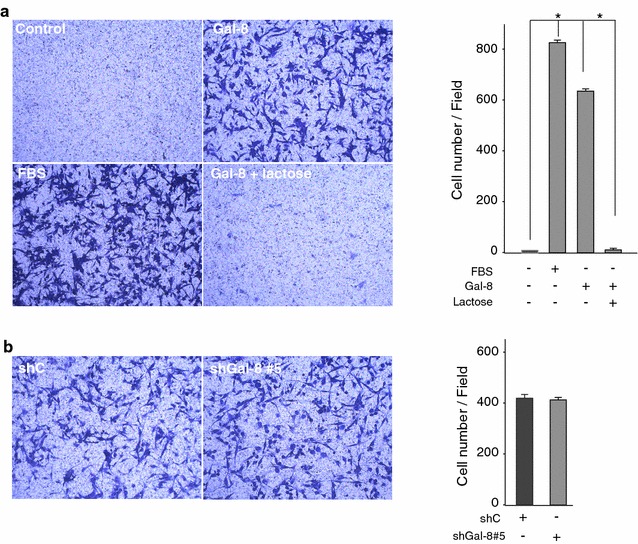
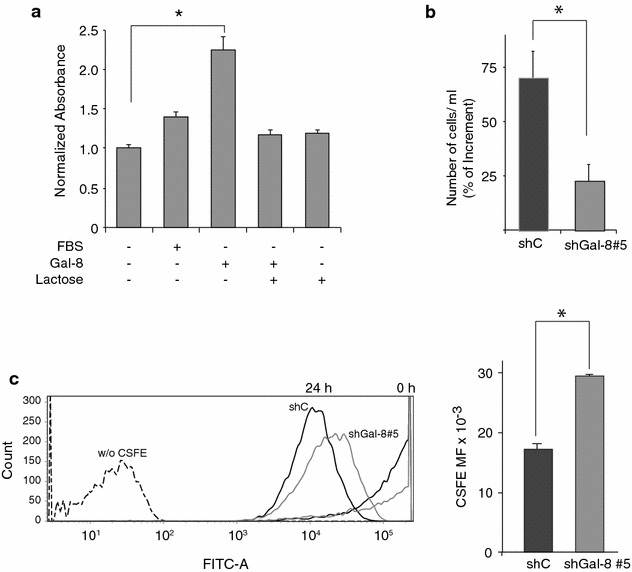
Gal-8 as a soluble stimulus triggered chemotactic migration of U87 cells across the polycarbonate filter of transwell chambers, almost as intensively as fetal bovine serum. Unexpectedly, Gal-8 also enhanced U87 cell growth. Co-incubation of Gal-8 with lactose, which blocks galectin-glycan interactions, abrogated both effects. Immunoblot showed Gal-8 in conditioned media reflecting its secretion. U87 cells transduced with silencing shRNA in a lentiviral vector expressed and secreted 30-40 % of their normal Gal-8 levels. These cells maintained their migratory capabilities, but decreased their proliferation rate and underwent higher levels of apoptosis, as revealed by flow cytometry analysis of cell cycle, CFSE and activated caspase-3 staining. Proliferation seemed to be more sensitive than migration to Gal-8 expression levels.
Gal-8, either secreted or exogenously enriched in the media, and acting through extracellular glycan interactions, constitutes a strong stimulus of directional migration in glioblastoma U87 cells and for the first time emerges as a factor that promotes proliferation and prevents apoptosis in cancerous cells. These properties could potentially contribute to the exaggerated malignancy of glioblastoma cells.
胶质母细胞瘤是最具侵袭性的脑癌之一。胶质母细胞瘤细胞的恶性特征包括迁移、增殖和存活能力增强。半乳糖凝集素是一类非传统分泌的聚糖结合蛋白,通过与细胞表面糖蛋白和细胞外基质的β-半乳糖苷相互作用来调节细胞黏附、迁移、增殖和凋亡过程。半乳糖凝集素-8是在胶质母细胞瘤细胞中高表达的半乳糖凝集素之一。最近发现它对这些高度恶性细胞中末端唾液酸化聚糖具有独特的选择性。先前一项针对胶质母细胞瘤细胞系的研究报道,包被在塑料表面的半乳糖凝集素-8可刺激二维运动。由于在其他细胞中半乳糖凝集素-8会抑制增殖并诱导凋亡,因此我们在此通过在U87胶质母细胞瘤细胞模型中分析所有这些过程来扩展对其的研究。
我们使用免疫印迹和RT-PCR分析半乳糖凝集素-8的表达,利用细菌系统生产的重组半乳糖凝集素-8处理细胞,以及通过慢病毒转导的短发夹RNA(shRNA)沉默半乳糖凝集素-8。通过Transwell小室评估细胞迁移。通过流式细胞术分析细胞增殖、细胞周期和凋亡。
作为可溶性刺激物,半乳糖凝集素-8触发U87细胞穿过Transwell小室的聚碳酸酯滤膜进行趋化迁移,其强度几乎与胎牛血清相同。出乎意料的是,半乳糖凝集素-8还增强了U87细胞的生长。半乳糖凝集素-8与乳糖共同孵育可阻断半乳糖凝集素-聚糖相互作用,从而消除这两种作用。免疫印迹显示条件培养基中有半乳糖凝集素-8,反映了其分泌情况。用慢病毒载体中的沉默shRNA转导的U87细胞表达并分泌的半乳糖凝集素-8水平为其正常水平的30%-40%。这些细胞保持了迁移能力,但增殖速率降低,且凋亡水平升高,这通过细胞周期、羧基荧光素二乙酸琥珀酰亚胺酯(CFSE)和活化的半胱天冬酶-3染色的流式细胞术分析得以揭示。增殖似乎比迁移对半乳糖凝集素-8表达水平更敏感。
分泌型或在培养基中外源性富集的半乳糖凝集素-8,通过细胞外聚糖相互作用发挥作用,构成了胶质母细胞瘤U87细胞定向迁移的强大刺激因素,并且首次作为促进癌细胞增殖和防止凋亡的因子出现。这些特性可能潜在地导致胶质母细胞瘤细胞的过度恶性。