Böni Lukas, Fischer Peter, Böcker Lukas, Kuster Simon, Rühs Patrick A
Department of Health Science and Technology, ETH Zürich, 8092 Zürich, Switzerland.
Department of Materials, ETH Zürich, 8093 Zürich, Switzerland.
Sci Rep. 2016 Jul 27;6:30371. doi: 10.1038/srep30371.
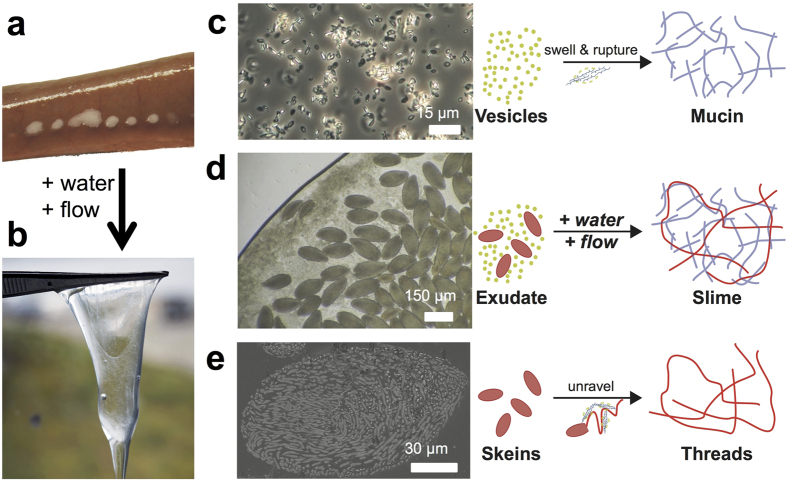
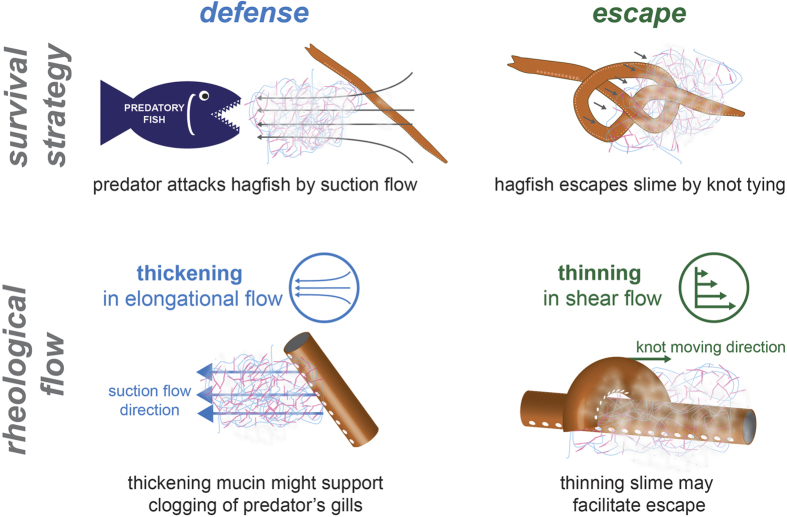
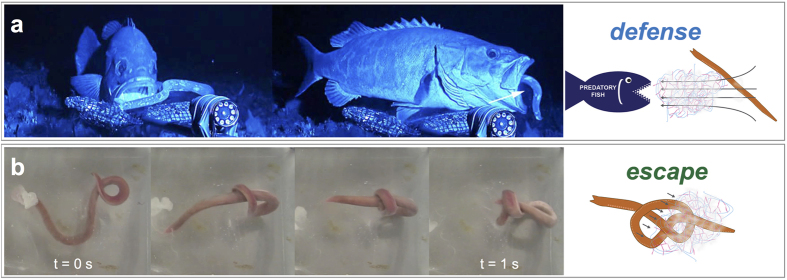
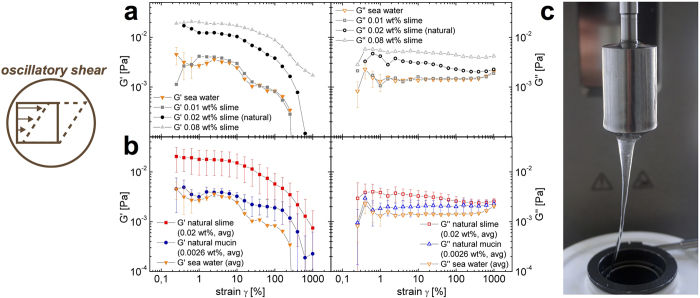
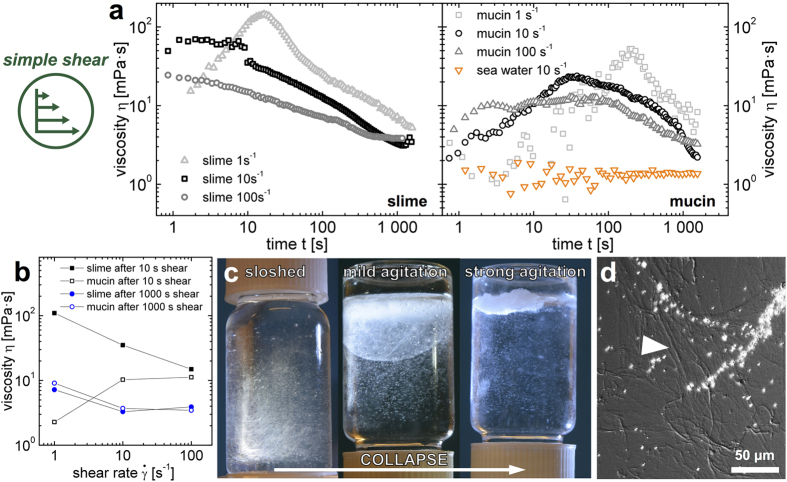
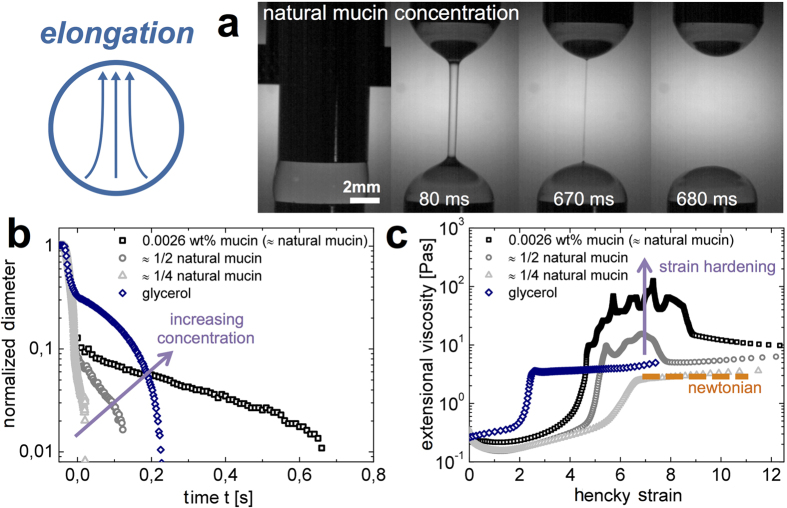
When hagfish (Myxinidae) are attacked by predators, they form a dilute, elastic, and cohesive defensive slime made of mucins and protein threads. In this study we propose a link between flow behavior and defense mechanism of hagfish slime. Oscillatory rheological measurements reveal that hagfish slime forms viscoelastic networks at low concentrations. Mucins alone did not contribute viscoelasticity, however in shear flow, viscosity was observed. The unidirectional flow, experienced by hagfish slime during suction feeding by predators, was mimicked with extensional rheology. Elongational stresses were found to increase mucin viscosity. The resulting higher resistance to flow could support clogging of the attacker's gills. Shear flow in contrast decreases the slime viscosity by mucin aggregation and leads to a collapse of the slime network. Hagfish may benefit from this collapse when trapped in their own slime and facing suffocation by tying a sliding knot with their body to shear off the slime. This removal could be facilitated by the apparent shear thinning behavior of the slime. Therefore hagfish slime, thickening in elongation and thinning in shear, presents a sophisticated natural high water content gel with flow properties that may be beneficial for both, defense and escape.
当盲鳗(粘盲鳗科)受到捕食者攻击时,它们会分泌出一种由粘蛋白和蛋白质丝组成的稀释、有弹性且有粘性的防御性黏液。在本研究中,我们提出了盲鳗黏液的流动行为与防御机制之间的联系。振荡流变学测量表明,盲鳗黏液在低浓度下形成粘弹性网络。单独的粘蛋白不会产生粘弹性,但在剪切流中会观察到粘性。通过拉伸流变学模拟了捕食者在吸食时盲鳗黏液所经历 的单向流动。发现拉伸应力会增加粘蛋白的粘性。由此产生的更高的流动阻力可能有助于堵塞攻击者的鳃。相比之下,剪切流会通过粘蛋白聚集降低黏液的粘性,并导致黏液网络崩溃。当盲鳗被困在自己的黏液中并面临窒息时,它们可能会通过用身体打一个滑动结来切断黏液而从这种崩溃中受益。黏液明显的剪切变稀行为可能有助于这种清除。因此,盲鳗黏液在拉伸时变稠,在剪切时变稀,呈现出一种复杂的天然高含水量凝胶,其流动特性可能对防御和逃脱都有益。