Kang Seung-Ji, Jin Hye-Mi, Won Eun Jeong, Cho Young-Nan, Jung Hyun-Ju, Kwon Yong-Soo, Kee Hae Jin, Ju Jae Kyun, Kim Jung-Chul, Kim Uh Jin, Jang Hee-Chang, Jung Sook-In, Kee Seung-Jung, Park Yong-Wook
Department of Infectious Diseases, Chonnam National University Medical School and Hospital, Gwangju, Republic of Korea.
Department of Rheumatology, Chonnam National University Medical School and Hospital, Gwangju, Republic of Korea.
PLoS Negl Trop Dis. 2016 Jul 27;10(7):e0004832. doi: 10.1371/journal.pntd.0004832. eCollection 2016 Jul.
Mucosal-associated invariant T (MAIT) cells contribute to protection against certain microorganism infections. However, little is known about the role of MAIT cells in Orientia tsutsugamushi infection. Hence, the aims of this study were to examine the level and function of MAIT cells in patients with scrub typhus and to evaluate the clinical relevance of MAIT cell levels.
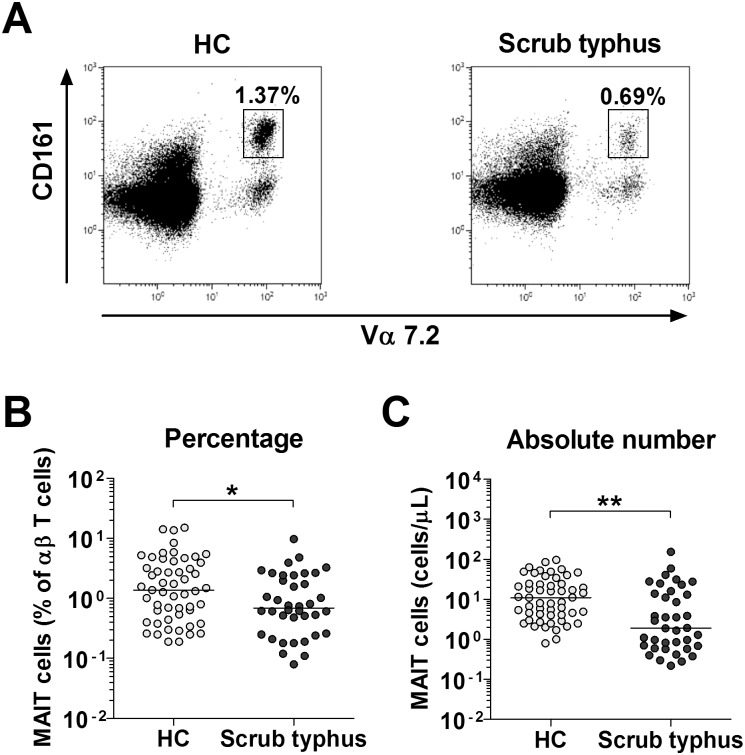
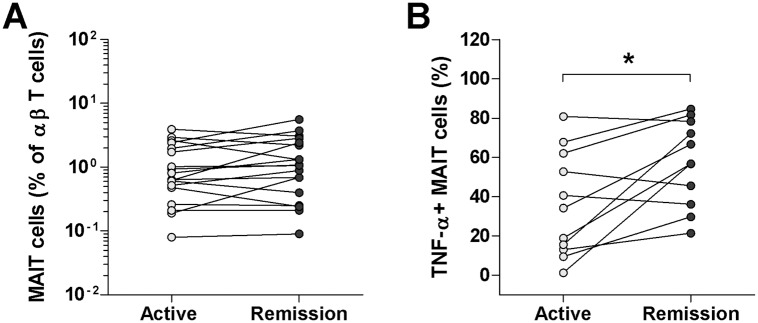
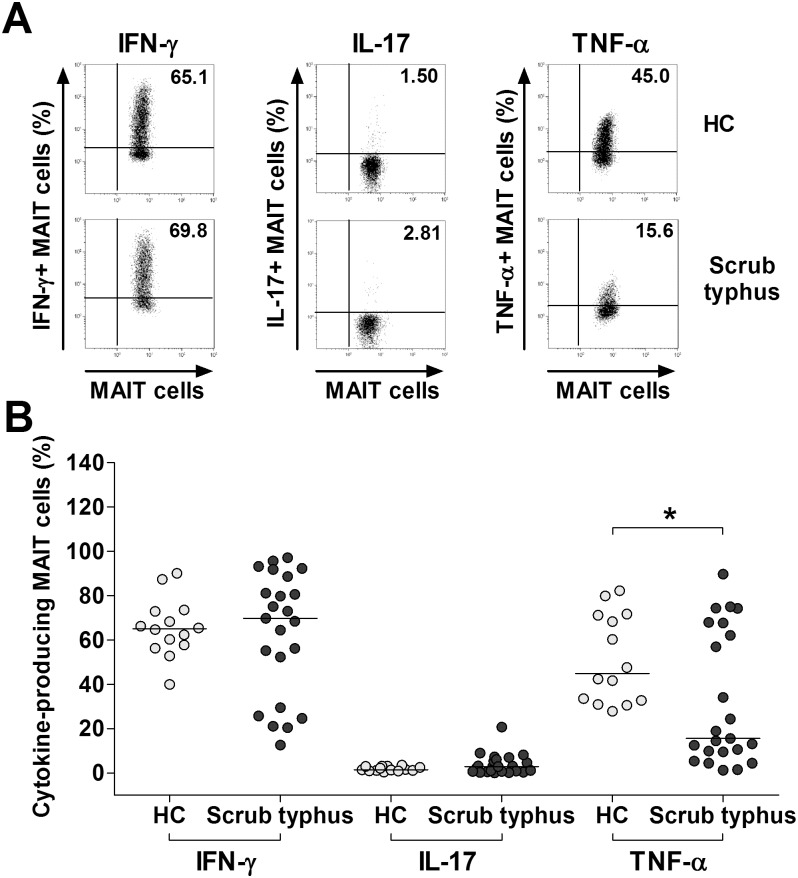
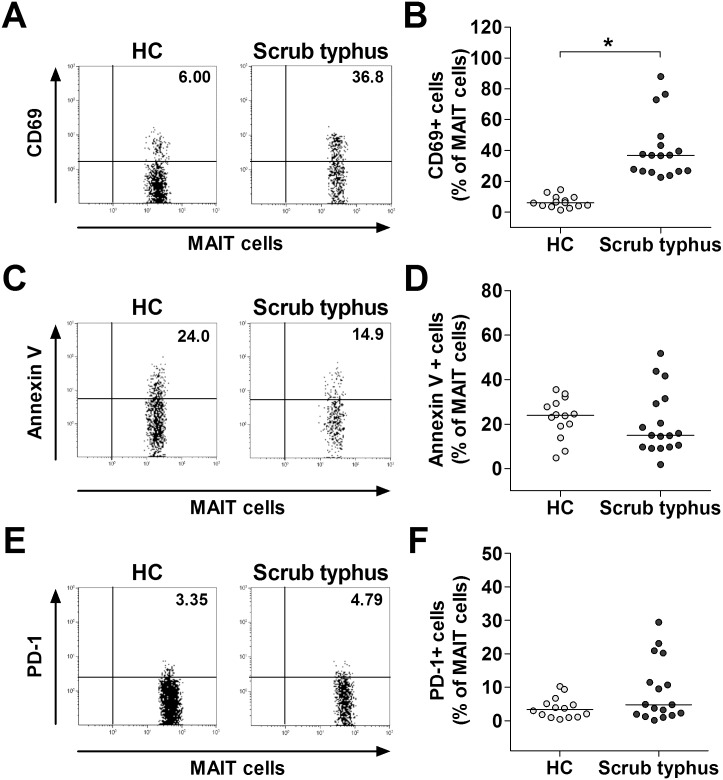
METHODOLOGY/PRINCIPAL FINDINGS: Thirty-eight patients with scrub typhus and 53 health control subjects were enrolled in the study. The patients were further divided into subgroups according to disease severity. MAIT cell level and function in the peripheral blood were measured by flow cytometry. Circulating MAIT cell levels were found to be significantly reduced in scrub typhus patients. MAIT cell deficiency reflects a variety of clinical conditions. In particular, MAT cell levels reflect disease severity. MAIT cells in scrub typhus patients displayed impaired tumor necrosis factor (TNF)-α production, which was restored during the remission phase. In addition, the impaired production of TNF-α by MAIT cells was associated with elevated CD69 expression.
This study shows that circulating MAIT cells are activated, numerically deficient, and functionally impaired in TNF-α production in patients with scrub typhus. These abnormalities possibly contribute to immune system dysregulation in scrub typhus infection.
黏膜相关恒定T(MAIT)细胞有助于抵御某些微生物感染。然而,关于MAIT细胞在恙虫病东方体感染中的作用知之甚少。因此,本研究的目的是检测恙虫病患者中MAIT细胞的水平和功能,并评估MAIT细胞水平的临床相关性。
方法/主要发现:本研究纳入了38例恙虫病患者和53名健康对照者。根据疾病严重程度将患者进一步分为亚组。通过流式细胞术检测外周血中MAIT细胞的水平和功能。发现恙虫病患者的循环MAIT细胞水平显著降低。MAIT细胞缺乏反映了多种临床状况。特别是,MAIT细胞水平反映了疾病的严重程度。恙虫病患者的MAIT细胞表现出肿瘤坏死因子(TNF)-α产生受损,在缓解期恢复。此外,MAIT细胞TNF-α产生受损与CD69表达升高有关。
本研究表明,恙虫病患者循环中的MAIT细胞被激活、数量不足且在TNF-α产生方面功能受损。这些异常可能导致恙虫病感染中的免疫系统失调。