Fernández Peter J, Holowka Nicholas B, Demes Brigitte, Jungers William L
Department of Anatomical Sciences, Stony Brook University, Stony Brook, NY 11794, USA.
Department of Human Evolutionary Biology, Harvard University, Cambridge, MA 02138, USA.
Sci Rep. 2016 Jul 28;6:30532. doi: 10.1038/srep30532.
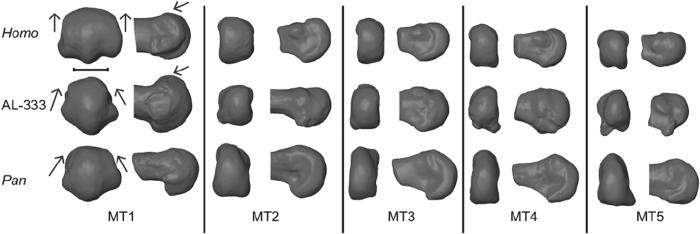
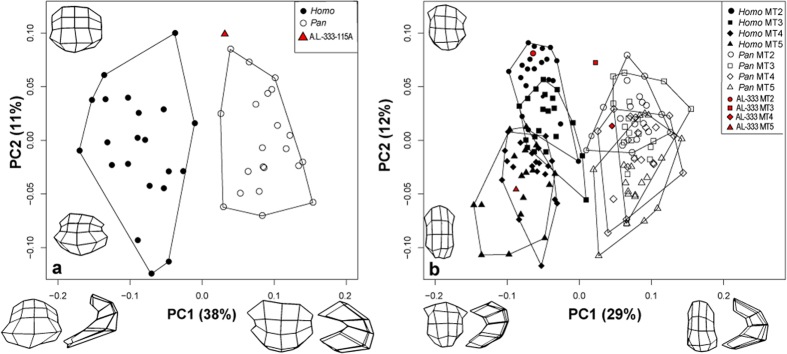
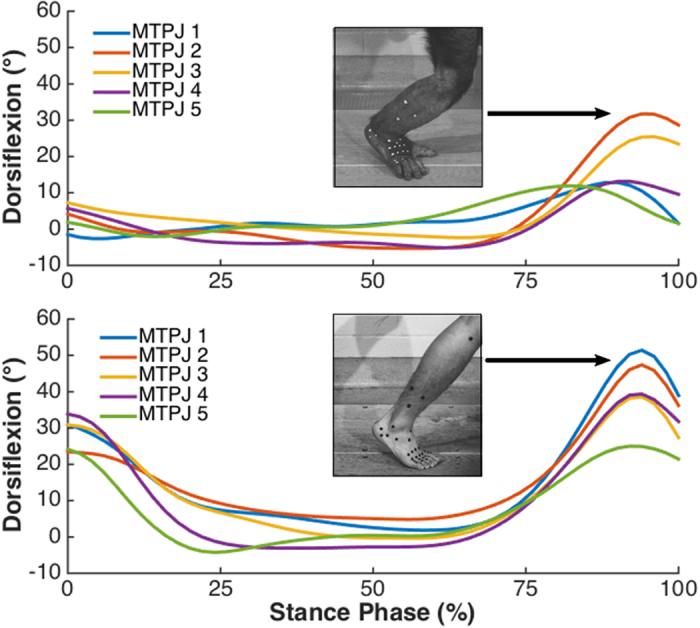
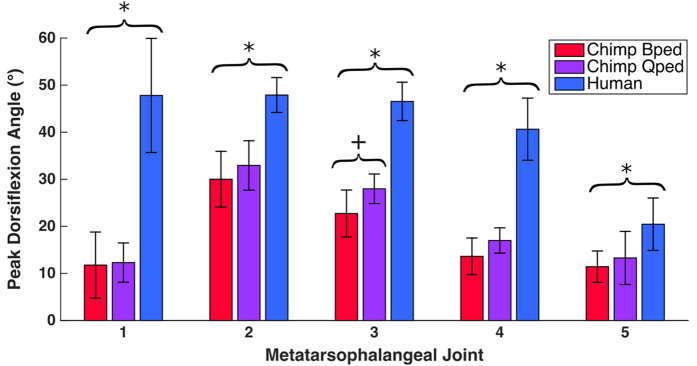
During bipedal walking, modern humans dorsiflex their forefoot at the metatarsophalangeal joints (MTPJs) prior to push off, which tightens the plantar soft tissues to convert the foot into a stiff propulsive lever. Particular features of metatarsal head morphology such as "dorsal doming" are thought to facilitate this stiffening mechanism. In contrast, chimpanzees are believed to possess MTPJ morphology that precludes high dorsiflexion excursions during terrestrial locomotion. The morphological affinity of the metatarsal heads has been used to reconstruct locomotor behavior in fossil hominins, but few studies have provided detailed empirical data to validate the assumed link between morphology and function at the MTPJs. Using three-dimensional kinematic and morphometric analyses, we show that humans push off with greater peak dorsiflexion angles at all MTPJs than do chimpanzees during bipedal and quadrupedal walking, with the greatest disparity occurring at MTPJ 1. Among MTPJs 2-5, both species exhibit decreasing peak angles from medial to lateral. This kinematic pattern is mirrored in the morphometric analyses of metatarsal head shape. Analyses of Australopithecus afarensis metatarsals reveal morphology intermediate between humans and chimpanzees, suggesting that this species used different bipedal push-off kinematics than modern humans, perhaps resulting in a less efficient form of bipedalism.
在两足行走过程中,现代人类在蹬离地面之前会在跖趾关节(MTPJs)处使前足背屈,这会拉紧足底软组织,从而将足部转变为一个坚硬的推进杠杆。跖骨头形态的一些特殊特征,如“背侧隆起”,被认为有助于这种硬化机制。相比之下,黑猩猩被认为具有的跖趾关节形态使其在陆地运动过程中无法进行大幅度的背屈。跖骨头的形态相似性已被用于重建化石人族的运动行为,但很少有研究提供详细的实证数据来验证跖趾关节形态与功能之间假设的联系。通过三维运动学和形态测量分析,我们发现,在两足和四足行走过程中,人类所有跖趾关节的蹬离时的峰值背屈角度都比黑猩猩大,其中第1跖趾关节的差异最大。在第2 - 5跖趾关节中,两个物种的峰值角度均从内侧到外侧逐渐减小。这种运动模式在跖骨头形状的形态测量分析中也有体现。对阿法南方古猿跖骨的分析揭示了其形态介于人类和黑猩猩之间,这表明该物种的两足蹬离运动学与现代人类不同,可能导致两足行走效率较低。