Sebastián-Serrano Álvaro, Engel Tobias, de Diego-García Laura, Olivos-Oré Luis A, Arribas-Blázquez Marina, Martínez-Frailes Carlos, Pérez-Díaz Carmen, Millán José Luis, Artalejo Antonio R, Miras-Portugal María Teresa, Henshall David C, Díaz-Hernández Miguel
Department of Biochemistry and Molecular Biology, Veterinary School, Complutense University of Madrid, Avda. Puerta de Hierro S/N, Madrid, Spain.
Instituto de Investigación Sanitaria del Hospital Clínico San Carlos, IdISSC, Madrid, Spain.
Hum Mol Genet. 2016 Oct 1;25(19):4143-4156. doi: 10.1093/hmg/ddw248. Epub 2016 Jul 27.
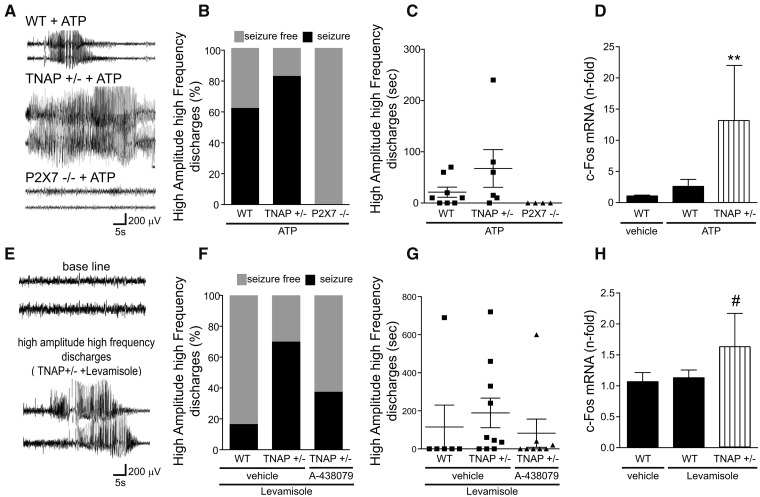
Hypomorphic mutations in the gene encoding the tissue-nonspecific alkaline phosphatase (TNAP) enzyme, ALPL in human or Akp2 in mice, cause hypophosphatasia (HPP), an inherited metabolic bone disease also characterized by spontaneous seizures. Initially, these seizures were attributed to the impairment of GABAergic neurotransmission caused by altered vitamin B6 (vit-B6) metabolism. However, clinical cases in human newborns and adults whose convulsions are refractory to pro-GABAergic drugs but controlled by the vit-B6 administration, suggest that other factors are involved. Here, to evaluate whether neurodevelopmental alterations are underlying the seizures associated to HPP, we performed morphological and functional characterization of postnatal homozygous TNAP null mice, a model of HPP. These analyses revealed that TNAP deficient mice present an increased proliferation of neural precursors, an altered neuronal morphology, and an augmented neuronal activity. We found that these alterations were associated with a partial downregulation of the purinergic P2X7 receptor (P2X7R). Even though deficient P2X7R mice present similar neurodevelopmental alterations, they do not develop neonatal seizures. Accordingly, we found that the additional blockage of P2X7R prevent convulsions and extend the lifespan of mice lacking TNAP. In agreement with these findings, we also found that exogenous administration of ATP or TNAP antagonists induced seizures in adult wild-type mice by activating P2X7R. Finally, our results also indicate that the anticonvulsive effects attributed to vit-B6 may be due to its capacity to block P2X7R. Altogether, these findings suggest that the purinergic signalling regulates the neurodevelopmental alteration and the neonatal seizures associated to HPP.
编码组织非特异性碱性磷酸酶(TNAP)的基因(人类中的ALPL或小鼠中的Akp2)发生亚效突变会导致低磷血症(HPP),这是一种遗传性代谢性骨病,其特征还包括自发性癫痫发作。最初,这些癫痫发作被归因于维生素B6(vit - B6)代谢改变导致的γ-氨基丁酸能神经传递受损。然而,人类新生儿和成人的临床病例显示,惊厥对促γ-氨基丁酸能药物难治,但通过补充vit - B6可得到控制,这表明还有其他因素参与其中。在此,为了评估神经发育改变是否是HPP相关癫痫发作的潜在原因,我们对产后纯合TNAP基因敲除小鼠(一种HPP模型)进行了形态学和功能特征分析。这些分析表明,TNAP缺陷小鼠的神经前体细胞增殖增加、神经元形态改变且神经元活性增强。我们发现这些改变与嘌呤能P2X7受体(P2X7R)的部分下调有关。尽管P2X7R缺陷小鼠也存在类似的神经发育改变,但它们不会发生新生儿癫痫发作。因此,我们发现额外阻断P2X7R可预防惊厥并延长缺乏TNAP的小鼠的寿命。与这些发现一致,我们还发现外源性给予ATP或TNAP拮抗剂可通过激活P2X7R在成年野生型小鼠中诱发癫痫发作。最后,我们的结果还表明,归因于vit - B6的抗惊厥作用可能是由于其阻断P2X7R的能力。总之,这些发现表明嘌呤能信号传导调节与HPP相关的神经发育改变和新生儿癫痫发作。