Reidy Paul T, Borack Michael S, Markofski Melissa M, Dickinson Jared M, Deer Rachel R, Husaini Syed H, Walker Dillon K, Igbinigie Sherry, Robertson Shay M, Cope Mark B, Mukherjea Ratna, Hall-Porter Janine M, Jennings Kristofer, Volpi Elena, Rasmussen Blake B
Division of Rehabilitation Sciences; Departments of Nutrition and Metabolism.
Sealy Center on Aging; and.
J Nutr. 2016 Sep;146(9):1660-9. doi: 10.3945/jn.116.231803. Epub 2016 Jul 27.
To our knowledge the efficacy of soy-dairy protein blend (PB) supplementation with resistance exercise training (RET) has not been evaluated in a longitudinal study.
Our aim was to determine the effect of PB supplementation during RET on muscle adaptation.
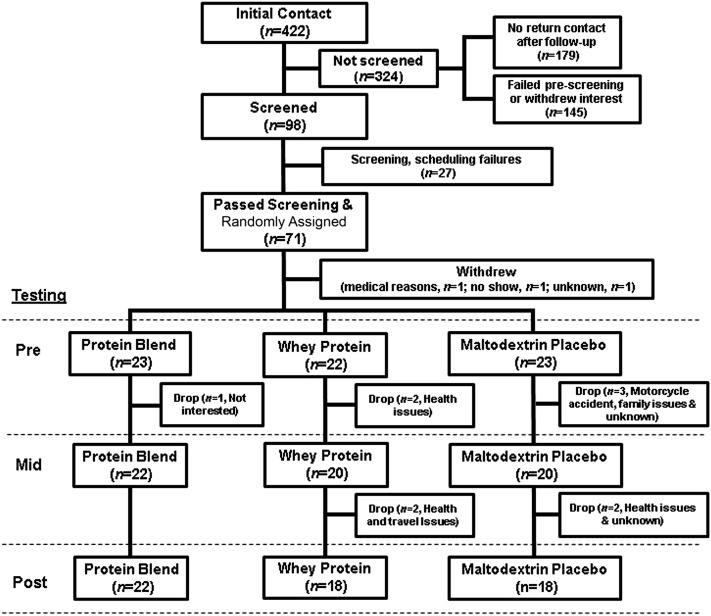
In this double-blind randomized clinical trial, healthy young men [18-30 y; BMI (in kg/m(2)): 25 ± 0.5] participated in supervised whole-body RET at 60-80% 1-repetition maximum (1-RM) for 3 d/wk for 12 wk with random assignment to daily receive 22 g PB (n = 23), whey protein (WP) isolate (n = 22), or an isocaloric maltodextrin (carbohydrate) placebo [(MDP) n = 23]. Serum testosterone, muscle strength, thigh muscle thickness (MT), myofiber cross-sectional area (mCSA), and lean body mass (LBM) were assessed before and after 6 and 12 wk of RET.
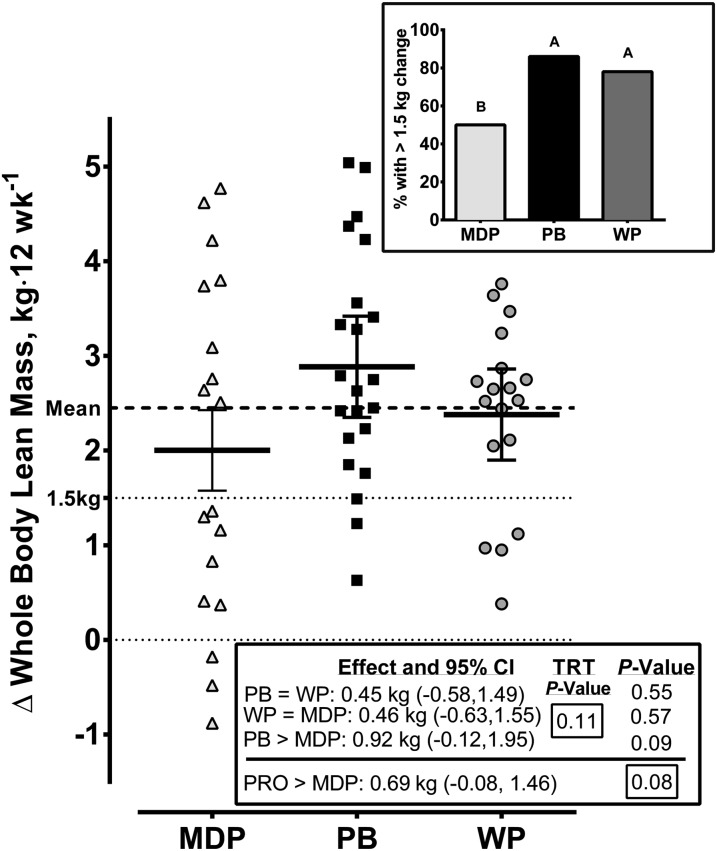
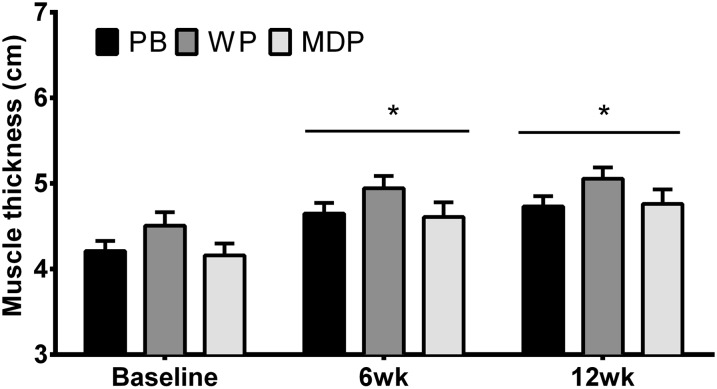
All treatments increased LBM (P < 0.001). ANCOVA did not identify an overall treatment effect at 12 wk (P = 0.11). There tended to be a greater change in LBM from baseline to 12 wk in the PB group than in the MDP group (0.92 kg; 95% CI: -0.12, 1.95 kg; P = 0.09); however, changes in the WP and MDP groups did not differ. Pooling data from combined PB and WP treatments showed a trend for greater change in LBM from baseline to 12 wk compared with MDP treatment (0.69 kg; 95% CI: -0.08, 1.46 kg; P = 0.08). Muscle strength, mCSA, and MT increased (P < 0.05) similarly for all treatments and were not different (P > 0.10) between treatments. Testosterone was not altered.
PB supplementation during 3 mo of RET tended to slightly enhance gains in whole-body and arm LBM, but not leg muscle mass, compared with RET without protein supplementation. Although protein supplementation minimally enhanced gains in LBM of healthy young men, there was no enhancement of gains in strength. This trial was registered at clinicaltrials.gov as NCT01749189.
据我们所知,尚未有纵向研究评估大豆-乳蛋白混合物(PB)补充剂与抗阻运动训练(RET)相结合的效果。
我们的目的是确定RET期间补充PB对肌肉适应性的影响。
在这项双盲随机临床试验中,健康年轻男性[18 - 30岁;体重指数(kg/m²):25±0.5]参加了监督下的全身RET,以60 - 80%的1次重复最大值(1-RM)进行,每周3天,共12周,并随机分配每天接受22克PB(n = 23)、乳清蛋白(WP)分离物(n = 22)或等热量的麦芽糊精(碳水化合物)安慰剂[(MDP)n = 23]。在RET进行6周和12周前后评估血清睾酮、肌肉力量、大腿肌肉厚度(MT)、肌纤维横截面积(mCSA)和瘦体重(LBM)。
所有治疗均增加了LBM(P < 0.001)。协方差分析未发现12周时的总体治疗效果(P = 0.11)。与MDP组相比,PB组从基线到12周LBM的变化趋势更大(0.92千克;95%置信区间:-0.12,1.95千克;P = 0.09);然而,WP组和MDP组的变化没有差异。汇总PB和WP联合治疗的数据显示,与MDP治疗相比,从基线到12周LBM的变化趋势更大(0.69千克;95%置信区间:-0.08,1.46千克;P = 0.08)。所有治疗的肌肉力量、mCSA和MT均有相似程度的增加(P < 0.05),且各治疗组之间无差异(P > 0.10)。睾酮未发生改变。
与不补充蛋白质的RET相比,RET期间补充3个月的PB往往会略微增强全身和手臂LBM的增加,但对腿部肌肉质量无影响。尽管补充蛋白质对健康年轻男性LBM的增加有最小程度的增强作用,但对力量的增加并无增强作用。该试验已在clinicaltrials.gov上注册,注册号为NCT01749189。