• 文献检索
  • 文档翻译
  • 深度研究
  • 学术资讯
  • Suppr Zotero 插件Zotero 插件
  • 邀请有礼
  • 套餐&价格
  • 历史记录
应用&插件
Suppr Zotero 插件Zotero 插件浏览器插件Mac 客户端Windows 客户端微信小程序
定价
高级版会员购买积分包购买API积分包
服务
文献检索文档翻译深度研究API 文档MCP 服务
关于我们
关于 Suppr公司介绍联系我们用户协议隐私条款
关注我们

Suppr 超能文献

核心技术专利:CN118964589B侵权必究
粤ICP备2023148730 号-1Suppr @ 2026

文献检索

告别复杂PubMed语法,用中文像聊天一样搜索,搜遍4000万医学文献。AI智能推荐,让科研检索更轻松。

立即免费搜索

文件翻译

保留排版,准确专业,支持PDF/Word/PPT等文件格式,支持 12+语言互译。

免费翻译文档

深度研究

AI帮你快速写综述,25分钟生成高质量综述,智能提取关键信息,辅助科研写作。

立即免费体验

生物力学和心理社会因素暴露是腕管综合征的独立危险因素:使用因果图评估混杂因素。

Biomechanical and psychosocial exposures are independent risk factors for carpal tunnel syndrome: assessment of confounding using causal diagrams.

作者信息

Harris-Adamson Carisa, Eisen Ellen A, Neophytou Andreas, Kapellusch Jay, Garg Arun, Hegmann Kurt T, Thiese Matthew S, Dale Ann Marie, Evanoff Bradley, Bao Stephen, Silverstein Barbara, Gerr Fred, Burt Susan, Rempel David

机构信息

Division of Occupational and Environmental Medicine, University of California, San Francisco, San Francisco, California, USA Department of Environmental Health Sciences, University of California Berkeley, Berkeley, California, USA.

Department of Environmental Health Sciences, University of California Berkeley, Berkeley, California, USA.

出版信息

Occup Environ Med. 2016 Nov;73(11):727-734. doi: 10.1136/oemed-2016-103634. Epub 2016 Jul 27.

DOI:10.1136/oemed-2016-103634
PMID:27466616
原文链接:https://pmc.ncbi.nlm.nih.gov/articles/PMC6555409/
Abstract

BACKGROUND

Between 2001 and 2010, six research groups conducted coordinated prospective studies of carpal tunnel syndrome (CTS) incidence among US workers from various industries to estimate exposure-response relationships.

OBJECTIVE

This analysis examined the presence and magnitude of confounding between biomechanical and workplace psychosocial factors and incidence of dominant-hand CTS.

METHODS

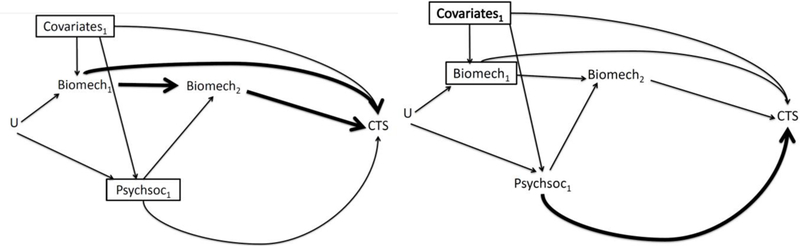
1605 participants, without CTS at enrolment, were followed for up to 3.5 years (2471 person-years). Demographic information, medical history and workplace psychosocial stress measures were collected at baseline. Individual workplace biomechanical exposures were collected for each task and combined across the workweek using time-weighted averaging (TWA). CTS case criteria were based on symptoms and results of electrophysiological testing. HRs were estimated with Cox proportional hazard models. Confounding was assessed using causal diagrams and an empirical criterion of 10% or greater change in effect estimate magnitude.

RESULTS

There were 109 incident CTS cases (IR=4.41/100 person-years; 6.7% cumulative incidence). The relationships between CTS and forceful repetition rate, % time forceful hand exertion and the Threshold Limit Value for Hand Activity Level (TLV-HAL) were slightly confounded by decision latitude with effect estimates being attenuated towards the null (10-14% change) after adjustment. The risk of CTS among participants reporting high job strain was attenuated towards the null by 14% after adjusting for the HAL Scale or the % time forceful hand exertions.

CONCLUSIONS

Although attenuation of the relationships between CTS and some biomechanical and work psychosocial exposures was observed after adjusting for confounding, the magnitudes were small and confirmed biomechanical and work psychosocial exposures as independent risk factors for incident CTS.

摘要

背景

2001年至2010年间,六个研究小组对美国不同行业工人的腕管综合征(CTS)发病率进行了协同前瞻性研究,以估计暴露-反应关系。

目的

本分析研究了生物力学和工作场所心理社会因素之间混杂的存在情况及其程度,以及优势手CTS的发病率。

方法

1605名入组时无CTS的参与者被随访长达3.5年(2471人年)。在基线时收集人口统计学信息、病史和工作场所心理社会压力指标。针对每项任务收集个体工作场所生物力学暴露情况,并使用时间加权平均法(TWA)在整个工作周进行汇总。CTS病例标准基于症状和电生理测试结果。使用Cox比例风险模型估计风险比(HRs)。使用因果图和效应估计量变化10%或更大的经验标准评估混杂情况。

结果

有109例CTS新发病例(发病率=4.41/100人年;累积发病率6.7%)。CTS与用力重复率、用力手部 exertion的时间百分比以及手部活动水平阈限值(TLV-HAL)之间的关系因决策自由度而略有混杂,调整后效应估计值向无效值衰减(变化10-14%)。在调整HAL量表或用力手部exertion的时间百分比后,报告高工作压力的参与者中CTS风险向无效值衰减了14%。

结论

尽管在调整混杂因素后观察到CTS与一些生物力学和工作心理社会暴露之间的关系有所衰减,但幅度较小,并证实生物力学和工作心理社会暴露是CTS新发的独立危险因素。
https://cdn.ncbi.nlm.nih.gov/pmc/blobs/8b77/6555409/d61b5703752f/nihms-1017976-f0001.jpg

相似文献

1
Biomechanical and psychosocial exposures are independent risk factors for carpal tunnel syndrome: assessment of confounding using causal diagrams.生物力学和心理社会因素暴露是腕管综合征的独立危险因素:使用因果图评估混杂因素。
Occup Environ Med. 2016 Nov;73(11):727-734. doi: 10.1136/oemed-2016-103634. Epub 2016 Jul 27.
2
Biomechanical risk factors for carpal tunnel syndrome: a pooled study of 2474 workers.腕管综合征的生物力学危险因素:对2474名工人的汇总研究。
Occup Environ Med. 2015 Jan;72(1):33-41. doi: 10.1136/oemed-2014-102378. Epub 2014 Oct 16.
3
Personal and workplace psychosocial risk factors for carpal tunnel syndrome: a pooled study cohort.个人和工作场所的腕管综合征的心理社会风险因素:一个汇总研究队列。
Occup Environ Med. 2013 Aug;70(8):529-37. doi: 10.1136/oemed-2013-101365. Epub 2013 May 3.
4
A prospective study of carpal tunnel syndrome: workplace and individual risk factors.前瞻性腕管综合征研究:工作场所和个体危险因素。
Occup Environ Med. 2013 Aug;70(8):568-74. doi: 10.1136/oemed-2012-101287. Epub 2013 Jun 20.
5
Occupational risk factors for work disability following carpal tunnel syndrome: a pooled prospective study.腕管综合征后工作残疾的职业风险因素:一项汇总前瞻性研究。
Occup Environ Med. 2022 Jul;79(7):442-451. doi: 10.1136/oemed-2021-107771. Epub 2022 Jan 24.
6
Associations between workplace factors and carpal tunnel syndrome: A multi-site cross sectional study.工作场所因素与腕管综合征之间的关联:一项多地点横断面研究。
Am J Ind Med. 2015 May;58(5):509-18. doi: 10.1002/ajim.22443. Epub 2015 Mar 16.
7
The Strain Index (SI) and Threshold Limit Value (TLV) for Hand Activity Level (HAL): risk of carpal tunnel syndrome (CTS) in a prospective cohort.应变指数 (SI) 和阈值限值 (TLV) 与手部活动水平 (HAL):前瞻性队列中腕管综合征 (CTS) 的风险。
Ergonomics. 2012;55(4):396-414. doi: 10.1080/00140139.2011.644328. Epub 2012 Mar 8.
8
Risk assessments using the Strain Index and the TLV for HAL, Part II: Multi-task jobs and prevalence of CTS.使用应变指数和HAL的阈限值进行风险评估,第二部分:多任务工作与腕管综合征的患病率
J Occup Environ Hyg. 2018 Feb;15(2):157-166. doi: 10.1080/15459624.2017.1401709.
9
Workplace and individual risk factors for carpal tunnel syndrome.工作场所和个体危险因素与腕管综合征。
Occup Environ Med. 2011 Dec;68(12):928-33. doi: 10.1136/oem.2010.063677. Epub 2011 May 25.
10
Modeling the Effect of the 2018 Revised ACGIH Hand Activity Threshold Limit Value (TLV) at Reducing Risk for Carpal Tunnel Syndrome.建立模型,以评估 2018 年修订的 ACGIH 手部活动阈限值(TLV)在降低腕管综合征风险方面的效果。
J Occup Environ Hyg. 2019 Sep;16(9):628-633. doi: 10.1080/15459624.2019.1640366. Epub 2019 Jul 30.

引用本文的文献

1
Comparison of Effects of Ultrasound Therapy and Nerve-Gliding Techniques on Patients with Carpal Tunnel Syndrome: A Randomized Clinical Trial.超声治疗与神经滑动技术对腕管综合征患者疗效的比较:一项随机临床试验
Anesth Pain Med. 2024 Jul 7;14(3):e147159. doi: 10.5812/aapm-147159. eCollection 2024 Jun.
2
What have we learned about risk assessment and interventions to prevent work-related musculoskeletal disorders and support work participation?我们从预防与工作相关的肌肉骨骼疾病和支持工作参与的风险评估和干预措施中学到了什么?
Scand J Work Environ Health. 2024 Jul 1;50(5):317-328. doi: 10.5271/sjweh.4172. Epub 2024 May 29.
3

本文引用的文献

1
Biomechanical risk factors for carpal tunnel syndrome: a pooled study of 2474 workers.腕管综合征的生物力学危险因素:对2474名工人的汇总研究。
Occup Environ Med. 2015 Jan;72(1):33-41. doi: 10.1136/oemed-2014-102378. Epub 2014 Oct 16.
2
Exposure-response relationships for the ACGIH threshold limit value for hand-activity level: results from a pooled data study of carpal tunnel syndrome.手部活动水平的美国政府工业卫生学家会议阈限值的暴露-反应关系:来自腕管综合征汇总数据研究的结果
Scand J Work Environ Health. 2014 Nov;40(6):610-620. doi: 10.5271/sjweh.3456. Epub 2014 Sep 30.
3
Pooling job physical exposure data from multiple independent studies in a consortium study of carpal tunnel syndrome.
Occupational and non-occupational risk factors correlating with the severity of clinical manifestations of carpal tunnel syndrome and related work disability among workers who work with a computer.
与使用计算机工作的劳动者腕管综合征临床表现严重程度和相关工作残疾相关的职业性和非职业性危险因素。
Arh Hig Rada Toksikol. 2023 Dec 29;74(4):252-272. doi: 10.2478/aiht-2023-74-3754. eCollection 2022.
4
Wearable Motion Capture Devices for the Prevention of Work-Related Musculoskeletal Disorders in Ergonomics-An Overview of Current Applications, Challenges, and Future Opportunities.可穿戴运动捕捉设备在人体工程学中预防与工作相关的肌肉骨骼疾病——当前应用、挑战和未来机遇概述。
Sensors (Basel). 2023 Apr 25;23(9):4259. doi: 10.3390/s23094259.
5
Work-relatedness of carpal tunnel syndrome: Systematic review including meta-analysis and GRADE.腕管综合征与工作的相关性:包括荟萃分析和GRADE的系统评价
Health Sci Rep. 2022 Nov 2;5(6):e888. doi: 10.1002/hsr2.888. eCollection 2022 Nov.
6
Can we distinguish the roles of demographic and temporal changes in the incidence and prevalence of musculoskeletal disorders? A systematic review.我们能否区分人口统计学和时间变化在肌肉骨骼疾病发病率和患病率中的作用?一项系统评价。
Scand J Work Environ Health. 2022 May 1;48(4):253-263. doi: 10.5271/sjweh.4018. Epub 2022 Mar 8.
7
Occupational risk factors for work disability following carpal tunnel syndrome: a pooled prospective study.腕管综合征后工作残疾的职业风险因素:一项汇总前瞻性研究。
Occup Environ Med. 2022 Jul;79(7):442-451. doi: 10.1136/oemed-2021-107771. Epub 2022 Jan 24.
8
Interaction between occupational physical burdens and low job control on musculoskeletal pain: Analysis of the 5th Korean Working Environment Survey.职业身体负担与低工作控制对肌肉骨骼疼痛的相互作用:韩国第五次工作环境调查分析
J Occup Health. 2021 Jan;63(1):e12244. doi: 10.1002/1348-9585.12244.
9
Adverse health manifestations in the hands of vibration exposed carpenters - a cross sectional study.手部振动暴露木工的不良健康表现——一项横断面研究
J Occup Med Toxicol. 2021 Apr 29;16(1):16. doi: 10.1186/s12995-021-00305-3.
10
Proportion and Number of Upper-Extremity Musculoskeletal Disorders Attributable to the Combined Effect of Biomechanical and Psychosocial Risk Factors in a Working Population.在工作人群中,与生物力学和心理社会风险因素共同作用相关的上肢肌肉骨骼疾病的比例和数量。
Int J Environ Res Public Health. 2021 Apr 7;18(8):3858. doi: 10.3390/ijerph18083858.
在腕管综合征的联合研究中,对多个独立研究的工作体力暴露数据进行汇总。
Ergonomics. 2013;56(6):1021-37. doi: 10.1080/00140139.2013.797112. Epub 2013 May 22.
4
Personal and workplace psychosocial risk factors for carpal tunnel syndrome: a pooled study cohort.个人和工作场所的腕管综合征的心理社会风险因素:一个汇总研究队列。
Occup Environ Med. 2013 Aug;70(8):529-37. doi: 10.1136/oemed-2013-101365. Epub 2013 May 3.
5
Prevalence and incidence of carpal tunnel syndrome in US working populations: pooled analysis of six prospective studies.美国工作人群中腕管综合征的患病率和发病率:六项前瞻性研究的汇总分析。
Scand J Work Environ Health. 2013 Sep 1;39(5):495-505. doi: 10.5271/sjweh.3351. Epub 2013 Feb 19.
6
The performance of different propensity score methods for estimating marginal hazard ratios.不同倾向评分方法估计边缘风险比的性能。
Stat Med. 2013 Jul 20;32(16):2837-49. doi: 10.1002/sim.5705. Epub 2012 Dec 12.
7
Reducing bias through directed acyclic graphs.通过有向无环图减少偏差。
BMC Med Res Methodol. 2008 Oct 30;8:70. doi: 10.1186/1471-2288-8-70.
8
Association of occupational and non-occupational risk factors with the prevalence of work related carpal tunnel syndrome.职业和非职业风险因素与工作相关腕管综合征患病率的关联
J Occup Rehabil. 2008 Jun;18(2):152-6. doi: 10.1007/s10926-008-9125-4. Epub 2008 Apr 17.
9
Carpal tunnel syndrome and manual work: a longitudinal study.腕管综合征与体力劳动:一项纵向研究。
J Occup Environ Med. 2007 Nov;49(11):1189-96. doi: 10.1097/JOM.0b013e3181594873.
10
Study of wrist posture, loading and repetitive motion as risk factors for developing carpal tunnel syndrome.将腕部姿势、负荷及重复性动作作为腕管综合征发病危险因素的研究。
Hand Surg. 2007;12(1):13-8. doi: 10.1142/S0218810407003341.