Min Yoon, Wi Sae Mi, Kang Jung-Ah, Yang Taewoo, Park Chul-Seung, Park Sung-Gyoo, Chung Sungkwon, Shim Jae-Hyuck, Chun Eunyoung, Lee Ki-Young
Department of Molecular Cell Biology, Samsung Biomedical Research Institute, Sungkyunkwan University School of Medicine, 300, Cheoncheon-dong, Jangan-Gu, Suwon 440-746, Gyeonggi-Do, Republic of Korea.
School of Life Sciences, Gwangju Institute of Science and Technology (GIST), Gwangju 500-712, Republic of Korea.
Cell Death Dis. 2016 Jul 28;7(7):e2313. doi: 10.1038/cddis.2016.226.
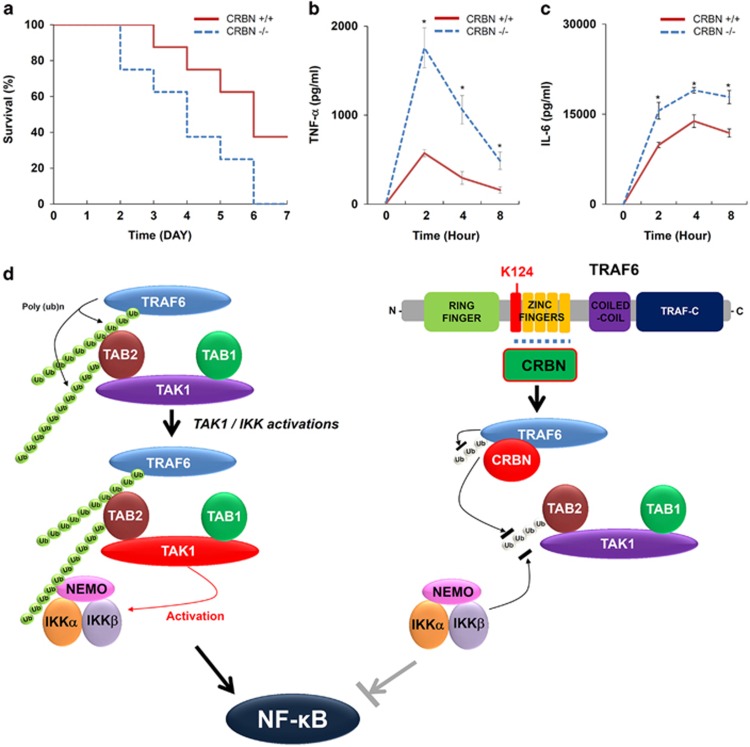
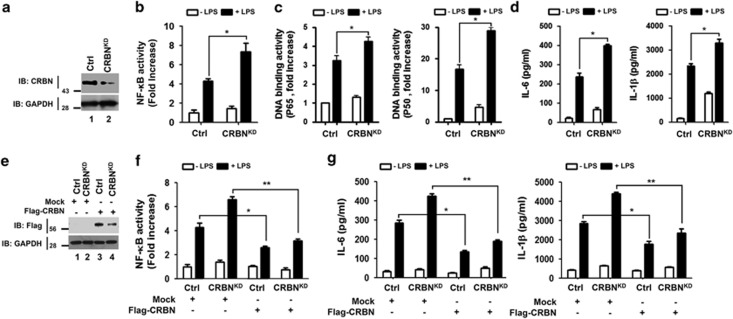
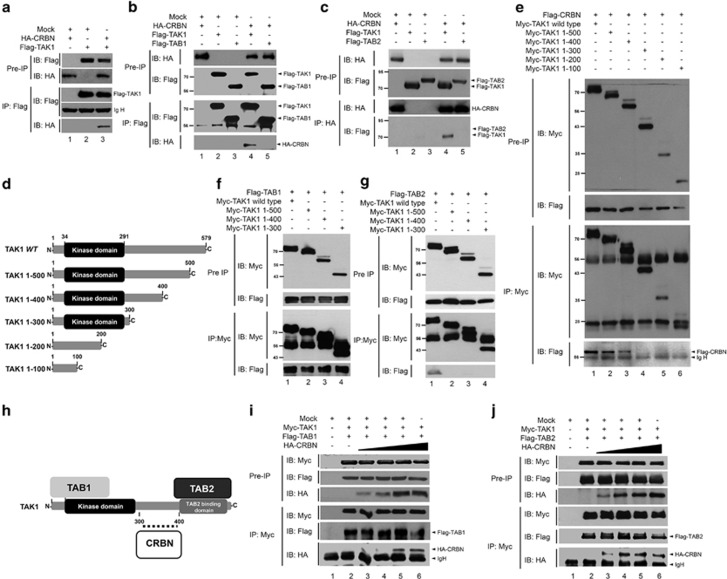
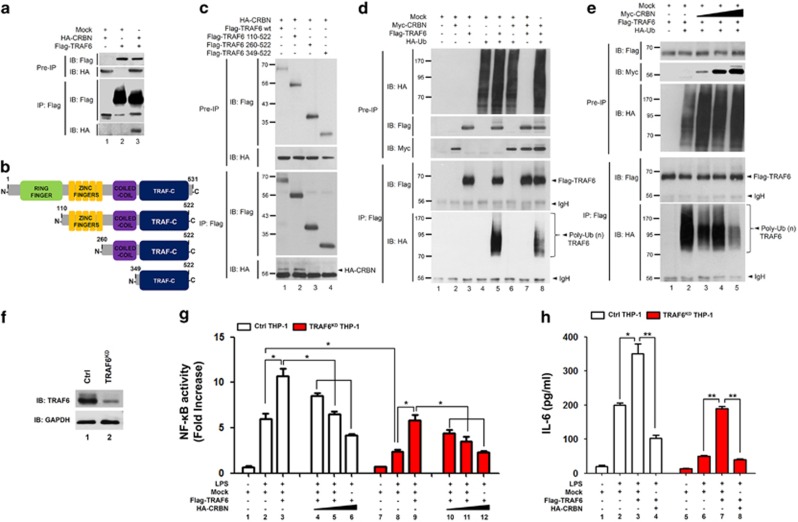
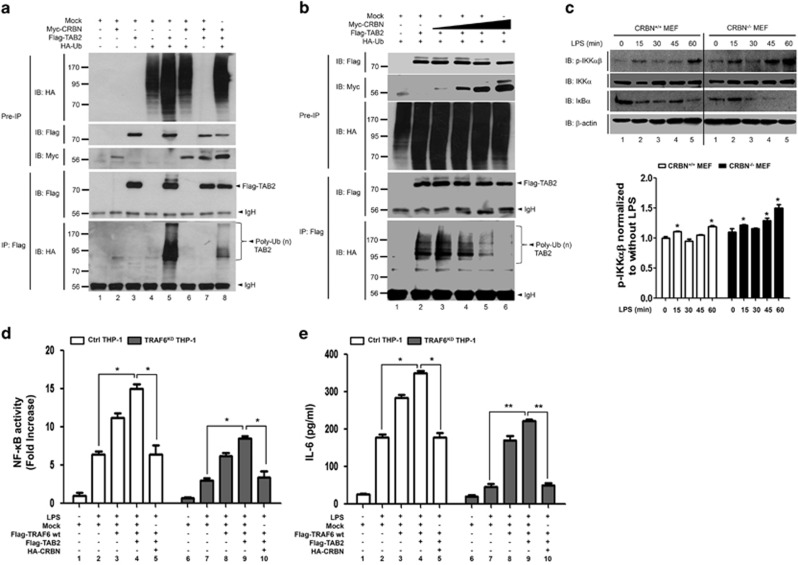
Cereblon (CRBN) is a substrate receptor protein for the CRL4A E3 ubiquitin ligase complex. In this study, we report on a new regulatory role of CRBN in TLR4 signaling. CRBN overexpression leads to suppression of NF-κB activation and production of pro-inflammatory cytokines including IL-6 and IL-1β in response to TLR4 stimulation. Biochemical studies revealed interactions between CRBN and TAK1, and TRAF6 proteins. The interaction between CRBN and TAK1 did not affect the association of the TAB1 and TAB2 proteins, which have pivotal roles in the activation of TAK1, whereas the CRBN-TRAF6 interaction critically affected ubiquitination of TRAF6 and TAB2. Binding mapping results revealed that CRBN interacts with the Zinc finger domain of TRAF6, which contains the ubiquitination site of TRAF6, leading to attenuation of ubiquitination of TRAF6 and TAB2. Functional studies revealed that CRBN-knockdown THP-1 cells show enhanced NF-κB activation and p65- or p50-DNA binding activities, leading to up-regulation of NF-κB-dependent gene expression and increased pro-inflammatory cytokine levels in response to TLR4 stimulation. Furthermore, Crbn(-/-) mice exhibit decreased survival in response to LPS challenge, accompanied with marked enhancement of pro-inflammatory cytokines, such as TNF-α and IL-6. Taken together, our data demonstrate that CRBN negatively regulates TLR4 signaling via attenuation of TRAF6 and TAB2 ubiquitination.
小脑萎缩相关蛋白(CRBN)是CRL4A E3泛素连接酶复合物的底物受体蛋白。在本研究中,我们报道了CRBN在Toll样受体4(TLR4)信号传导中的一种新的调节作用。CRBN的过表达导致在TLR4刺激下,核因子κB(NF-κB)激活受到抑制,以及包括白细胞介素6(IL-6)和白细胞介素1β(IL-1β)在内的促炎细胞因子的产生受到抑制。生化研究揭示了CRBN与转化生长因子β激活激酶1(TAK1)以及肿瘤坏死因子受体相关因子6(TRAF6)蛋白之间的相互作用。CRBN与TAK1之间的相互作用并不影响TAK1激活中起关键作用的TAB1和TAB2蛋白的结合,而CRBN与TRAF6的相互作用则严重影响TRAF6和TAB2的泛素化。结合图谱结果显示,CRBN与TRAF6的锌指结构域相互作用,该结构域包含TRAF6的泛素化位点,从而导致TRAF6和TAB2泛素化减弱。功能研究表明,CRBN基因敲低的人单核细胞白血病细胞系(THP-1)细胞在TLR4刺激下显示出增强的NF-κB激活以及p65或p50与DNA的结合活性,导致NF-κB依赖的基因表达上调以及促炎细胞因子水平升高。此外,小脑萎缩相关蛋白基因敲除(Crbn-/-)小鼠在脂多糖(LPS)攻击后存活率降低,同时伴有肿瘤坏死因子-α(TNF-α)和IL-6等促炎细胞因子的显著增加。综上所述,我们的数据表明CRBN通过减弱TRAF6和TAB2的泛素化对TLR4信号传导起负向调节作用。