Kim Mi-Jeong, Kim Ji Young, Shin Ji Hye, Kang Yeeun, Lee Ji Su, Son Juhee, Jeong Soo-Kyung, Kim Daesik, Kim Duk-Hwan, Chun Eunyoung, Lee Ki-Young
Department of Immunology, Samsung Biomedical Research Institute, Sungkyunkwan University School of Medicine, Suwon, 16419, Republic of Korea.
R&D Center, CHA Vaccine Institute, Seongnam-si, 13493, Republic of Korea.
Cell Biosci. 2023 Jun 7;13(1):102. doi: 10.1186/s13578-023-01038-y.
Free fatty acid receptors (FFARs) and toll-like receptors (TLRs) recognize microbial metabolites and conserved microbial products, respectively, and are functionally implicated in inflammation and cancer. However, whether the crosstalk between FFARs and TLRs affects lung cancer progression has never been addressed.
We analyzed the association between FFARs and TLRs using The Cancer Genome Atlas (TCGA) lung cancer data and our cohort of non-small cell lung cancer (NSCLC) patient data (n = 42), and gene set enrichment analysis (GSEA) was performed. For the functional analysis, we generated FFAR2-knockout (FFAR2KO) A549 and FFAR2KO H1299 human lung cancer cells and performed biochemical mechanistic studies and cancer progression assays, including migration, invasion, and colony-formation assays, in response to TLR stimulation.
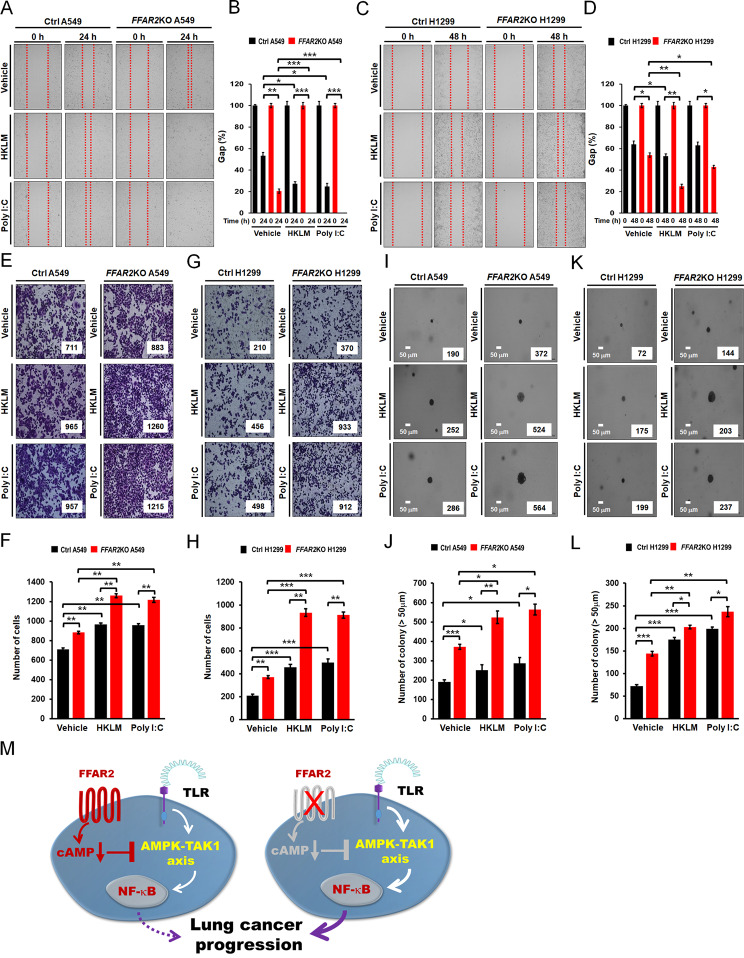
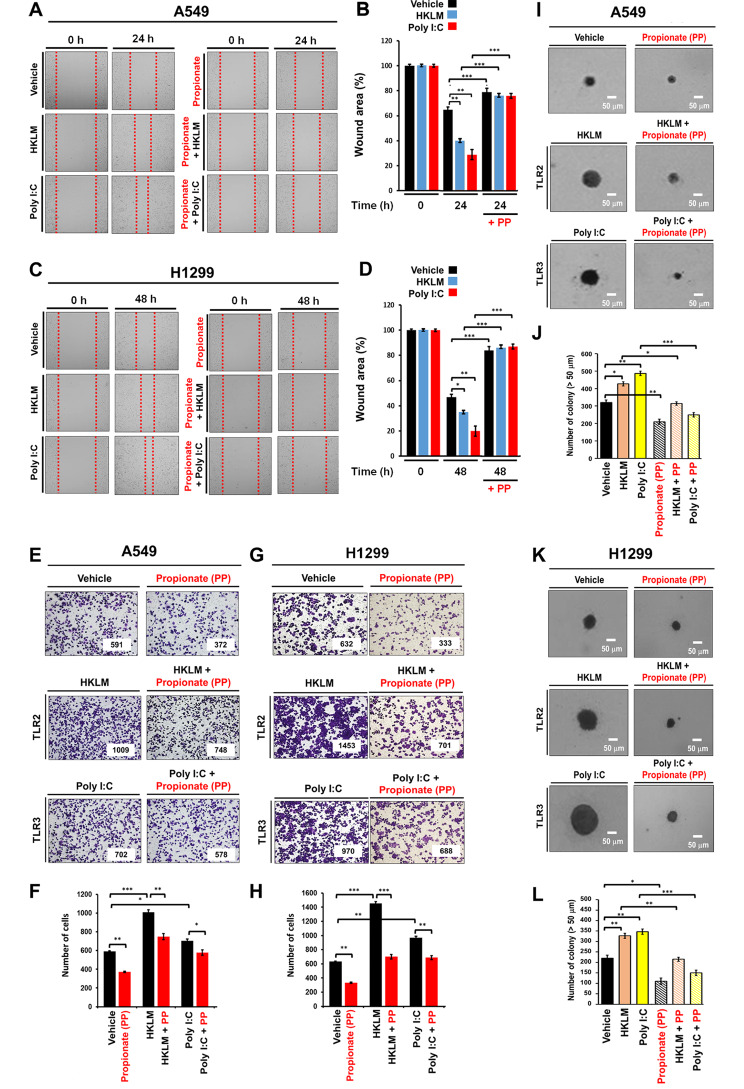
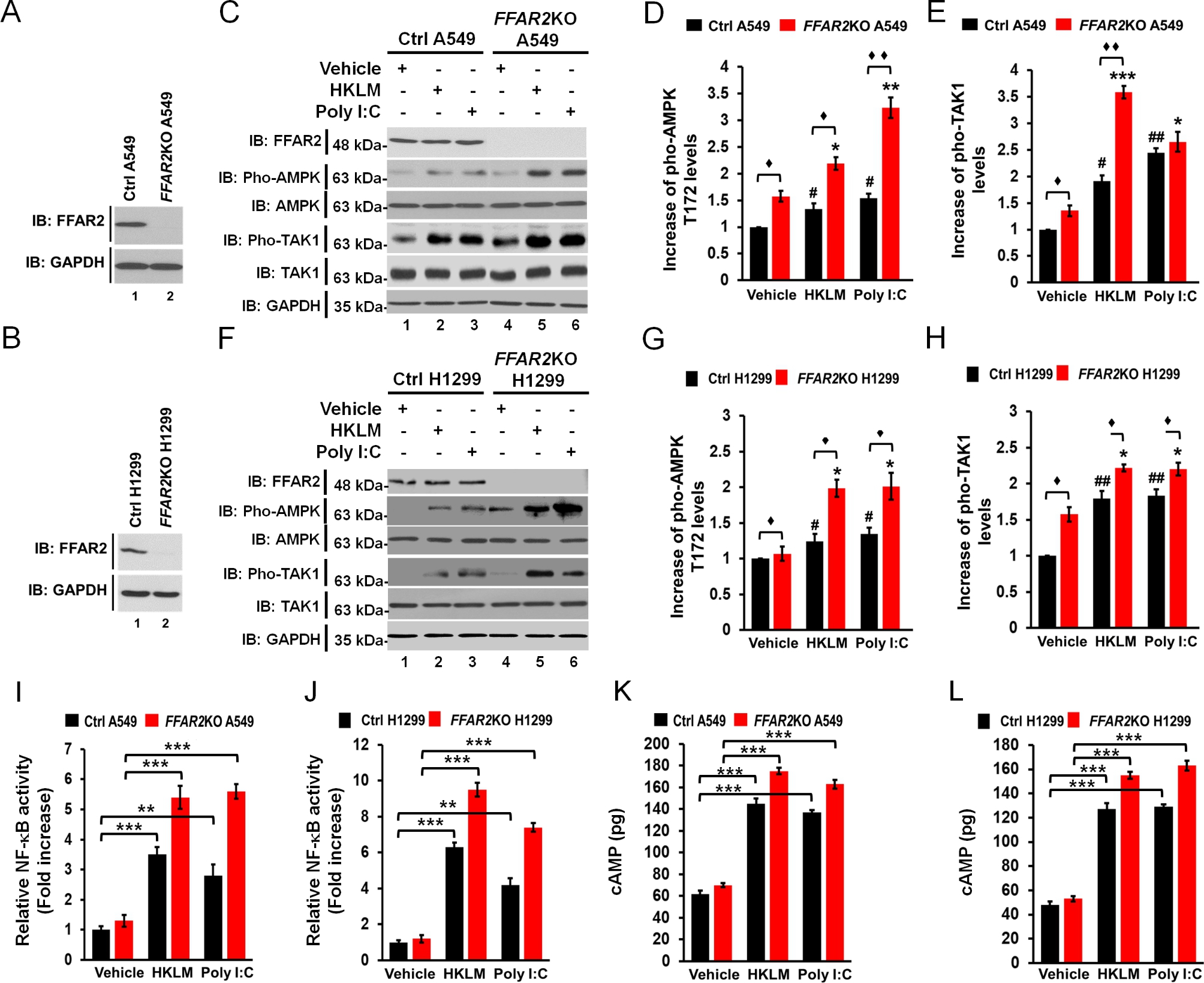
The clinical TCGA data showed a significant down-regulation of FFAR2, but not FFAR1, FFAR3, and FFAR4, in lung cancer, and a negative correlation with TLR2 and TLR3. Notably, GSEA showed significant enrichment in gene sets related to the cancer module, the innate signaling pathway, and the cytokine-chemokine signaling pathway in FFAR2TLR2TLR3 lung tumor tissues (LTTs) vs. FFAR2TLR2TLR3 LTTs. Functionally, treatment with propionate (an agonist of FFAR2) significantly inhibited human A549 or H1299 lung cancer migration, invasion, and colony formation induced by TLR2 or TLR3 through the attenuation of the cAMP-AMPK-TAK1 signaling axis for the activation of NF-κB. Moreover, FFAR2KO A549 and FFAR2KO H1299 human lung cancer cells showed marked increases in cell migration, invasion, and colony formation in response to TLR2 or TLR3 stimulation, accompanied by elevations in NF-κB activation, cAMP levels, and the production of C-C motif chemokine ligand (CCL)2, interleukin (IL)-6, and matrix metalloproteinase (MMP) 2 cytokines.
Our results suggest that FFAR2 signaling antagonized TLR2- and TLR3-induced lung cancer progression via the suppression of the cAMP-AMPK-TAK1 signaling axis for the activation of NF-κB, and its agonist might be a potential therapeutic agent for the treatment of lung cancer.
游离脂肪酸受体(FFARs)和Toll样受体(TLRs)分别识别微生物代谢产物和保守的微生物产物,在炎症和癌症中发挥功能作用。然而,FFARs与TLRs之间的相互作用是否影响肺癌进展尚未得到研究。
我们使用癌症基因组图谱(TCGA)肺癌数据和我们的非小细胞肺癌(NSCLC)患者队列数据(n = 42)分析了FFARs与TLRs之间的关联,并进行了基因集富集分析(GSEA)。为了进行功能分析,我们构建了FFAR2基因敲除(FFAR2KO)的A549和FFAR2KO H1299人肺癌细胞,并进行了生化机制研究和癌症进展分析,包括迁移、侵袭和集落形成分析,以响应TLR刺激。
临床TCGA数据显示,肺癌中FFAR2显著下调,但FFAR1、FFAR3和FFAR4未下调,且与TLR2和TLR3呈负相关。值得注意的是,GSEA显示,与FFAR2TLR2TLR3肺肿瘤组织(LTTs)相比,FFAR2TLR2TLR3 LTTs中与癌症模块、固有信号通路和细胞因子 - 趋化因子信号通路相关的基因集显著富集。在功能上,丙酸(FFAR2的激动剂)处理通过减弱cAMP - AMPK - TAK1信号轴以激活NF - κB,显著抑制了TLR2或TLR3诱导的人A549或H1299肺癌细胞的迁移、侵袭和集落形成。此外,FFAR2KO A549和FFAR2KO H1299人肺癌细胞在响应TLR2或TLR3刺激时,细胞迁移、侵袭和集落形成显著增加,同时伴随着NF - κB激活、cAMP水平以及C - C基序趋化因子配体(CCL)2、白细胞介素(IL) - 6和基质金属蛋白酶(MMP)2细胞因子的产生增加。
我们的结果表明,FFAR2信号通过抑制cAMP - AMPK - TAK1信号轴以激活NF - κB,拮抗TLR2和TLR3诱导的肺癌进展,其激动剂可能是治疗肺癌的潜在治疗药物。