Ishitsuka Koji, Sakaki Yusuke, Sakai Shota, Uwatoko Takeshi, Aibe Hitoshi, Ago Tetsuro, Kitazono Takanari, Sugimori Hiroshi
Department of Cerebrovascular Medicine, Saga Medical Center Koseikan, Kase-machi Nakabaru 400, Saga, 840-8571, Japan.
Department of Cerebrovascular Disease, Japanese Fukuoka Red Cross Hospital, Fukuoka, 815-8555, Japan.
BMC Neurol. 2016 Jul 29;16:121. doi: 10.1186/s12883-016-0637-9.
Volume isotropic turbo spin-echo acquisition (VISTA) is a new method similar to the 3D black-blood imaging method that enables visualization of a intramural hematoma. T1-VISTA has recently been applied in the diagnosis of intracranial arterial dissection. However, the identification of an intramural hematoma in posterior inferior cerebellar dissection (PICA-D) by T1-VISTA has only rarely been reported.
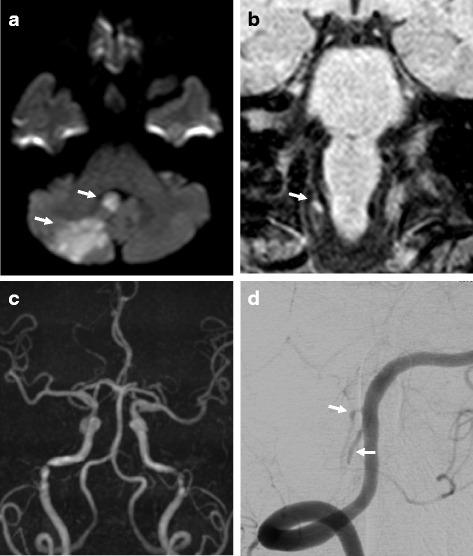
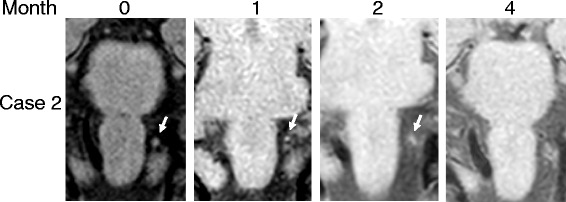
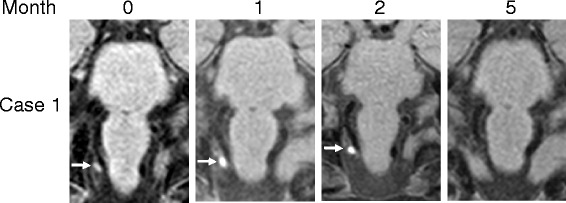
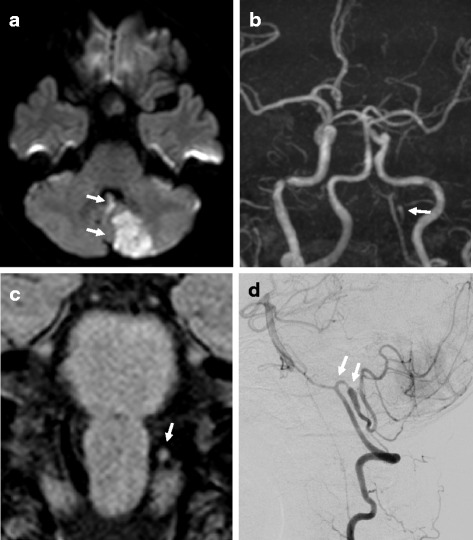
We herein report two patients who suffered from PICA-D complicated with ischemic stroke. Initial magnetic resonance arteriography was not informative, however, T1-VISTA depicted high-intensity signal areas suggesting an intramural hematoma of PICA-D in both cases. The high-intensity signal areas gradually reduced and finally disappeared at 4 months and 5 months after the onset, respectively.
Our cases demonstrate that T1-VISTA was able to assist in the diagnosis and follow-up of PICA-D.
容积各向同性涡轮自旋回波采集(VISTA)是一种类似于三维黑血成像方法的新方法,能够实现壁内血肿的可视化。T1-VISTA最近已应用于颅内动脉夹层的诊断。然而,通过T1-VISTA识别小脑后下动脉夹层(PICA-D)中的壁内血肿的报道很少。
我们在此报告2例患有PICA-D并伴有缺血性卒中的患者。最初的磁共振血管造影未提供有用信息,然而,T1-VISTA在2例病例中均显示出高强度信号区域,提示PICA-D的壁内血肿。高强度信号区域分别在发病后4个月和5个月逐渐缩小并最终消失。
我们的病例表明,T1-VISTA能够辅助PICA-D的诊断和随访。