• 文献检索
  • 文档翻译
  • 深度研究
  • 学术资讯
  • Suppr Zotero 插件Zotero 插件
  • 邀请有礼
  • 套餐&价格
  • 历史记录
应用&插件
Suppr Zotero 插件Zotero 插件浏览器插件Mac 客户端Windows 客户端微信小程序
定价
高级版会员购买积分包购买API积分包
服务
文献检索文档翻译深度研究API 文档MCP 服务
关于我们
关于 Suppr公司介绍联系我们用户协议隐私条款
关注我们

Suppr 超能文献

核心技术专利:CN118964589B侵权必究
粤ICP备2023148730 号-1Suppr @ 2026

文献检索

告别复杂PubMed语法,用中文像聊天一样搜索,搜遍4000万医学文献。AI智能推荐,让科研检索更轻松。

立即免费搜索

文件翻译

保留排版,准确专业,支持PDF/Word/PPT等文件格式,支持 12+语言互译。

免费翻译文档

深度研究

AI帮你快速写综述,25分钟生成高质量综述,智能提取关键信息,辅助科研写作。

立即免费体验

一种基于网络的药物重新定位方法识别出了乳腺癌和前列腺癌的潜在候选药物。

A network based approach to drug repositioning identifies plausible candidates for breast cancer and prostate cancer.

作者信息

Chen Hsiao-Rong, Sherr David H, Hu Zhenjun, DeLisi Charles

机构信息

Bioinformatics Program, College of Engineering, Boston University, Boston, MA, USA.

Graduate Program in Translational Molecular Medicine, Boston University School of Medicine, Boston, MA, USA.

出版信息

BMC Med Genomics. 2016 Jul 30;9(1):51. doi: 10.1186/s12920-016-0212-7.

DOI:10.1186/s12920-016-0212-7
PMID:27475327
原文链接:https://pmc.ncbi.nlm.nih.gov/articles/PMC4967295/
Abstract

BACKGROUND

The high cost and the long time required to bring drugs into commerce is driving efforts to repurpose FDA approved drugs-to find new uses for which they weren't intended, and to thereby reduce the overall cost of commercialization, and shorten the lag between drug discovery and availability. We report on the development, testing and application of a promising new approach to repositioning.

METHODS

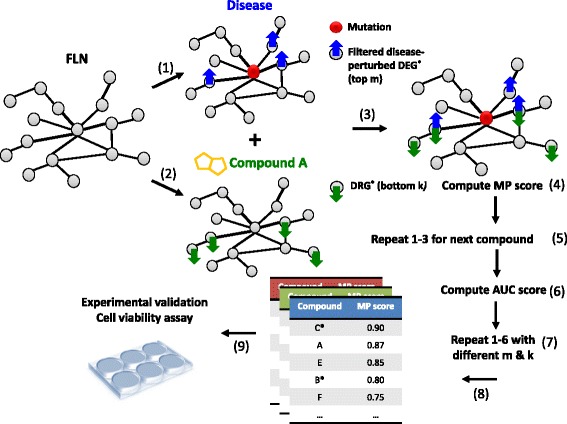
Our approach is based on mining a human functional linkage network for inversely correlated modules of drug and disease gene targets. The method takes account of multiple information sources, including gene mutation, gene expression, and functional connectivity and proximity of within module genes.

RESULTS

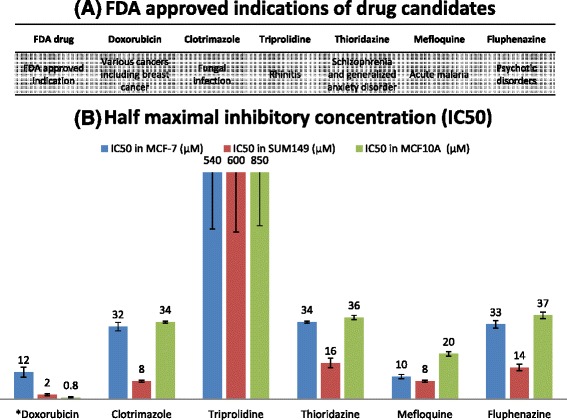
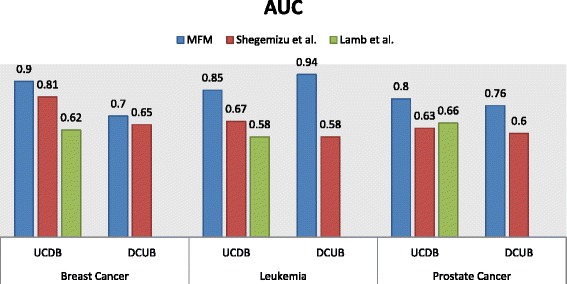
The method was used to identify candidates for treating breast and prostate cancer. We found that (i) the recall rate for FDA approved drugs for breast (prostate) cancer is 20/20 (10/11), while the rates for drugs in clinical trials were 131/154 and 82/106; (ii) the ROC/AUC performance substantially exceeds that of comparable methods; (iii) preliminary in vitro studies indicate that 5/5 candidates have therapeutic indices superior to that of Doxorubicin in MCF7 and SUM149 cancer cell lines. We briefly discuss the biological plausibility of the candidates at a molecular level in the context of the biological processes that they mediate.

CONCLUSIONS

Our method appears to offer promise for the identification of multi-targeted drug candidates that can correct aberrant cellular functions. In particular the computational performance exceeded that of other CMap-based methods, and in vitro experiments indicate that 5/5 candidates have therapeutic indices superior to that of Doxorubicin in MCF7 and SUM149 cancer cell lines. The approach has the potential to provide a more efficient drug discovery pipeline.

摘要

背景

将药物推向市场所需的高成本和长时间促使人们努力对FDA批准的药物进行重新定位——寻找它们原本未被设计的新用途,从而降低商业化的总体成本,并缩短药物发现与上市之间的时间间隔。我们报告了一种有前景的重新定位新方法的开发、测试和应用。

方法

我们的方法基于挖掘人类功能联系网络,以寻找药物和疾病基因靶点的负相关模块。该方法考虑了多种信息来源,包括基因突变、基因表达以及模块内基因的功能连通性和邻近性。

结果

该方法用于识别治疗乳腺癌和前列腺癌的候选药物。我们发现:(i)FDA批准用于乳腺癌(前列腺癌)的药物召回率为20/20(10/11),而临床试验中的药物召回率分别为131/154和82/106;(ii)ROC/AUC性能显著超过可比方法;(iii)初步体外研究表明,5/5的候选药物在MCF7和SUM149癌细胞系中的治疗指数优于阿霉素。我们在它们所介导的生物学过程的背景下,简要讨论了候选药物在分子水平上的生物学合理性。

结论

我们的方法似乎有望识别出能够纠正异常细胞功能的多靶点候选药物。特别是计算性能超过了其他基于CMap的方法,体外实验表明,5/5的候选药物在MCF7和SUM149癌细胞系中的治疗指数优于阿霉素。该方法有可能提供更高效的药物发现流程。
https://cdn.ncbi.nlm.nih.gov/pmc/blobs/9601/4967295/097e0aaa4361/12920_2016_212_Fig3_HTML.jpg
https://cdn.ncbi.nlm.nih.gov/pmc/blobs/9601/4967295/dfff1622c201/12920_2016_212_Fig1_HTML.jpg
https://cdn.ncbi.nlm.nih.gov/pmc/blobs/9601/4967295/63fa2c0aac91/12920_2016_212_Fig2_HTML.jpg
https://cdn.ncbi.nlm.nih.gov/pmc/blobs/9601/4967295/097e0aaa4361/12920_2016_212_Fig3_HTML.jpg
https://cdn.ncbi.nlm.nih.gov/pmc/blobs/9601/4967295/dfff1622c201/12920_2016_212_Fig1_HTML.jpg
https://cdn.ncbi.nlm.nih.gov/pmc/blobs/9601/4967295/63fa2c0aac91/12920_2016_212_Fig2_HTML.jpg
https://cdn.ncbi.nlm.nih.gov/pmc/blobs/9601/4967295/097e0aaa4361/12920_2016_212_Fig3_HTML.jpg

相似文献

1
A network based approach to drug repositioning identifies plausible candidates for breast cancer and prostate cancer.一种基于网络的药物重新定位方法识别出了乳腺癌和前列腺癌的潜在候选药物。
BMC Med Genomics. 2016 Jul 30;9(1):51. doi: 10.1186/s12920-016-0212-7.
2
Predicting Potential Drugs for Breast Cancer based on miRNA and Tissue Specificity.基于 miRNA 和组织特异性预测乳腺癌潜在药物。
Int J Biol Sci. 2018 May 22;14(8):971-982. doi: 10.7150/ijbs.23350. eCollection 2018.
3
Drug repositioning in SLE: crowd-sourcing, literature-mining and Big Data analysis.系统性红斑狼疮中的药物重新定位:众包、文献挖掘与大数据分析。
Lupus. 2016 Sep;25(10):1150-70. doi: 10.1177/0961203316657437.
4
Computational drugs repositioning identifies inhibitors of oncogenic PI3K/AKT/P70S6K-dependent pathways among FDA-approved compounds.计算药物重新定位在FDA批准的化合物中识别出致癌性PI3K/AKT/P70S6K依赖性途径的抑制剂。
Oncotarget. 2016 Sep 13;7(37):58743-58758. doi: 10.18632/oncotarget.11318.
5
MD-Miner: a network-based approach for personalized drug repositioning.MD-Miner:一种基于网络的个性化药物重新定位方法。
BMC Syst Biol. 2017 Oct 3;11(Suppl 5):86. doi: 10.1186/s12918-017-0462-9.
6
Using a novel computational drug-repositioning approach (DrugPredict) to rapidly identify potent drug candidates for cancer treatment.利用一种新颖的计算药物重定位方法(DrugPredict),快速鉴定出用于癌症治疗的有效药物候选物。
Oncogene. 2018 Jan 18;37(3):403-414. doi: 10.1038/onc.2017.328. Epub 2017 Oct 2.
7
Using functional signatures to identify repositioned drugs for breast, myelogenous leukemia and prostate cancer.利用功能特征鉴定用于乳腺癌、髓性白血病和前列腺癌的再定位药物。
PLoS Comput Biol. 2012 Feb;8(2):e1002347. doi: 10.1371/journal.pcbi.1002347. Epub 2012 Feb 9.
8
A Systematic Framework for Drug Repositioning from Integrated Omics and Drug Phenotype Profiles Using Pathway-Drug Network.一种基于通路-药物网络,利用整合组学和药物表型谱进行药物重新定位的系统框架。
Biomed Res Int. 2016;2016:7147039. doi: 10.1155/2016/7147039. Epub 2016 Dec 26.
9
Computational Drug Repositioning with Random Walk on a Heterogeneous Network.基于异质网络随机游走的计算药物重定位
IEEE/ACM Trans Comput Biol Bioinform. 2019 Nov-Dec;16(6):1890-1900. doi: 10.1109/TCBB.2018.2832078. Epub 2018 May 2.
10
A computational method for drug repositioning using publicly available gene expression data.一种利用公开可用基因表达数据进行药物重新定位的计算方法。
BMC Bioinformatics. 2015;16 Suppl 17(Suppl 17):S5. doi: 10.1186/1471-2105-16-S17-S5. Epub 2015 Dec 7.

引用本文的文献

1
Reconciling multiple connectivity-based systems biology methods for drug repurposing.协调多种基于连通性的系统生物学方法用于药物再利用。
Brief Bioinform. 2025 Jul 2;26(4). doi: 10.1093/bib/bbaf387.
2
Network-based identification of key proteins and repositioning of drugs for non-small cell lung cancer.基于网络的非小细胞肺癌关键蛋白鉴定和药物重定位。
Cancer Rep (Hoboken). 2024 Apr;7(4):e2031. doi: 10.1002/cnr2.2031.
3
The OREGANO knowledge graph for computational drug repurposing.奥里根诺计算药物再利用知识图谱。

本文引用的文献

1
Computational drug repositioning for peripheral arterial disease: prediction of anti-inflammatory and pro-angiogenic therapeutics.外周动脉疾病的计算药物重新定位:抗炎和促血管生成疗法的预测
Front Pharmacol. 2015 Aug 25;6:179. doi: 10.3389/fphar.2015.00179. eCollection 2015.
2
Large-scale Direct Targeting for Drug Repositioning and Discovery.用于药物重新定位和发现的大规模直接靶向
Sci Rep. 2015 Jul 9;5:11970. doi: 10.1038/srep11970.
3
A2aR antagonists: Next generation checkpoint blockade for cancer immunotherapy.A2aR拮抗剂:癌症免疫疗法的新一代检查点阻断剂。
Sci Data. 2023 Dec 6;10(1):871. doi: 10.1038/s41597-023-02757-0.
4
Tailored modulation of S100A1 and RASSF8 expression by butanediamide augments healing of rotator cuff tears.丁二酰胺对 S100A1 和 RASSF8 表达的靶向调节增强肩袖撕裂的愈合。
PeerJ. 2023 Aug 14;11:e15791. doi: 10.7717/peerj.15791. eCollection 2023.
5
Network neighborhood operates as a drug repositioning method for cancer treatment.网络邻居可作为癌症治疗的药物再利用方法。
PeerJ. 2023 Jul 10;11:e15624. doi: 10.7717/peerj.15624. eCollection 2023.
6
Validation of transcriptome signature reversion for drug repurposing in oncology.肿瘤学中药物再利用的转录组特征逆转验证。
Brief Bioinform. 2023 Jan 19;24(1). doi: 10.1093/bib/bbac490.
7
Artificial intelligence to guide precision anticancer therapy with multitargeted kinase inhibitors.人工智能指导多靶点激酶抑制剂的精准抗癌治疗。
BMC Cancer. 2022 Nov 24;22(1):1211. doi: 10.1186/s12885-022-10293-0.
8
A comprehensive review of artificial intelligence and network based approaches to drug repurposing in Covid-19.人工智能和基于网络的方法在新冠病毒药物再利用中的综合综述
Biomed Pharmacother. 2022 Sep;153:113350. doi: 10.1016/j.biopha.2022.113350. Epub 2022 Jun 28.
9
The Discovery of New Drug-Target Interactions for Breast Cancer Treatment.用于乳腺癌治疗的新药靶标相互作用的发现。
Molecules. 2021 Dec 10;26(24):7474. doi: 10.3390/molecules26247474.
10
Using predictive machine learning models for drug response simulation by calibrating patient-specific pathway signatures.利用预测性机器学习模型,通过校准患者特异性通路特征,对药物反应进行模拟。
NPJ Syst Biol Appl. 2021 Oct 27;7(1):40. doi: 10.1038/s41540-021-00199-1.
Comput Struct Biotechnol J. 2015 Apr 8;13:265-72. doi: 10.1016/j.csbj.2015.03.008. eCollection 2015.
4
Regulation of breast cancer stem cell features.乳腺癌干细胞特征的调控
Contemp Oncol (Pozn). 2015;19(1A):A7-A15. doi: 10.5114/wo.2014.47126.
5
Large-scale exploration and analysis of drug combinations.大规模药物组合的探索与分析。
Bioinformatics. 2015 Jun 15;31(12):2007-16. doi: 10.1093/bioinformatics/btv080. Epub 2015 Feb 8.
6
Large-scale integration of small molecule-induced genome-wide transcriptional responses, Kinome-wide binding affinities and cell-growth inhibition profiles reveal global trends characterizing systems-level drug action.大规模整合小分子诱导的全基因组转录反应、激酶组结合亲和力和细胞生长抑制谱,揭示了表征系统水平药物作用的全局趋势。
Front Genet. 2014 Sep 30;5:342. doi: 10.3389/fgene.2014.00342. eCollection 2014.
7
Identification of structural features in chemicals associated with cancer drug response: a systematic data-driven analysis.鉴定与癌症药物反应相关的化学物质的结构特征:一项系统的数据驱动分析。
Bioinformatics. 2014 Sep 1;30(17):i497-504. doi: 10.1093/bioinformatics/btu456.
8
The PI3K/AKT/mTOR pathway in breast cancer: targets, trials and biomarkers.乳腺癌中的 PI3K/AKT/mTOR 通路:靶点、试验和生物标志物。
Ther Adv Med Oncol. 2014 Jul;6(4):154-66. doi: 10.1177/1758834014530023.
9
Functional Module Connectivity Map (FMCM): a framework for searching repurposed drug compounds for systems treatment of cancer and an application to colorectal adenocarcinoma.功能模块连接图(FMCM):一种用于寻找再利用药物化合物的系统治疗癌症的框架,以及在结直肠腺癌中的应用。
PLoS One. 2014 Jan 27;9(1):e86299. doi: 10.1371/journal.pone.0086299. eCollection 2014.
10
Blockade of A2A receptors potently suppresses the metastasis of CD73+ tumors.A2A 受体阻断剂能有效抑制 CD73+肿瘤的转移。
Proc Natl Acad Sci U S A. 2013 Sep 3;110(36):14711-6. doi: 10.1073/pnas.1308209110. Epub 2013 Aug 20.