Tokić Stana, Štefanić Mario, Glavaš-Obrovac Ljubica, Jaman Sonja, Novosadová Eva, Petrkova Jana, Navratilova Zdenka, Suver Stević Mirjana, Petrek Martin
Department of Molecular Diagnostics and Tissue Typing, Osijek University Hospital, Josipa Huttlera 4, 31000 Osijek, Croatia; Faculty of Medicine, University of Osijek, Cara Hadrijana 10E, 31000 Osijek, Croatia; Laboratory of Immunogenomics, Department of Pathological Physiology, Faculty of Medicine and Dentistry, Palacký University, 775 20 Olomouc, Czech Republic.
Faculty of Medicine, University of Osijek, Cara Hadrijana 10E, 31000 Osijek, Croatia; Clinical Institute of Nuclear Medicine and Radiation Protection, Osijek University Hospital, Josipa Huttlera 4, 31000 Osijek, Croatia.
Mediators Inflamm. 2016;2016:3687420. doi: 10.1155/2016/3687420. Epub 2016 Jul 5.
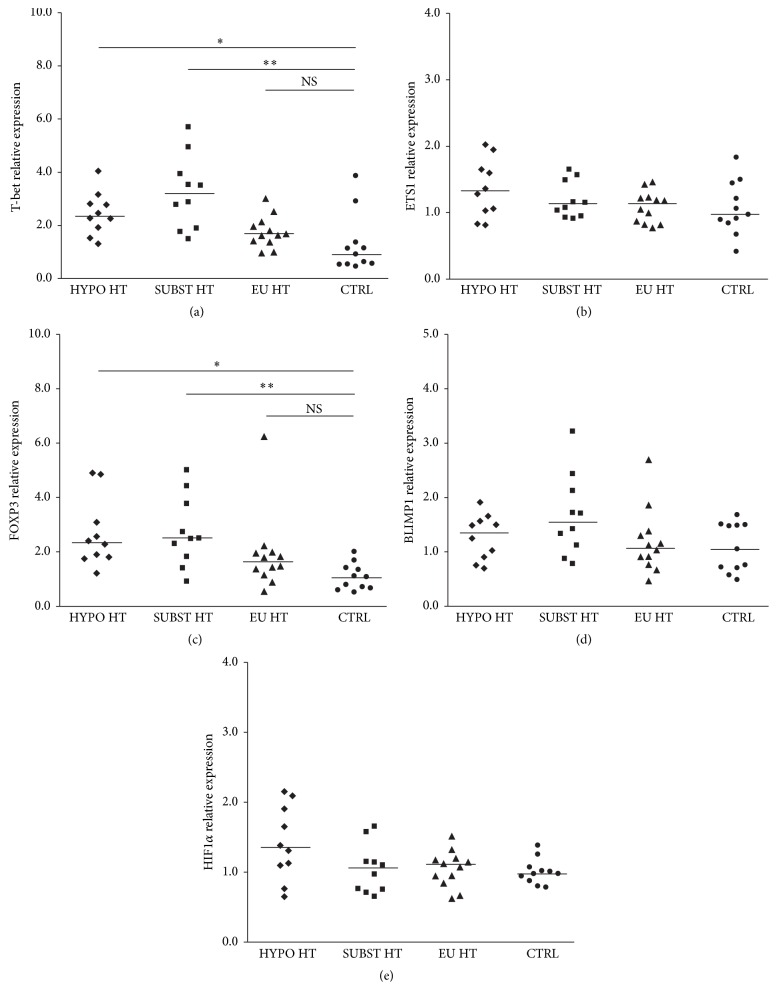
Hashimoto's thyroiditis (HT) is an organ-specific autoimmune disorder characterized by progressive thyroid failure. Th1 and Treg subset of CD4(+) cells have been implicated in the pathogenesis; however, less is known about their respective roles across the spectrum of HT clinical presentations. To shed more light on CD4(+) subsets role in HT, we investigated the mRNA expression levels of several Th1/Treg-associated transcription factors (T-bet/ETS1, HIF1α/BLIMP1/FOXP3) in peripheral blood T cells of 10 hypothyroid, untreated HT patients, 10 hypothyroid patients undergoing hormone replacement therapy, 12 euthyroid HT subjects, and 11 healthy controls by the qRT-PCR. Compared to euthyroid HT patients and controls, both hypothyroid (2.34-fold difference versus controls, P < 0.01) and thyroxine-supplemented patients (2.5-fold, P < 0.001) showed an increased FOXP3 mRNA expression in T cells. Similarly, mRNA expression levels of T-bet were upregulated in severely affected but not in euthyroid HT subjects (2.37-fold and 3.2-fold, hypothyroid and thyroxine-supplemented HT patients versus controls, resp., P < 0.01). By contrast, no differences in mRNA expression levels of ETS1, BLIMP1, and HIF1α were observed across the study groups. In summary, severe but not euthyroid HT was associated with robust upregulation of T-bet and FOXP3 mRNA in peripheral T cells, independent of the thyroid hormone status but proportional to disease activity.
桥本甲状腺炎(HT)是一种以进行性甲状腺功能衰竭为特征的器官特异性自身免疫性疾病。CD4(+)细胞的Th1和Treg亚群与发病机制有关;然而,对于它们在HT临床表现谱中的各自作用了解较少。为了更清楚地了解CD4(+)亚群在HT中的作用,我们通过qRT-PCR研究了10例未经治疗的甲状腺功能减退HT患者、10例接受激素替代治疗的甲状腺功能减退患者、12例甲状腺功能正常的HT受试者和11例健康对照者外周血T细胞中几种Th1/Treg相关转录因子(T-bet/ETS1、HIF1α/BLIMP1/FOXP3)的mRNA表达水平。与甲状腺功能正常的HT患者和对照相比,甲状腺功能减退患者(与对照相比差异为2.34倍,P < 0.01)和补充甲状腺素的患者(2.5倍,P < 0.001)的T细胞中FOXP3 mRNA表达均增加。同样,T-bet的mRNA表达水平在病情严重的HT受试者中上调,但在甲状腺功能正常的HT受试者中未上调(甲状腺功能减退和补充甲状腺素的HT患者与对照相比分别为2.37倍和3.2倍,P < 0.01)。相比之下,在各研究组中未观察到ETS1、BLIMP1和HIF1α的mRNA表达水平存在差异。总之,严重而非甲状腺功能正常的HT与外周T细胞中T-bet和FOXP3 mRNA的强烈上调有关,与甲状腺激素状态无关,但与疾病活动度成正比。