Yu Fang, Sharma Suveena, Edwards Julie, Feigenbaum Lionel, Zhu Jinfang
Laboratory of Immunology, National Institute of Allergy and Infectious Diseases, National Institutes of Health, Bethesda, Maryland, USA.
Laboratory Animal Sciences Program, National Cancer Institute, Frederick, Maryland, USA.
Nat Immunol. 2015 Feb;16(2):197-206. doi: 10.1038/ni.3053. Epub 2014 Dec 15.
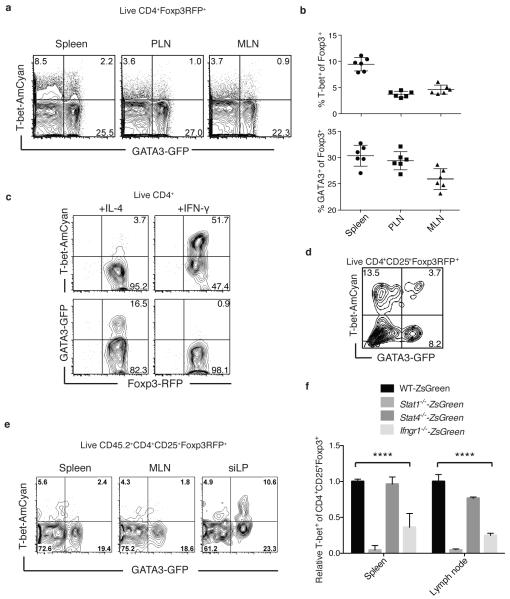
Regulatory T cells (Treg cells) can express the transcription factors T-bet and GATA-3, but the function of this expression and whether such cells represent stable subsets is still unknown. By using various reporter tools, we found that the expression of T-bet and GATA-3 in Treg cells was dynamically influenced by the cytokine environment. Treg cell-specific deletion of the gene encoding either T-bet (Tbx21) or GATA-3 (Gata3) alone did not result in loss of Treg cell function; however, mice with combined deficiency in both genes in Treg cells developed severe autoimmune-like diseases. Loss of Treg cell function correlated with upregulation of expression of the transcription factor RORγt and reduced expression of the transcription factor Foxp3. Thus, in the steady state, activated Treg cells transiently upregulated either T-bet or GATA-3 to maintain T cell homeostasis.
调节性T细胞(Treg细胞)能够表达转录因子T-bet和GATA-3,但这种表达的功能以及此类细胞是否代表稳定的亚群仍不清楚。通过使用各种报告工具,我们发现Treg细胞中T-bet和GATA-3的表达受到细胞因子环境的动态影响。单独对编码T-bet(Tbx21)或GATA-3(Gata3)的基因进行Treg细胞特异性缺失,并不会导致Treg细胞功能丧失;然而,Treg细胞中这两个基因均存在缺陷的小鼠会发展出严重的自身免疫样疾病。Treg细胞功能的丧失与转录因子RORγt表达上调以及转录因子Foxp3表达降低相关。因此,在稳态下,活化的Treg细胞会短暂上调T-bet或GATA-3以维持T细胞稳态。