Jeong Kyoung Yong, Son Mina, Park Jin Hee, Park Kyung Hee, Park Hye Jung, Lee Jae-Hyun, Hong Chein-Soo, Park Jung-Won
Department of Internal Medicine, Institute of Allergy, Yonsei University College of Medicine, Seoul, Korea .
Department of Biology Education, Faculty of Education, Seowon University, Cheongju, Korea .
J Korean Med Sci. 2016 Aug;31(8):1202-7. doi: 10.3346/jkms.2016.31.8.1202. Epub 2016 May 20.
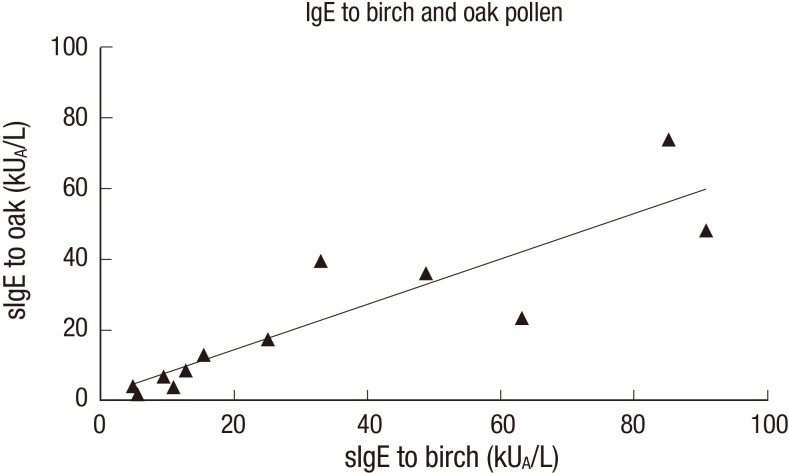
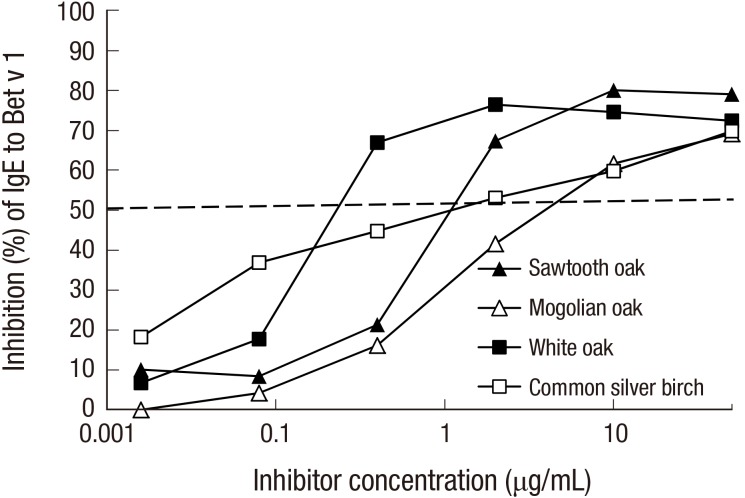
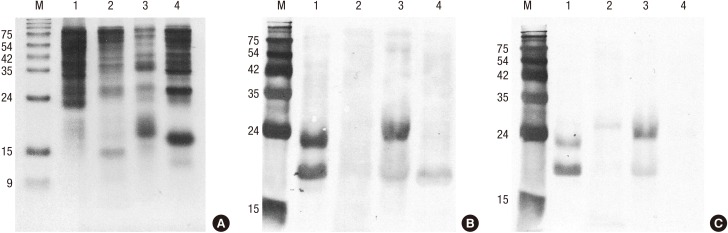
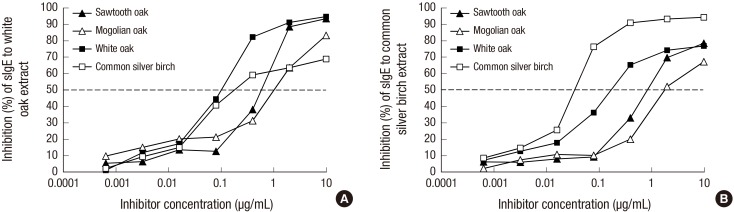
Oak and birch trees belong to Fagales order. Specific IgE to pollen allergens of both trees are frequently found in Korea pollinosis patients. Oak trees which comprise 40% of forest area are common in Korea. However, birch trees are sparse. We compared the allergenicity of pollen extracts of white oak, sawtooth and Mongolian oaks which are prevalent species in Korea, with the pollen extract of birch. The cross-reactivity of four pollen extracts was examined with pooled sera of 12 patients by ELISA, immunoblotting and CAP inhibitions. A protein of 17 kDa, putatively homologous to a major birch allergen Bet v 1, displayed strong IgE reactivity from white oak and sawtooth oak pollen extract but not from Mongolian oak pollen. Notably, a 23-kDa protein from sawtooth and white oaks showed strong IgE reactivity and inhibited by Bet v 1. IgE binding to white oak was inhibited a maximum of 94.6% by white oak, 93.4% by sawtooth oak, 83.2% by Mongolian oak, and 68.8% by birch. Furthermore, sawtooth oak, white oak, and Mongolian oak extracts were able to inhibit up to 78.5%, 76.6% and 67.3% of IgE binding to birch extract, while birch extract itself inhibited up to 94.3%. Specific IgE to Bet v 1 was inhibited a maximum of 79.1% by sawtooth oak, 77.4% by white oak, and 72.7% by Mongolian oak, while 81.5% inhibition was shown by birch. Bet v 1 was able to partially inhibit its homologous molecules from sawtooth oak and white oak in immunoblotting. Birch pollen extract was found to be cross-reactive primarily with Bet v 1-homologous allergen from oak pollens in Korea pollinosis patients. Considering the sparseness of birch tree in Korea, oak, especially sawtooth oak may be the main cause of tree pollinosis in Korea, rather than birch.
橡树和桦树属于壳斗目。韩国花粉症患者中经常发现对这两种树的花粉过敏原的特异性IgE。占森林面积40%的橡树在韩国很常见。然而,桦树很稀少。我们将韩国常见的白橡树、锯齿橡树和蒙古栎的花粉提取物的致敏性与桦树的花粉提取物进行了比较。通过ELISA、免疫印迹和CAP抑制试验,用12名患者的混合血清检测了四种花粉提取物的交叉反应性。一种17 kDa的蛋白质,推测与主要桦树过敏原Bet v 1同源,在白橡树和锯齿橡树花粉提取物中显示出强烈的IgE反应性,但在蒙古栎花粉中没有。值得注意的是,来自锯齿橡树和白橡树的一种23 kDa蛋白质显示出强烈的IgE反应性,并被Bet v 1抑制。白橡树对白橡树IgE结合的抑制率最高为94.6%,锯齿橡树为93.4%,蒙古栎为83.2%,桦树为68.8%。此外,锯齿橡树、白橡树和蒙古栎提取物能够分别抑制高达78.5%、76.6%和67.3%的IgE与桦树提取物的结合,而桦树提取物本身的抑制率高达94.