Division of Allergy and Immunology, Department of Internal Medicine, Yonsei University College of Medicine, Seoul, Korea. ; Institute of Allergy, Yonsei University College of Medicine, Seoul, Korea.
Department of Internal Medicine, Yonsei University College of Medicine, Seoul, Korea.
Allergy Asthma Immunol Res. 2014 May;6(3):222-7. doi: 10.4168/aair.2014.6.3.222. Epub 2014 Feb 5.
The higher prevalence of respiratory allergic disease may be due to increased exposure to inhalation allergens. We conducted a survey of allergic diseases in autumn and winter with detection of major indoor allergens in major cities in Korea.
We enrolled 110 subjects from the fourth Korea National Health and Nutrition Examination Survey with stratified, cluster, and systematic sampling procedures. All participants answered a health questionnaire as well as underwent a skin prick test (SPT) and ImmunoCAP for 11 indoor major allergens. We also measured the levels of 5 major allergens (Der f 1, Der p 1, Can f 1, Bla g 1, and Asp f 1) in fine indoor dust from the houses of 60 subjects with a 2-site ELISA.
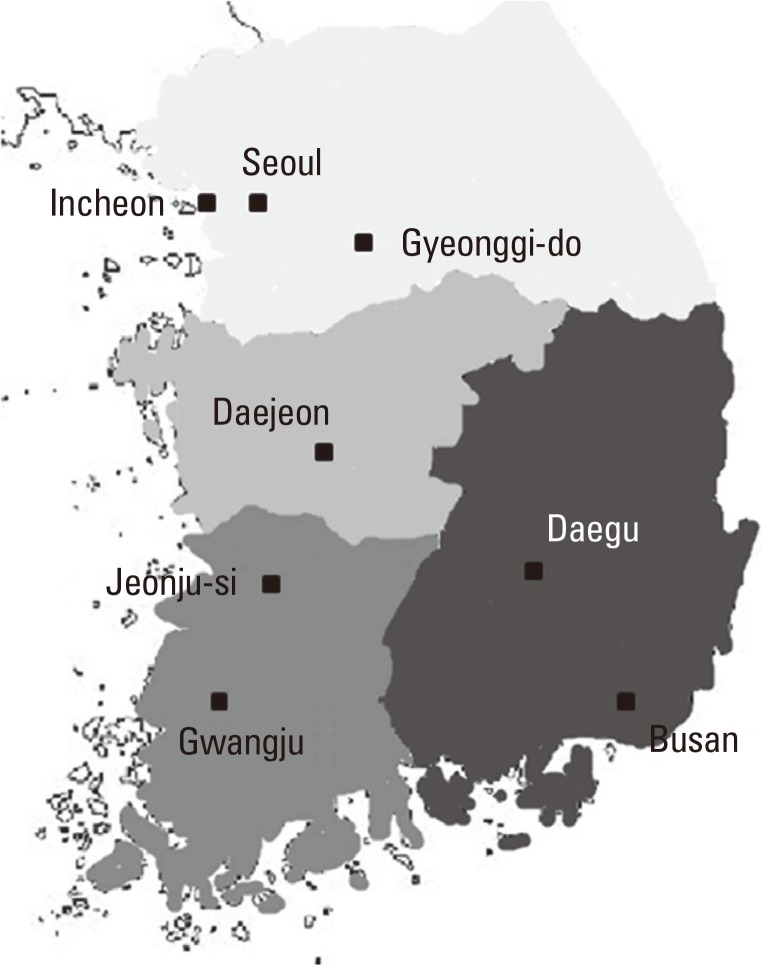
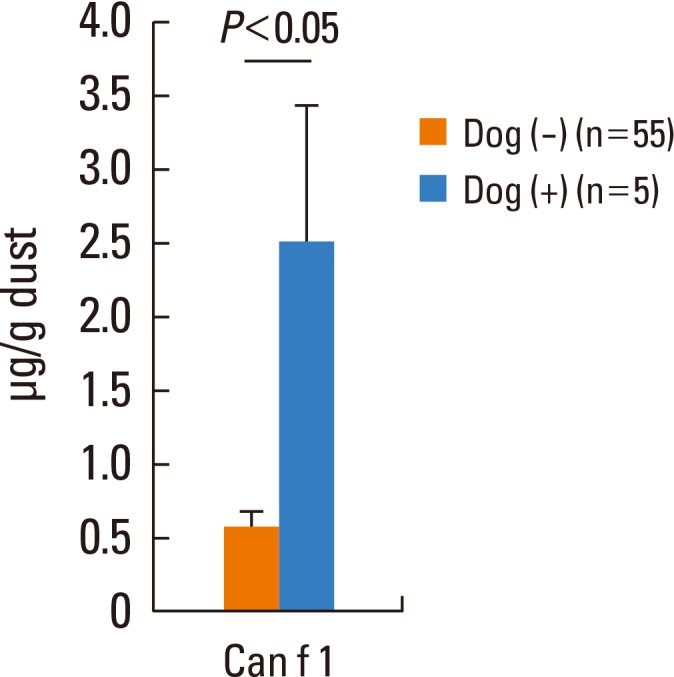
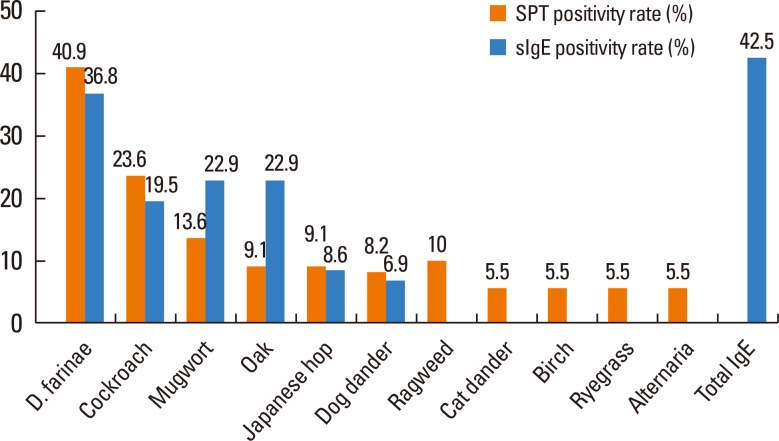
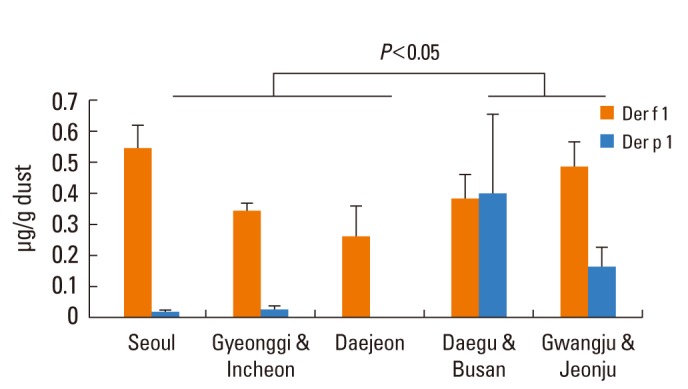
The prevalence of allergic rhinitis and asthma were 25.5% and 7.3%, respectively. The most common sensitized allergens identified by SPT and ImmunoCAP were Dermatophagoides farinae (40.9%, 36.8%), followed by cockroach (23.6%, 19.5%), mugwort (13.6%, 22.9%), oak (9.1%, 22.9%), Japanese hop (9.1%, 8.6%), and dog dander (8.2%, 6.9%). There was a modest discrepancy between SPT and ImmunoCAP. Der f 1 and Der p 1 were detected in 91.7% and 45.0% of the enrolled houses, respectively. Der f 1 indicated high concentrations in all specific provinces in Korea; however, Der p 1 measured high only in the south. Dog dander allergens were present in 71.7% of houses; however, Bla g 1 was present in only 11.7% of houses and Asp f 1 was not detected in any houses.
The most important inhalant allergens in Korea are house dust mites followed by cockroach, mugwort, oak, Japanese hop, and dog dander in indoor environment, in which The dominant species of house dust mites were different according to region.
呼吸过敏性疾病的高发率可能是由于人们更多地接触到吸入性过敏原。我们对韩国各大城市的秋季和冬季进行了一项过敏性疾病调查,并检测了主要的室内过敏原。
我们通过分层、聚类和系统抽样程序,从第四次韩国国家健康和营养检查调查中招募了 110 名受试者。所有参与者都回答了一份健康问卷,还接受了皮肤点刺试验(SPT)和免疫CAP 测试,以检测 11 种主要室内过敏原。我们还使用 2 点 ELISA 从 60 名受试者的家中测量了 5 种主要过敏原(Der f 1、Der p 1、Can f 1、Bla g 1 和 Asp f 1)在室内尘埃中的含量。
过敏性鼻炎和哮喘的患病率分别为 25.5%和 7.3%。通过 SPT 和免疫CAP 鉴定出的最常见致敏过敏原是屋尘螨(40.9%,36.8%),其次是蟑螂(23.6%,19.5%)、艾蒿(13.6%,22.9%)、栎属(9.1%,22.9%)、豚草(9.1%,8.6%)和狗皮屑(8.2%,6.9%)。SPT 和免疫 CAP 之间存在一定差异。在所有入组的房屋中,分别检测到 91.7%和 45.0%的 Der f 1 和 Der p 1。在韩国所有特定省份都检测到高浓度的 Der f 1;然而,只有在南部地区才检测到高浓度的 Der p 1。在 71.7%的房屋中存在狗皮屑过敏原;然而,Bla g 1 仅在 11.7%的房屋中存在,而在任何房屋中都未检测到 Asp f 1。
在韩国,最重要的吸入性过敏原是屋尘螨,其次是蟑螂、艾蒿、栎属、豚草和狗皮屑,在室内环境中,尘螨的优势种因地区而异。