Wu Jiayuan, Hu Liren, Chen Manyu, Cao Wenjun, Chen Haicong, He Taiping
Nutritional Department, the Affiliated Hospital of Guangdong Medical University.
Department of Epidemiology and Health Statistics, School of Public Health, Guangdong Medical University.
Onco Targets Ther. 2016 Jul 14;9:4277-88. doi: 10.2147/OTT.S106508. eCollection 2016.
The expression of pyruvate kinase M2 (PKM2) has been linked to tumor formation and invasion. Specifically, the relationship between high PKM2 expression and prognosis has been evaluated in solid tumors of digestive system. However, the prognostic value of PKM2 remains controversial.
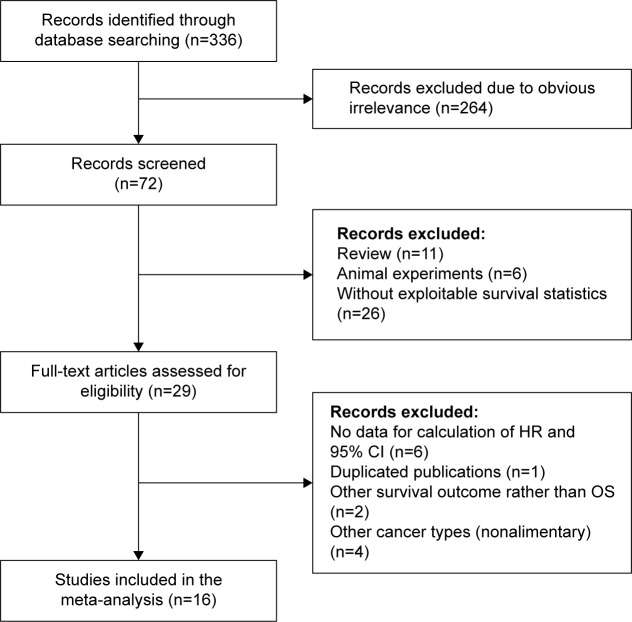
A literature search of PubMed, Embase, and Cochrane databases was conducted until October 2015. The end point focused on overall survival (OS). The pooled hazard ratio (HR) or odds ratio and the 95% confidence intervals were calculated to correlate PKM2 overexpression with OS and clinicopathological characteristics by employing fixed- or random-effects models, depending on the heterogeneity of the included studies.
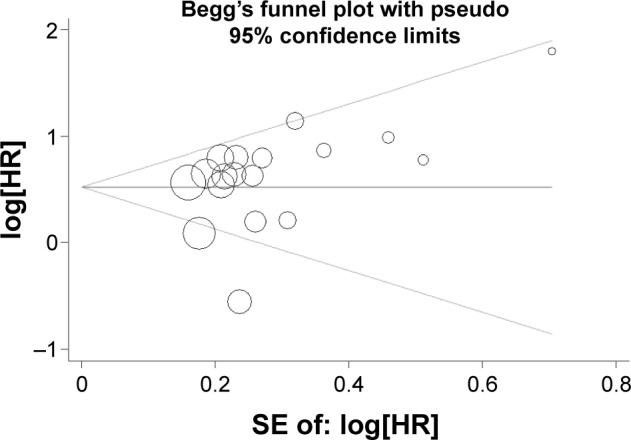
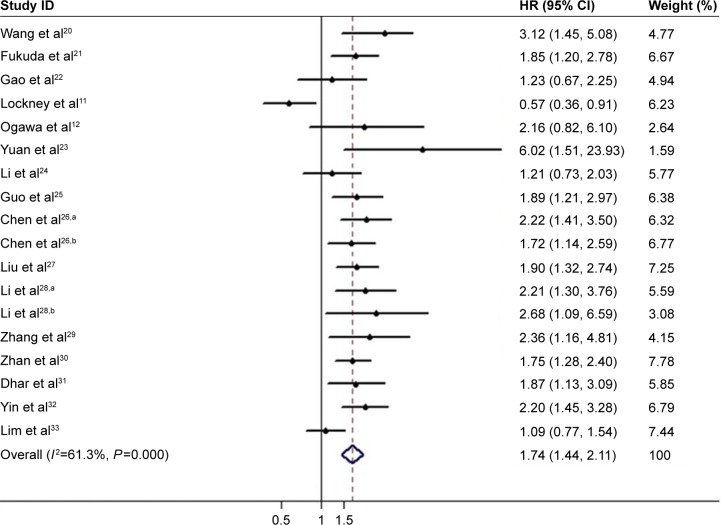
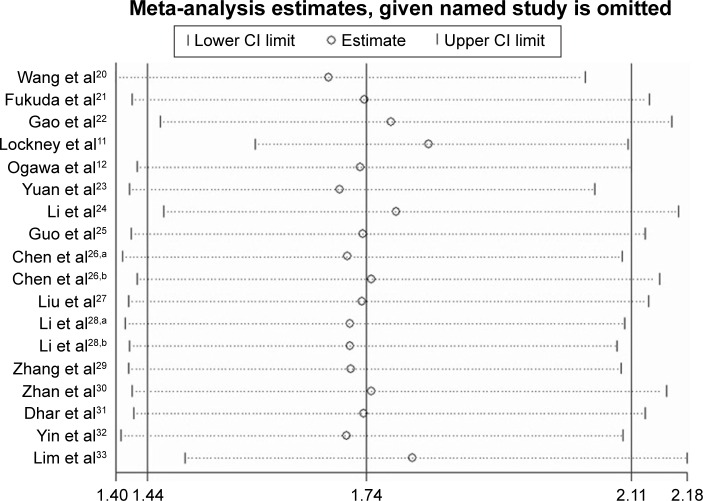
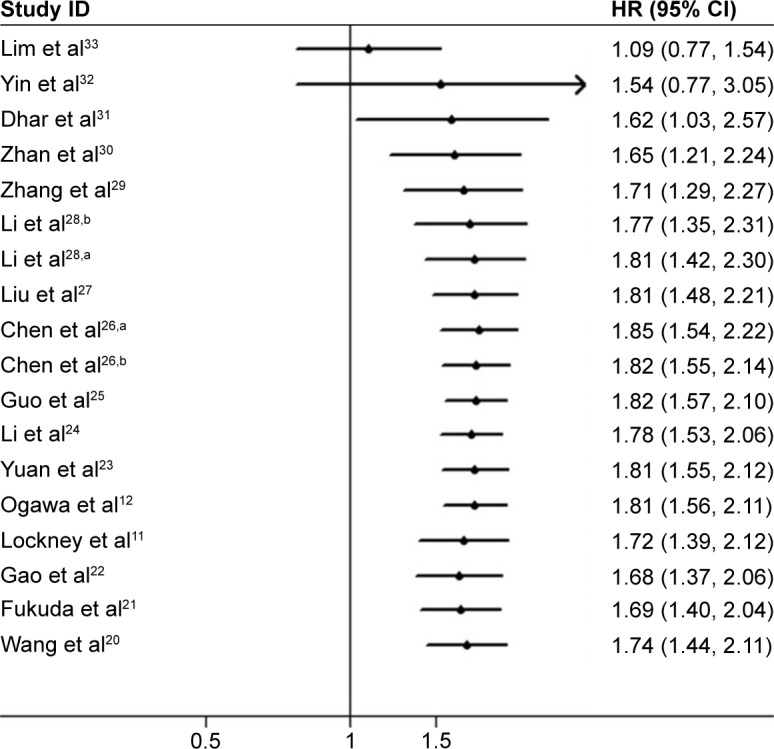
We identified 18 cohorts in 16 studies involving 2,812 patients for this meta-analysis. Overall, the combined HR for OS in all tumor types was 1.74 (1.44-2.11; P<0.001). When stratified by tumor type, the influence of PKM2 expression on poor prognosis was also found in gastric cancer (HR =1.54 [1.08-2.21], P=0.018), esophageal squamous cell carcinoma (HR =1.71 [1.38-2.12], P<0.001), hepatocellular cancer (HR =1.92 [1.52-2.42], P<0.001), biliary cancer (HR =2.11 [1.50-2.95], P<0.001), and oral cancer (HR =3.49 [1.97-6.18], P<0.001), but not in pancreatic ductal adenocarcinoma (HR =1.03 [0.28-3.76], P=0.968). Furthermore, PKM2 overexpression had a negative effect on the late clinical stage of all tumor types except for pancreatic ductal adenocarcinoma. The high density of PKM2 overexpression was significantly associated with some clinical characteristics in different cancer types, such as tumor stage, modal metastasis, and tumor size.
Our findings revealed significant association of PKM2 overexpression with OS and certain clinicopathological features in solid tumors of digestive system, thereby suggesting that PKM2 might be an indicator of poor prognosis in digestive system cancers.
丙酮酸激酶M2(PKM2)的表达与肿瘤形成和侵袭有关。具体而言,已对消化系统实体瘤中PKM2高表达与预后之间的关系进行了评估。然而,PKM2的预后价值仍存在争议。
截至2015年10月,对PubMed、Embase和Cochrane数据库进行了文献检索。终点指标聚焦于总生存期(OS)。根据纳入研究的异质性,采用固定效应模型或随机效应模型计算合并风险比(HR)或比值比以及95%置信区间,以关联PKM2过表达与OS及临床病理特征。
我们在16项研究中确定了18个队列,涉及2812例患者用于此项荟萃分析。总体而言,所有肿瘤类型中OS的合并HR为1.74(1.44 - 2.11;P < 0.001)。按肿瘤类型分层时,在胃癌(HR = 1.54 [1.08 - 2.21],P = 0.018)、食管鳞状细胞癌(HR = 1.71 [1.38 - 2.12],P < 0.001)、肝细胞癌(HR = 1.92 [1.52 - 2.42],P < 0.001)、胆管癌(HR = 2.11 [1.50 - 2.95],P < 0.001)和口腔癌(HR = 3.49 [1.97 - 6.18],P < 0.001)中也发现了PKM2表达对预后不良的影响,但在胰腺导管腺癌中未发现(HR = 1.03 [0.28 - 3.76],P = 0.968)。此外,除胰腺导管腺癌外,PKM2过表达对所有肿瘤类型的晚期临床分期有负面影响。PKM2过表达的高密度与不同癌症类型的一些临床特征显著相关,如肿瘤分期、转移方式和肿瘤大小。
我们的研究结果揭示了PKM2过表达与消化系统实体瘤的OS及某些临床病理特征之间存在显著关联,从而表明PKM2可能是消化系统癌症预后不良的一个指标。