Hanna Ramy Magdy, Yang Wan-Ting, Lopez Eduardo A, Riad Joseph Nabil, Wilson James
Division of Nephrology, Department of Medicine , Cedars-Sinai Medical Center , 8700 Beverly Blvd, Los Angeles, CA , USA.
Division of Nephrology, Department of Medicine , Kaiser Permanente , Fontana, CA , USA.
Clin Kidney J. 2016 Aug;9(4):530-9. doi: 10.1093/ckj/sfw034. Epub 2016 May 24.
Improper correction of hyponatremia can cause severe complications, including osmotic demyelination syndrome (ODS). The Adrogué-Madias equation (AM), the Barsoum-Levine (BL) equation, the Electrolyte Free Water Clearance (EFWC) equation and the Nguyen-Kurtz (NK) equation are four derived equations based on the empirically derived Edelman equation for predicting sodium at a later time (Na2) from a known starting sodium (Na1), fluid/electrolyte composition and input and output volumes.
Our retrospective study included 43 data points from 31 mostly hyponatremic patients. We calculated Na2 based on five sets of rules that were progressively more precisely calculated. Sets A-D included all 31 patients and 43 data points and set E was based on 15 patients and 27 data points.
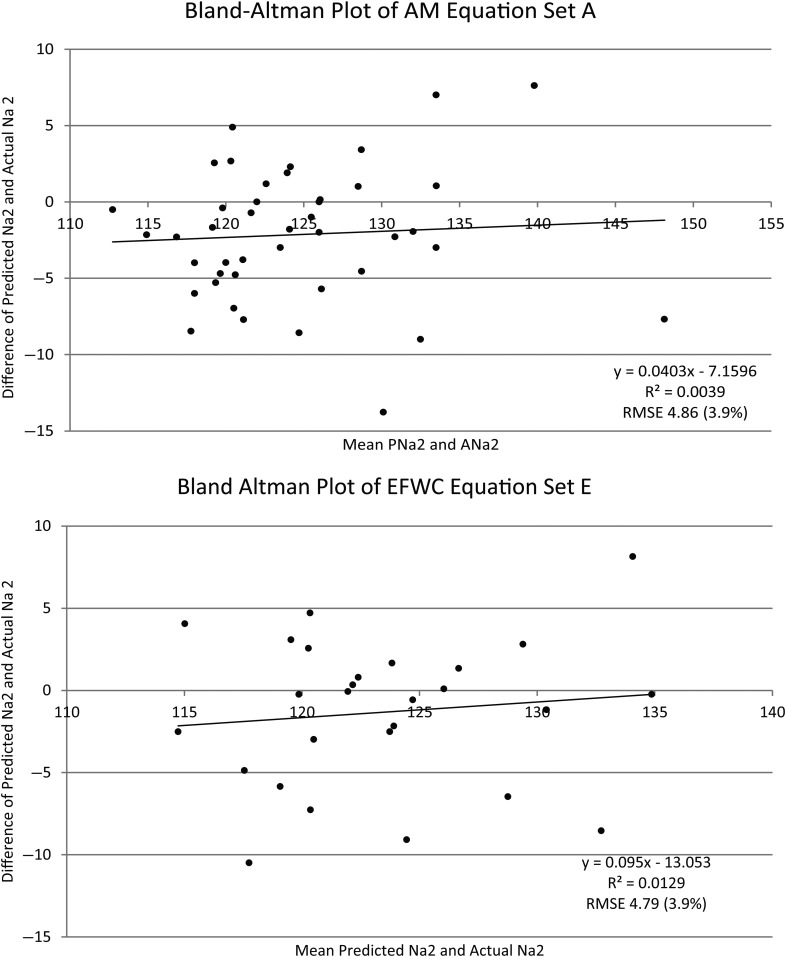
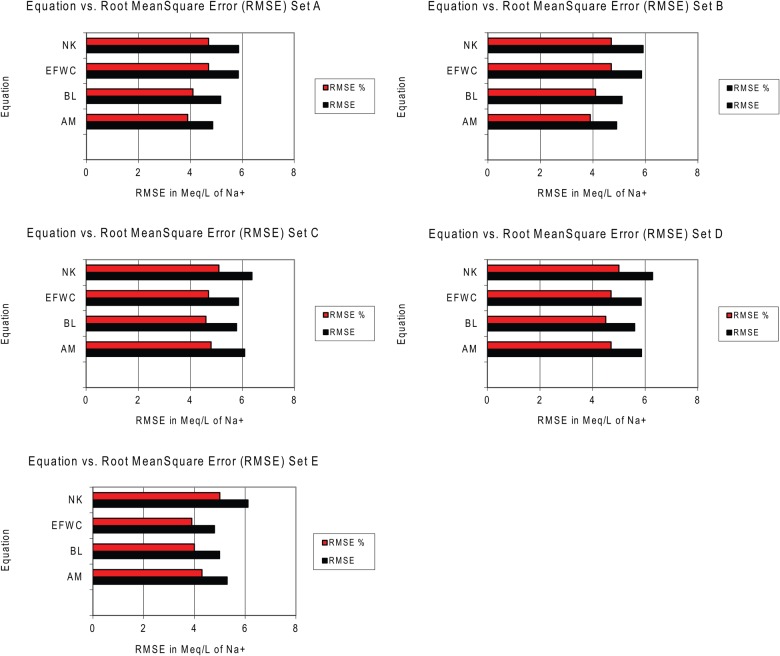
The root mean square error was calculated and found to be between 4.79 and 6.37 mmol/L (mEq/L) for all sets. Bland-Altman analysis showed high variability and discrepancies between the predicted and actual Na2.
Like similar studies in hypernatremic patients, the data suggest that hyponatremic modeling equations are not reliably accurate in predicting Na2 from Na1 and available clinical data regarding sodium, potassium and fluid balance over longer time frames (12-30 h). Our study was retrospective and was done in an inpatient setting and thus was subject to limitations and laboratory measurement variability, but showed that all four equations are not able to reliably predict Na2 from Na1 and inputs across a 12-30 h period.
低钠血症纠正不当可导致严重并发症,包括渗透性脱髓鞘综合征(ODS)。阿德罗格 - 马迪亚斯方程(AM)、巴尔苏姆 - 莱文方程(BL)、电解质自由水清除率(EFWC)方程和阮 - 库尔茨方程(NK)是基于经验推导的埃德尔曼方程得出的四个方程,用于根据已知的起始钠浓度(Na1)、液体/电解质组成以及输入和输出量预测后续某一时刻的钠浓度(Na2)。
我们的回顾性研究纳入了31例主要为低钠血症患者的43个数据点。我们根据五组计算精度逐步提高的规则来计算Na2。A - D组纳入了全部31例患者和43个数据点,E组基于15例患者和27个数据点。
计算了均方根误差,发现所有组的均方根误差在4.79至6.37 mmol/L(mEq/L)之间。布兰德 - 奥特曼分析显示预测的Na2与实际的Na2之间存在很大差异。
与高钠血症患者的类似研究一样,数据表明在较长时间范围(12 - 30小时)内,低钠血症建模方程在根据Na1以及关于钠、钾和液体平衡的可用临床数据预测Na2时并不可靠准确。我们的研究是回顾性的,且在住院环境中进行,因此存在局限性以及实验室测量的变异性,但研究表明,在12 - 30小时期间,所有这四个方程都无法可靠地根据Na1和输入量预测Na2。