Lesmana Cosmas Rinaldi A, Cahyadinata Lidwina, Pakasi Levina S, Lesmana Laurentius A
Digestive Disease & GI Oncology Center, Medistra Hospital, Jakarta, Indonesia; Hepatobiliary Division, Department of Internal Medicine, Cipto Mangunkusumo Hospital, University of Indonesia, Jakarta, Indonesia.
Digestive Disease & GI Oncology Center, Medistra Hospital, Jakarta, Indonesia.
Case Rep Gastroenterol. 2016 Jun 27;10(2):315-22. doi: 10.1159/000447290. eCollection 2016 May-Aug.
Prothrombin complex concentrates (PCCs) containing prothrombin, factors VII, IX, and X, as well as the inhibitors protein C and S have been used as an emergent reversal for oral anticoagulation therapy. The use of PCCs in hepatobiliary disorder patients or patients with liver coagulopathy who need to undergo invasive procedures has not been well studied.
To evaluate the efficacy of PCC treatment in order to control or prevent bleeding complications in patients with liver coagulopathy who undergo various invasive procedures.
This was a prospective, open-label, non-randomized, before-and-after study in patients with hepatobiliary disorders who underwent invasive procedures accompanied by liver impairment and received PCC injection (Cofact(®), Sanquin, The Netherlands). Patients with coagulopathy from various causes were recruited consecutively. Data collected were the episodes of bleeding, liver function test and the international normalized ratio (INR) before and after PCC therapy. The primary endpoint was INR change after treatment, while secondary endpoints included bleeding control and bleeding event after treatment.
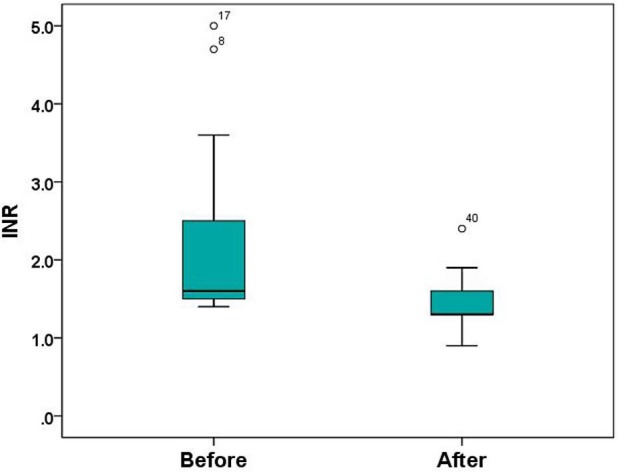
Thirty patients (17 men, 13 women) were enrolled. Patients' mean age was 57.0 + 15.5 years. Liver cirrhosis was found in 14 patients (46.7%). The procedures consisted of liver biopsy, liver abscess aspiration, abdominal paracentesis, therapeutic upper gastrointestinal endoscopy, abdominal surgery, endoscopic retrograde cholangiopancreatography and percutaneous transhepatic biliary drainage. After treatment, 25 patients (83.3%) showed a decreased median INR (from 1.6 to 1.3) (p < 0.001, Wilcoxon's signed-rank test). Five patients failed to show INR reduction. No new bleeding event related to the invasive procedures was observed.
PCC treatment is effective to control and prevent bleeding complications in patients with liver coagulopathy who undergo invasive procedures.
含有凝血酶原、凝血因子 VII、IX 和 X 以及抑制物蛋白 C 和 S 的凝血酶原复合物浓缩剂(PCCs)已被用作口服抗凝治疗的紧急逆转剂。PCCs 在肝胆疾病患者或需要接受侵入性操作的肝脏凝血病患者中的应用尚未得到充分研究。
评估 PCC 治疗对控制或预防接受各种侵入性操作的肝脏凝血病患者出血并发症的疗效。
这是一项前瞻性、开放标签、非随机的前后对照研究,研究对象为患有肝胆疾病且伴有肝功能损害并接受 PCC 注射(Cofact(®),荷兰 Sanquin 公司)的患者,这些患者接受了侵入性操作。连续招募各种原因导致凝血病的患者。收集的数据包括 PCC 治疗前后的出血事件、肝功能检查和国际标准化比值(INR)。主要终点是治疗后 INR 的变化,次要终点包括出血控制和治疗后的出血事件。
共纳入 30 例患者(17 例男性,13 例女性)。患者的平均年龄为 57.0 + 15.5 岁。14 例患者(46.7%)患有肝硬化。操作包括肝活检、肝脓肿穿刺引流、腹腔穿刺术、治疗性上消化道内镜检查、腹部手术、内镜逆行胰胆管造影术和经皮经肝胆道引流术。治疗后,25 例患者(83.3%)的 INR 中位数下降(从 1.6 降至 1.3)(p < 0.001,Wilcoxon 符号秩检验)。5 例患者 INR 未降低。未观察到与侵入性操作相关的新的出血事件。
PCC 治疗对于控制和预防接受侵入性操作的肝脏凝血病患者的出血并发症是有效的。