Lee Hongkyung, Song Jongchan, Kim Yun-Jung, Park Jung-Ki, Kim Hee-Tak
Department of Chemical and Biomolecular Engineering, Korea Advanced Institute of Science and Technology, 291 Daehak-ro, Yuseong-gu, Daejeon, 34141, Republic of Korea.
Sci Rep. 2016 Aug 3;6:30830. doi: 10.1038/srep30830.
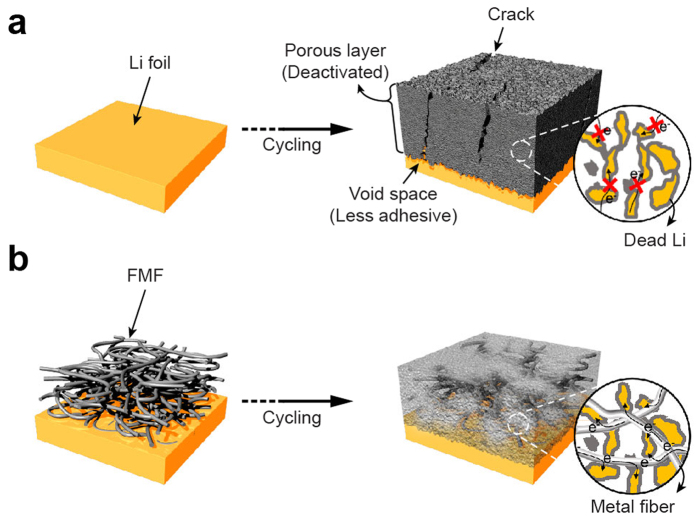
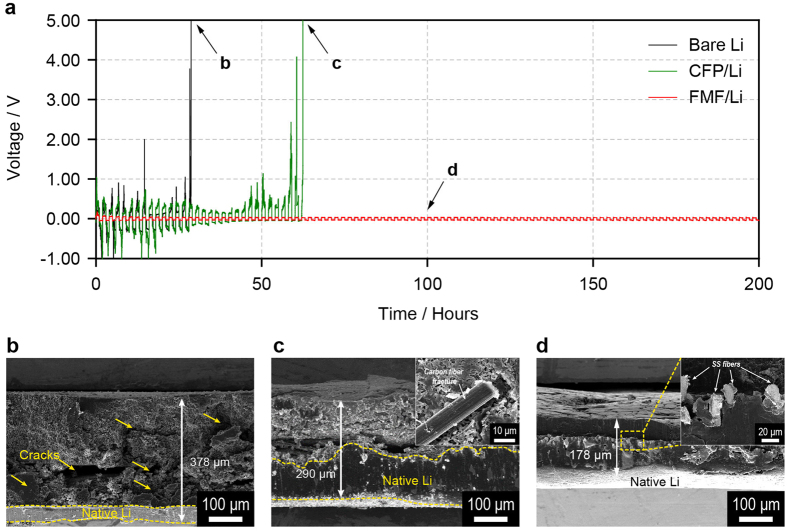
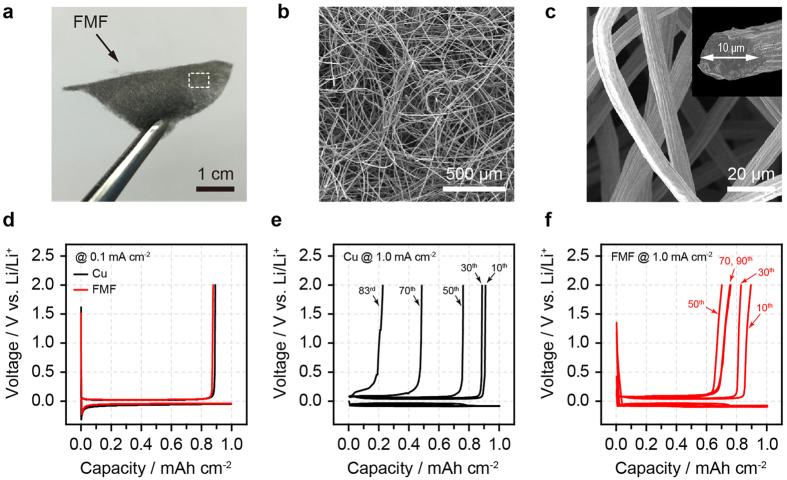
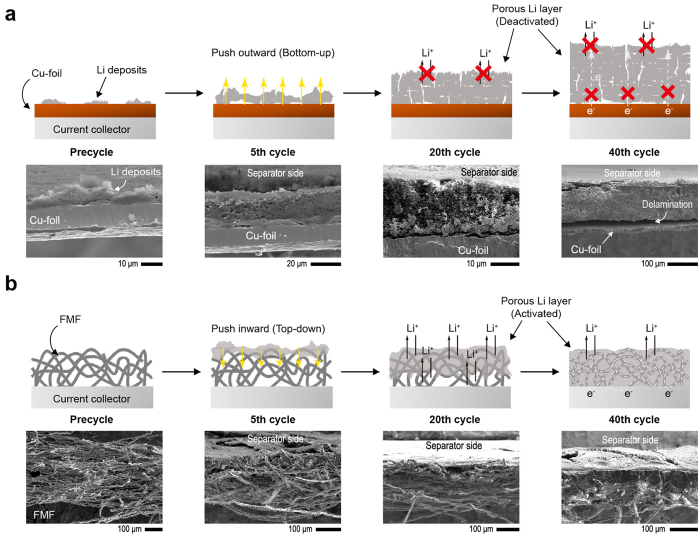
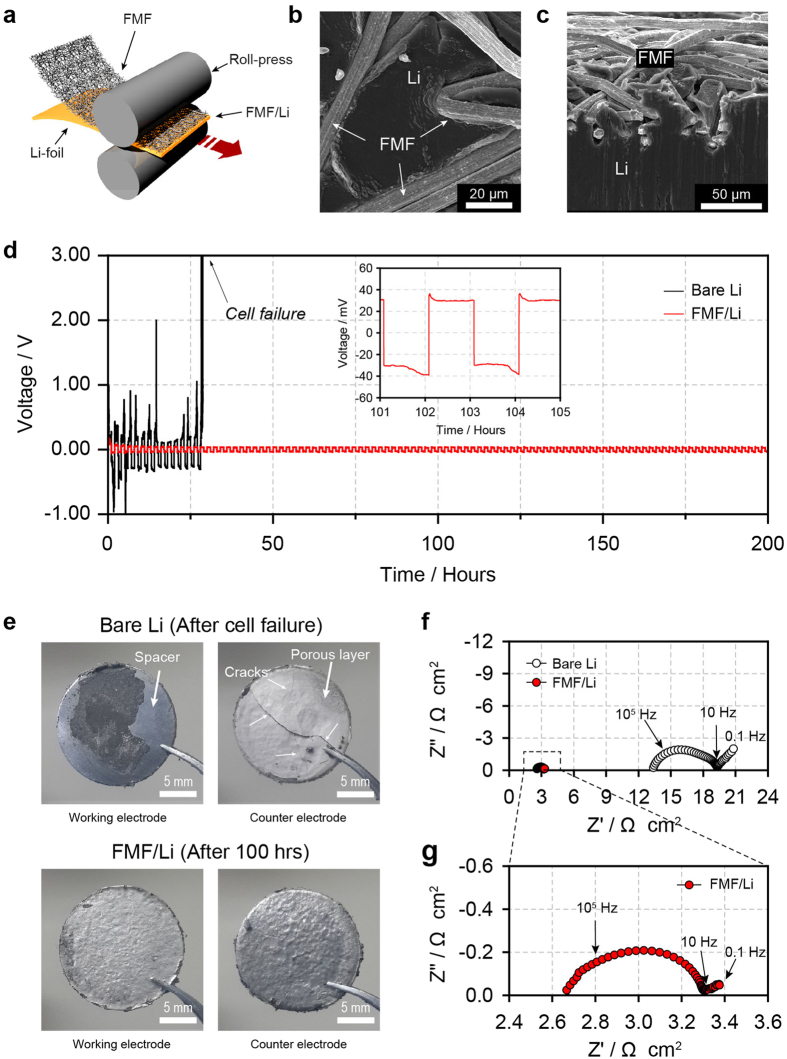
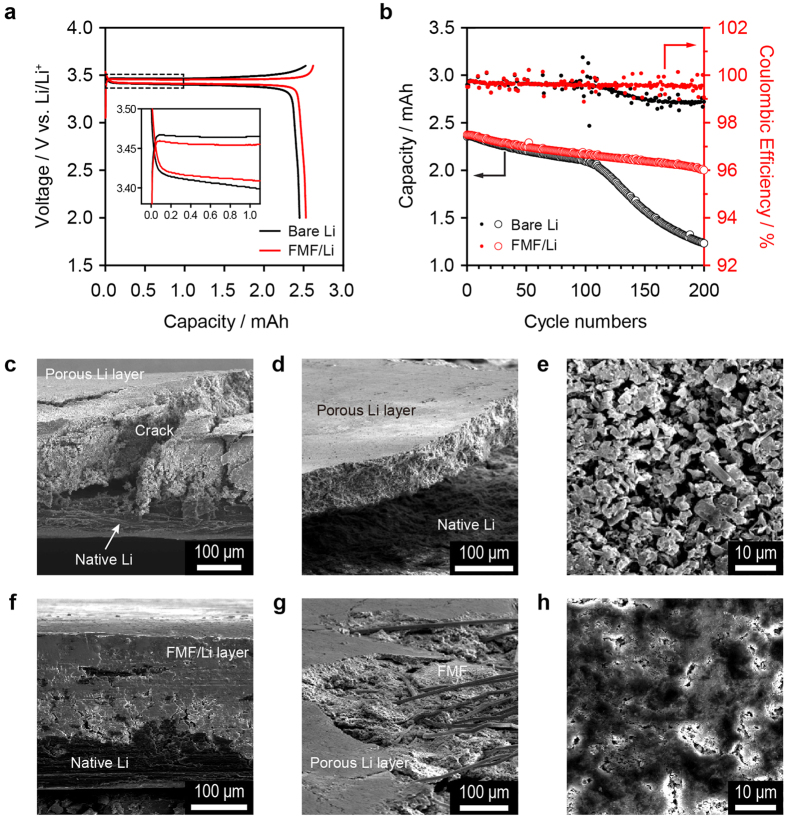
The use of lithium (Li) metal anodes has been reconsidered because of the necessity for a higher energy density in secondary batteries. However, Li metal anodes suffer from 'dead' Li formation and surface deactivation which consequently form a porous layer of redundant Li aggregates. In this work, a fibrous metal felt (FMF) as a three-dimensional conductive interlayer was introduced between the separator and the Li metal anode to improve the reversibility of the Li metal anode. The FMF can facilitate charge transfer in the porous layer, rendering it electrochemically more active. In addition, the FMF acted as a robust scaffold to accommodate Li deposits compactly in its interstitial sites. The FMF-integrated Li metal (FMF/Li) electrode operated with a small polarisation even at a current density of 10 mA cm(-2), and it exhibited a seven times longer cycle-life than that of an FMF-free Li electrode in a symmetric cell configuration. A Li metal battery (LMB) using the FMF/Li electrode and a LiFePO4 electrode exhibited a two-fold increase in cycling stability compared with that of a bare Li metal electrode, demonstrating the practical effectiveness of this approach for high performance LMBs.
由于二次电池需要更高的能量密度,锂(Li)金属阳极的使用已被重新考虑。然而,锂金属阳极存在“死”锂形成和表面失活的问题,这会导致形成一层由多余锂聚集体组成的多孔层。在这项工作中,在隔膜和锂金属阳极之间引入了一种纤维金属毡(FMF)作为三维导电中间层,以提高锂金属阳极的可逆性。FMF可以促进多孔层中的电荷转移,使其在电化学上更具活性。此外,FMF作为一个坚固的支架,将锂沉积物紧密地容纳在其间隙位置。集成了FMF的锂金属(FMF/Li)电极即使在10 mA cm(-2)的电流密度下也能以较小的极化运行,并且在对称电池配置中,其循环寿命比无FMF的锂电极长七倍。使用FMF/Li电极和LiFePO4电极的锂金属电池(LMB)与裸锂金属电极相比,循环稳定性提高了两倍,证明了这种方法对高性能LMB的实际有效性。