Morton Andrew, Murawski Caroline, Pulver Stefan R, Gather Malte C
Organic Semiconductor Centre, SUPA, School of Physics and Astronomy, University of St Andrews, North Haugh, St Andrews KY16 9SS, United Kingdom.
Institut für Angewandte Photophysik, Technische Universität Dresden, George-Bähr-Str. 1, 01062 Dresden, Germany.
Sci Rep. 2016 Aug 3;6:31117. doi: 10.1038/srep31117.
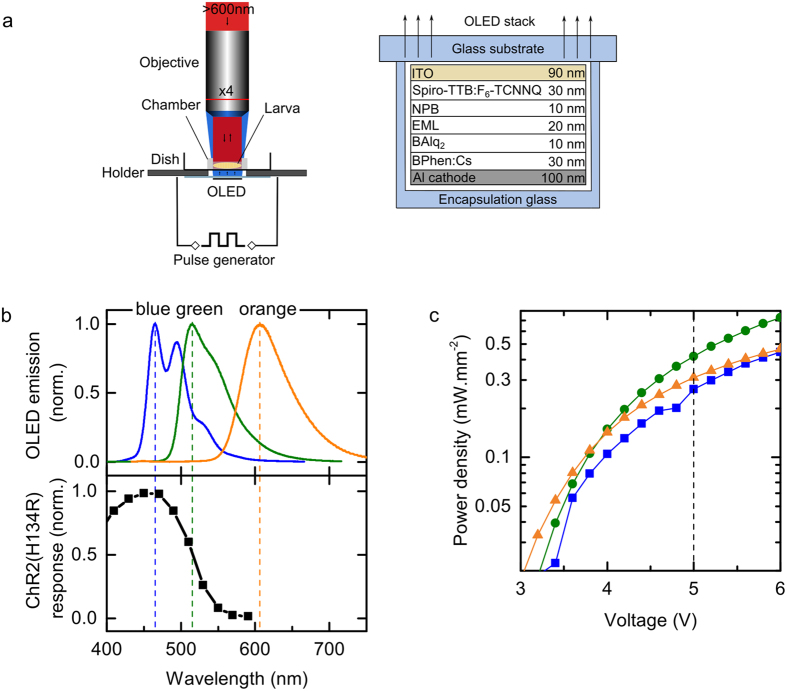
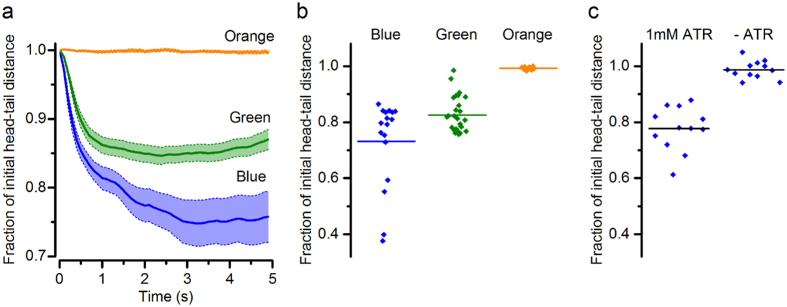
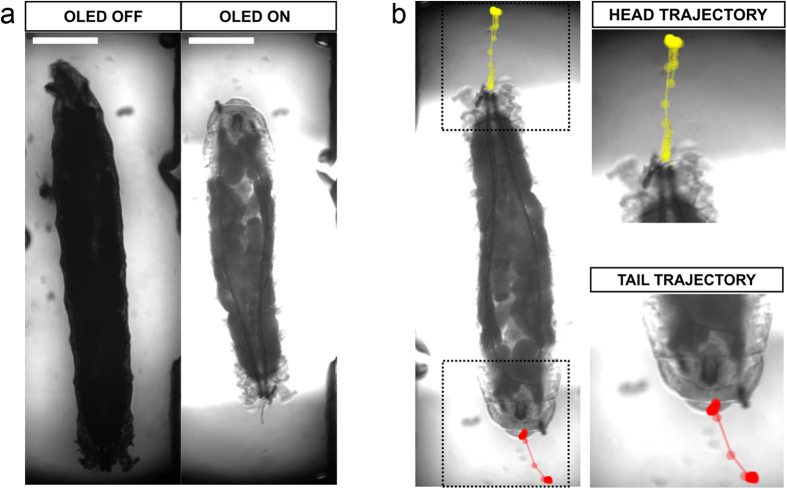
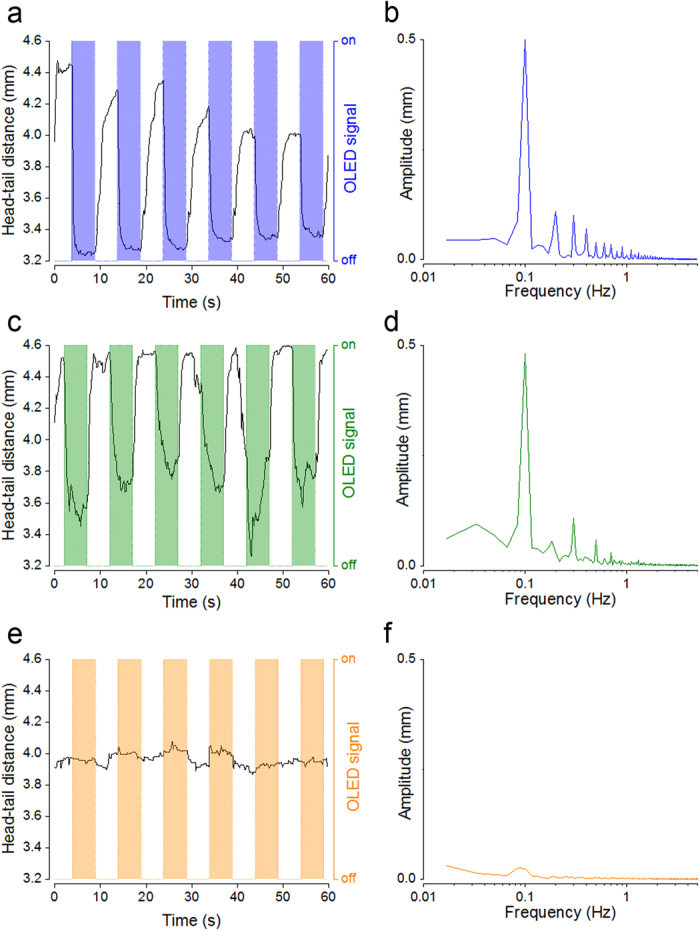
Organic light emitting diodes (OLEDs) are in widespread use in today's mobile phones and are likely to drive the next generation of large area displays and solid-state lighting. Here we show steps towards their utility as a platform technology for biophotonics, by demonstrating devices capable of optically controlling behaviour in live animals. Using devices with a pin OLED architecture, sufficient illumination intensity (0.3 mW.mm(-2)) to activate channelrhodopsins (ChRs) in vivo was reliably achieved at low operating voltages (5 V). In Drosophila melanogaster third instar larvae expressing ChR2(H134R) in motor neurons, we found that pulsed illumination from blue and green OLEDs triggered robust and reversible contractions in animals. This response was temporally coupled to the timing of OLED illumination. With blue OLED illumination, the initial rate and overall size of the behavioural response was strongest. Green OLEDs achieved roughly 70% of the response observed with blue OLEDs. Orange OLEDs did not produce contractions in larvae, in agreement with the spectral response of ChR2(H134R). The device configuration presented here could be modified to accommodate other small model organisms, cell cultures or tissue slices and the ability of OLEDs to provide patterned illumination and spectral tuning can further broaden their utility in optogenetics experiments.
有机发光二极管(OLED)在当今的手机中得到了广泛应用,并且很可能推动下一代大面积显示屏和固态照明的发展。在此,我们展示了将其用作生物光子学平台技术的一些步骤,通过展示能够光学控制活体动物行为的器件来实现。使用具有针状OLED结构的器件,在低工作电压(5V)下可靠地实现了足以在体内激活通道视紫红质(ChR)的光照强度(0.3 mW·mm⁻²)。在运动神经元中表达ChR2(H134R)的黑腹果蝇三龄幼虫中,我们发现来自蓝色和绿色OLED的脉冲光照引发了动物强烈且可逆的收缩。这种反应在时间上与OLED光照的时间同步。使用蓝色OLED光照时,行为反应的初始速率和总体大小最强。绿色OLED实现了蓝色OLED所观察到反应的约70%。橙色OLED未在幼虫中产生收缩,这与ChR2(H134R)的光谱响应一致。此处展示的器件配置可以进行修改,以适应其他小型模式生物、细胞培养物或组织切片,并且OLED提供图案化光照和光谱调谐的能力可以进一步拓宽它们在光遗传学实验中的应用。