Thiel Ansgar, Thedinga Hendrik K, Thomas Samantha L, Barkhoff Harald, Giel Katrin E, Schweizer Olesia, Thiel Syra, Zipfel Stephan
Institute of Sport Science, Eberhard Karls University of Tübingen, Tübingen, Germany.
Centre for Population Health Research, Faculty of Health and Social Development, Deakin University, Melbourne, Australia.
BMC Public Health. 2016 Aug 2;16:689. doi: 10.1186/s12889-016-3392-3.
Physical inactivity is one of the biggest health problems nowadays. Recent research shows that socio-cultural barriers to physical activity are mostly related to modern lifestyles. However, there is a lack of research on how social and group dynamics influence engagement in physical activity. Furthermore, there are few cross-cultural studies that have compared the social dynamics of (in)activity in different cultural settings. This paper therefore aims to analyse how social group dynamics influence physical activity and inactivity in informal social environments and whether physical activity is influenced by the socio-cultural settings.
The paper presents the qualitative data collected within a covert participant observation study. Data was collected by keeping observational notes in order to record typical, regular patterns regarding physical (in)activity related behaviour of groups at an artificial open air swimming pool in Germany and a natural pond in Hawai'i. The data collection period was eight and a half months. Data was interpreted based on constant comparative analysis in order to identify most generative patterns in the field notes.
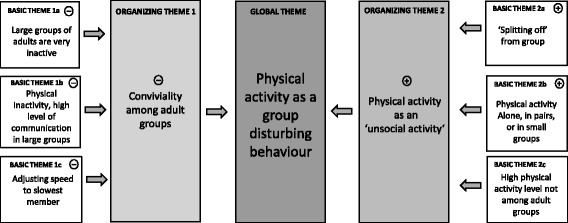
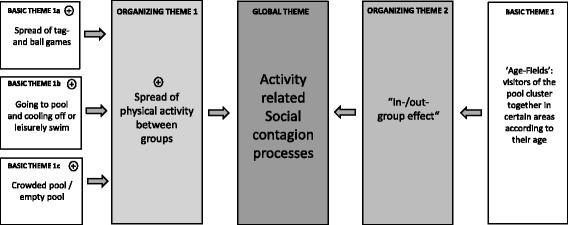
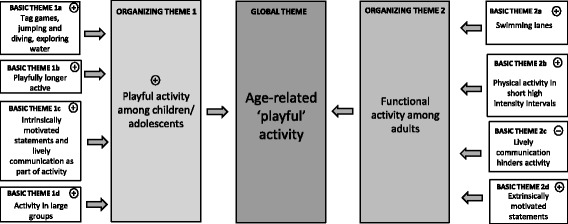
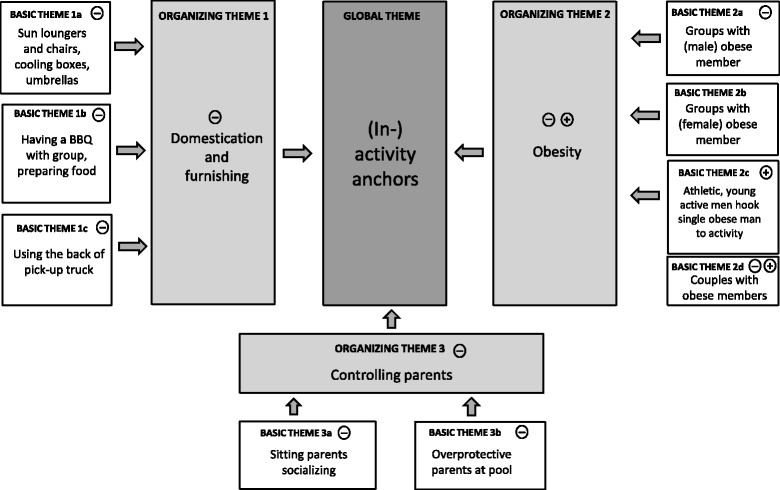
Group structures appear to play a significant role regarding the activity of the group members. In this study, we identified four key factors that influence group based physical activity: 1) Physical activity seems to be a group disturbing behaviour particularly in larger groups of adults; 2) Physical activity appears to be more functional and less joyful in adults than in children; 3) Group activity is influenced by (in)activity anchors, including 'domestication' of a group's site, obesity, and controlling parents. 4) Physical activity is to a certain extent socially contagious, particularly with regard to playful activities.
Successful promotion of physical activity should target the social structures of inactive individuals' groups. In this regard, one of the main problems is that fun and wellbeing, as very important targets of public health strategies for the adult population, appear not to be compatible with physical activity. Developing strategies to reframe physical activity rather as 'fun' and less as functional may be one way to engage inactive individuals in physical activity in leisure settings.
缺乏体育锻炼是当今最大的健康问题之一。最近的研究表明,体育活动的社会文化障碍大多与现代生活方式有关。然而,关于社会和群体动态如何影响体育活动参与度的研究却很匮乏。此外,很少有跨文化研究比较不同文化背景下(不)活动的社会动态。因此,本文旨在分析社会群体动态如何影响非正式社会环境中的体育活动和不活动情况,以及体育活动是否受到社会文化背景的影响。
本文呈现了在一项隐蔽参与观察研究中收集的定性数据。通过记录观察笔记来收集数据,以记录德国一个人工露天游泳池和夏威夷一个天然池塘中群体与体育(不)活动相关行为的典型、常规模式。数据收集期为八个半月。基于持续比较分析对数据进行解读,以识别田野笔记中最具生成性的模式。
群体结构似乎在群体成员的活动中起着重要作用。在本研究中,我们确定了影响基于群体的体育活动的四个关键因素:1)体育活动似乎是一种干扰群体的行为,尤其是在较大的成年人群体中;2)与儿童相比,成年人的体育活动似乎功能性更强而乐趣更少;3)群体活动受到(不)活动锚点的影响,包括群体活动场所的“家庭化”、肥胖以及控制欲强的父母。4)体育活动在一定程度上具有社会传染性,尤其是在趣味性活动方面。
成功推广体育活动应针对不活跃个体群体的社会结构。在这方面,主要问题之一是,作为针对成年人群体的公共卫生策略的非常重要目标的乐趣和幸福感,似乎与体育活动不相容。制定策略将体育活动更多地重新定义为“有趣”而非功能性的,可能是让不活跃个体在休闲环境中参与体育活动的一种方式。