Leitsch David, Müller Joachim, Müller Norbert
Institute of Parasitology, Vetsuisse Faculty, University of Bern, Länggassstrasse 122, CH-3012, Bern, Switzerland; Institute of Specific Prophylaxis and Tropical Medicine, Medical University of Vienna, Kinderspitalgasse 15, A-1090, Vienna, Austria.
Institute of Parasitology, Vetsuisse Faculty, University of Bern, Länggassstrasse 122, CH-3012, Bern, Switzerland.
Int J Parasitol Drugs Drug Resist. 2016 Dec;6(3):148-153. doi: 10.1016/j.ijpddr.2016.07.003. Epub 2016 Jul 22.
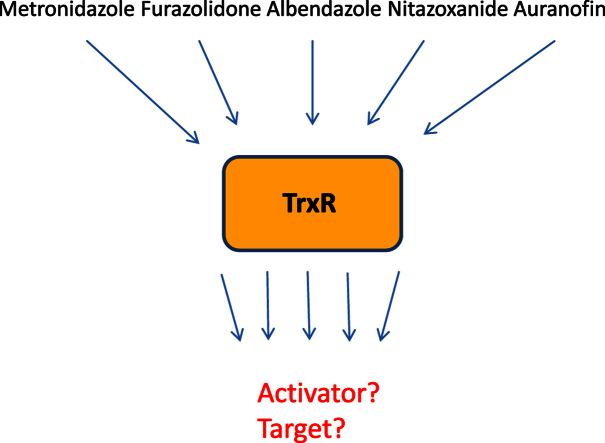
The antioxidative enzyme thioredoxin reductase (TrxR) has been suggested to be a drug target in several pathogens, including the protist parasite Giardia lamblia. TrxR is also believed to catalyse the reduction of nitro drugs, e.g. metronidazole and furazolidone, a reaction required to render these compounds toxic to G. lamblia and other microaerophiles/anaerobes. It was the objective of this study to assess the potential of TrxR as a drug target in G. lamblia and to find direct evidence for the role of this enzyme in the activation of metronidazole and other nitro drugs. TrxR was overexpressed approximately 10-fold in G. lamblia WB C6 cells by placing the trxR gene behind the arginine deiminase (ADI) promoter on a plasmid. Likewise, a mutant TrxR with a defective disulphide reductase catalytic site was strongly expressed in another G. lamblia WB C6 cell line. Susceptibilities to five antigiardial drugs, i.e. metronidazole, furazolidone, nitazoxanide, albendazole and auranofin were determined in both transfectant cell lines and compared to wildtype. Further, the impact of all five drugs on TrxR activity in vivo was measured. Overexpression of TrxR rendered G. lamblia WB C6 more susceptible to metronidazole and furazolidone but not to nitazoxanide, albendazole, and auranofin. Of all five drugs tested, only auranofin had an appreciably negative effect on TrxR activity in vivo, albeit to a much smaller extent than expected. Overexpression of TrxR and mutant TrxR had hardly any impact on growth of G. lamblia WB C6, although the enzyme also exerts a strong NADPH oxidase activity which is a source of oxidative stress. Our results constitute first direct evidence for the notion that TrxR is an activator of metronidazole and furazolidone but rather question that it is a relevant drug target of presently used antigiardial drugs.
抗氧化酶硫氧还蛋白还原酶(TrxR)已被认为是包括原生动物寄生虫蓝氏贾第鞭毛虫在内的多种病原体的药物靶点。TrxR还被认为可催化硝基药物的还原反应,例如甲硝唑和呋喃唑酮,这一反应是使这些化合物对蓝氏贾第鞭毛虫和其他微需氧菌/厌氧菌产生毒性所必需的。本研究的目的是评估TrxR作为蓝氏贾第鞭毛虫药物靶点的潜力,并找到该酶在甲硝唑和其他硝基药物活化中作用的直接证据。通过将trxR基因置于质粒上的精氨酸脱亚氨酶(ADI)启动子之后,TrxR在蓝氏贾第鞭毛虫WB C6细胞中过表达了约10倍。同样,具有缺陷二硫键还原酶催化位点的突变型TrxR在另一株蓝氏贾第鞭毛虫WB C6细胞系中强烈表达。在这两种转染细胞系中测定了对五种抗贾第鞭毛虫药物,即甲硝唑、呋喃唑酮、硝唑尼特、阿苯达唑和金诺芬的敏感性,并与野生型进行比较。此外,还测定了所有五种药物对体内TrxR活性的影响。TrxR的过表达使蓝氏贾第鞭毛虫WB C6对甲硝唑和呋喃唑酮更敏感,但对硝唑尼特、阿苯达唑和金诺芬不敏感。在所有测试的五种药物中,只有金诺芬对体内TrxR活性有明显的负面影响,尽管程度比预期小得多。TrxR和突变型TrxR的过表达对蓝氏贾第鞭毛虫WB C6的生长几乎没有影响,尽管该酶也具有很强的NADPH氧化酶活性,这是氧化应激的一个来源。我们的结果首次直接证明了TrxR是甲硝唑和呋喃唑酮的激活剂,但对其是否是目前使用的抗贾第鞭毛虫药物的相关药物靶点提出了质疑。