Grubesic Tony H, Wei Ran, Murray Alan T, Pridemore William Alex
Center for Spatial Reasoning & Policy Analytics, College of Public Service & Community Solutions, Arizona State University, 411 N. Central Ave, Suite 600, Phoenix, AZ 85004 USA.
Department of Geography, University of Utah, 260 S. Central Campus Dr., Salt Lake City, Utah 84112 USA.
Popul Health Metr. 2016 Aug 2;14:25. doi: 10.1186/s12963-016-0097-x. eCollection 2016.
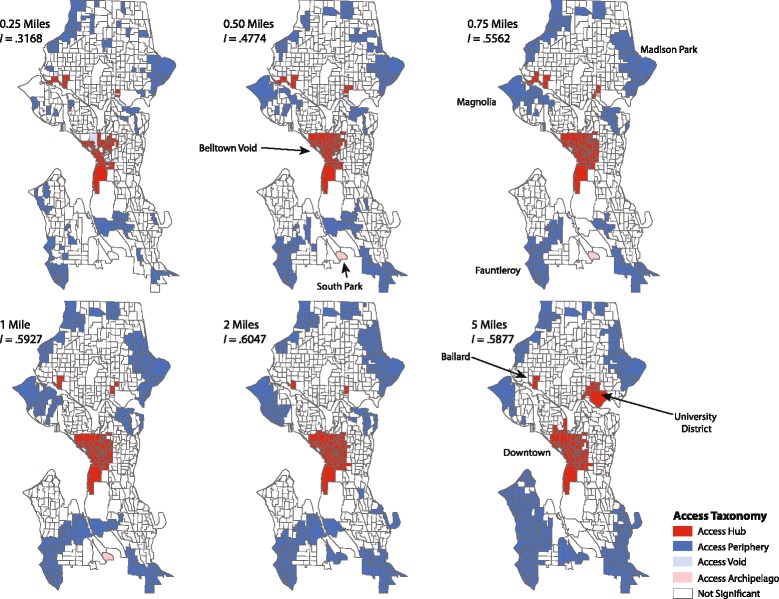
A growing body of research recommends controlling alcohol availability to reduce harm. Various common approaches, however, provide dramatically different pictures of the physical availability of alcohol. This limits our understanding of the distribution of alcohol access, the causes and consequences of this distribution, and how best to reduce harm. The aim of this study is to introduce both a gravity potential measure of access to alcohol outlets, comparing its strengths and weaknesses to other popular approaches, and an empirically-derived taxonomy of neighborhoods based on the type of alcohol access they exhibit.
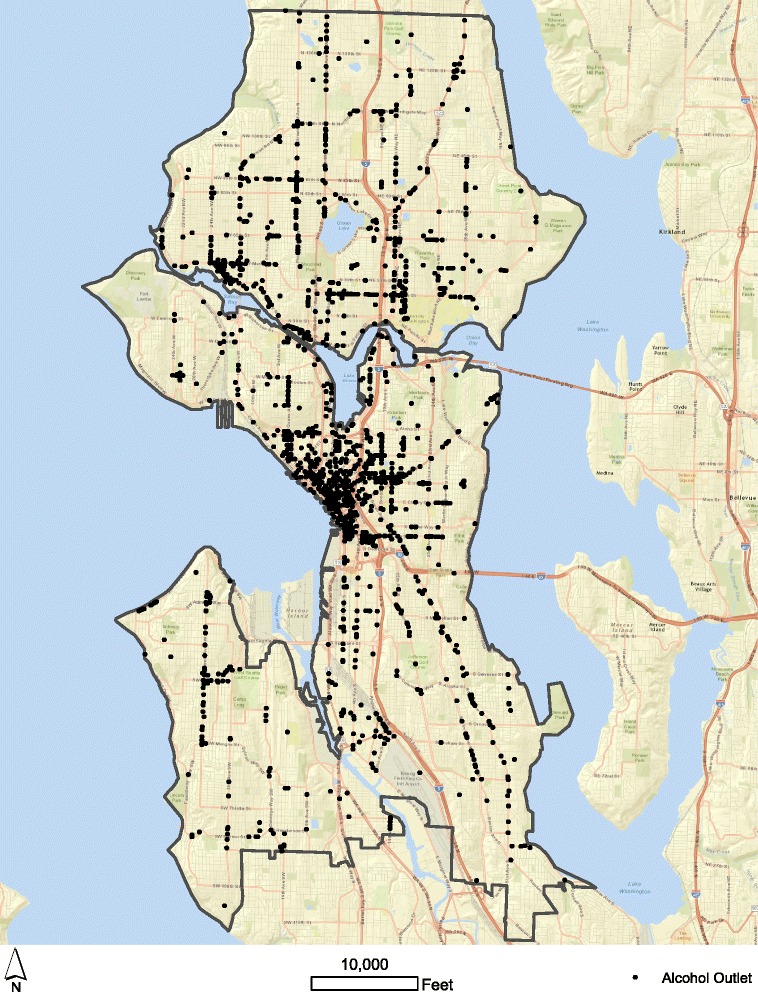
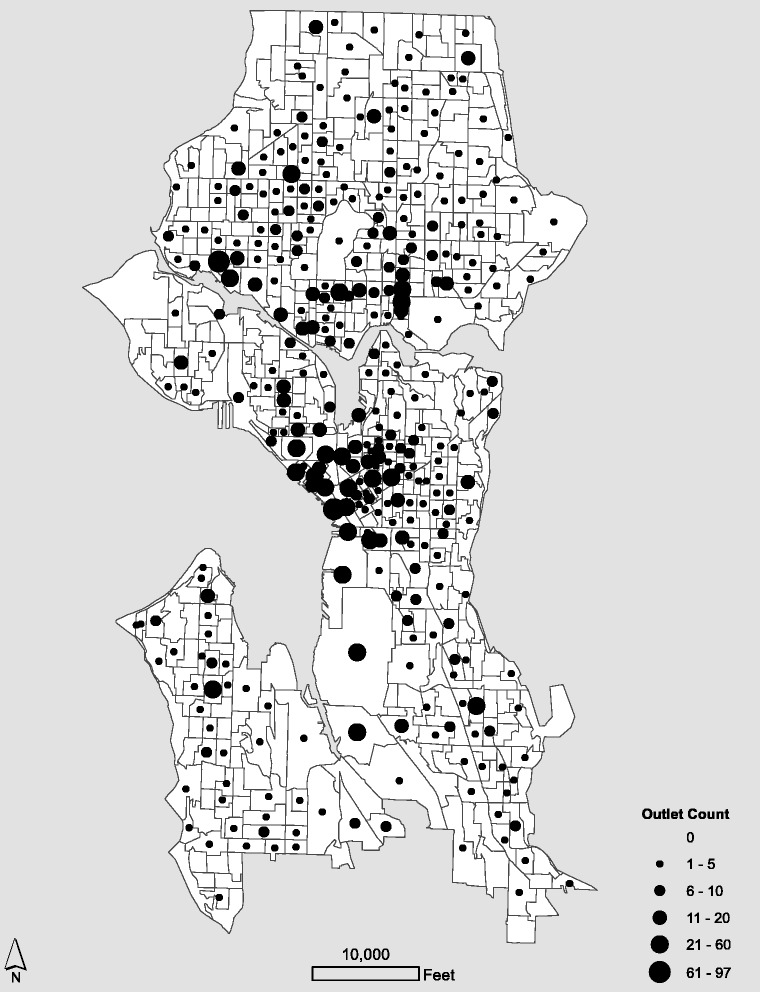
We obtained geospatial data on Seattle, including the location of 2402 alcohol outlets, United States Census Bureau estimates on 567 block groups, and a comprehensive street network. We used exploratory spatial data analysis and employed a measure of inter-rater agreement to capture differences in our taxonomy of alcohol availability measures.
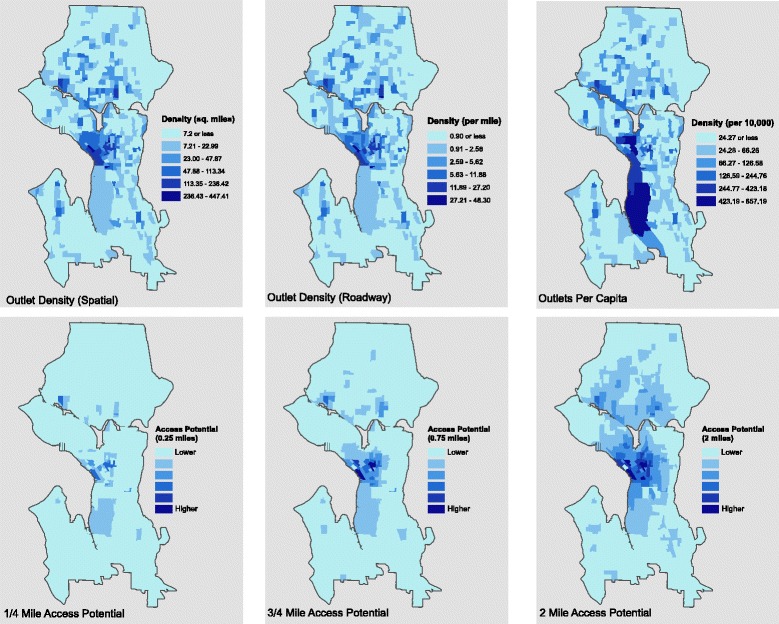
Significant statistical and spatial variability exists between measures of alcohol access, and these differences have meaningful practical implications. In particular, standard measures of outlet density (e.g., spatial, per capita, roadway miles) can lead to biased estimates of physical availability that over-emphasize the influence of the control variables. Employing a gravity potential approach provides a more balanced, geographically-sensitive measure of access to alcohol outlets.
Accurately measuring the physical availability of alcohol is critical for understanding the causes and consequences of its distribution and for developing effective evidence-based policy to manage the alcohol outlet licensing process. A gravity potential model provides a superior measure of alcohol access, and the alcohol access-based taxonomy a helpful evidence-based heuristic for scholars and local policymakers.
越来越多的研究建议控制酒精供应以减少危害。然而,各种常见方法对酒精的实际可得性呈现出截然不同的情况。这限制了我们对酒精获取分布情况、这种分布的原因和后果以及如何最好地减少危害的理解。本研究的目的是引入一种衡量酒精销售点可达性的引力势能指标,将其优缺点与其他常用方法进行比较,并基于社区所呈现的酒精获取类型建立一种基于实证的社区分类法。
我们获取了西雅图的地理空间数据,包括2402个酒精销售点的位置、美国人口普查局对567个普查街区组的估计数据以及一个全面的街道网络。我们使用探索性空间数据分析,并采用评分者间一致性度量来捕捉我们在酒精可得性度量分类法中的差异。
酒精获取度量之间存在显著的统计和空间变异性,这些差异具有重要的实际意义。特别是,销售点密度的标准度量(例如空间密度、人均密度、道路里程密度)可能导致对实际可得性的偏差估计,过度强调了控制变量的影响。采用引力势能方法可以提供一种更平衡、对地理因素更敏感的酒精销售点可达性度量。
准确测量酒精的实际可得性对于理解其分布的原因和后果以及制定有效的循证政策来管理酒精销售点许可程序至关重要。引力势能模型提供了一种更好的酒精获取度量,基于酒精获取的分类法为学者和地方政策制定者提供了一种有用的循证启发式方法。