Geographic Information Systems and Spatial Analysis Laboratory, College of Information Science and Technology, Drexel University, Philadelphia, PA 19104, USA.
BMC Public Health. 2012 Nov 21;12:1015. doi: 10.1186/1471-2458-12-1015.
With Pennsylvania currently considering a move away from an Alcohol Beverage Control state to a privatized alcohol distribution system, this study uses a spatial analytical approach to examine potential impacts of privatization on the number and spatial distribution of alcohol outlets in the city of Philadelphia over a long time horizon.
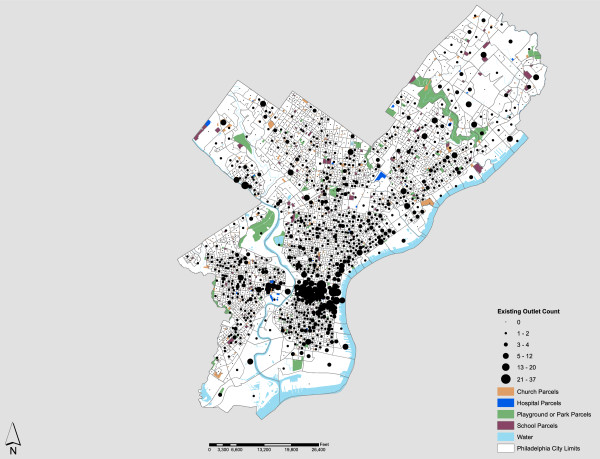
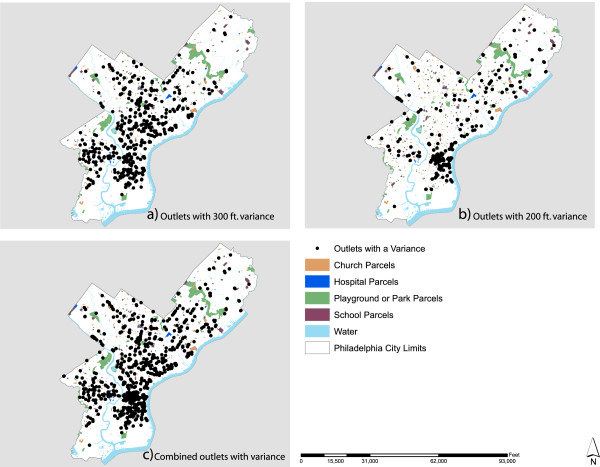
A suite of geospatial data were acquired for Philadelphia, including 1,964 alcohol outlet locations, 569,928 land parcels, and school, church, hospital, park and playground locations. These data were used as inputs for exploratory spatial analysis to estimate the expected number of outlets that would eventually operate in Philadelphia. Constraints included proximity restrictions (based on current ordinances regulating outlet distribution) of at least 200 feet between alcohol outlets and at least 300 feet between outlets and schools, churches, hospitals, parks and playgrounds.
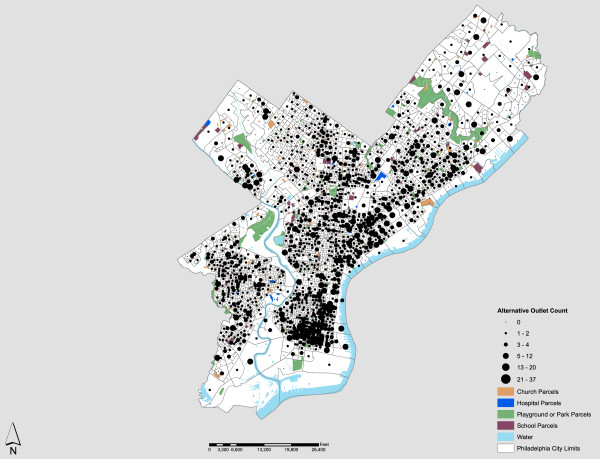
Findings suggest that current state policies on alcohol outlet distributions in Philadelphia are loosely enforced, with many areas exhibiting extremely high spatial densities of outlets that violate existing proximity restrictions. The spatial model indicates that an additional 1,115 outlets could open in Philadelphia if privatization was to occur and current proximity ordinances were maintained.
The study reveals that spatial analytical approaches can function as an excellent tool for contingency-based "what-if" analysis, providing an objective snapshot of potential policy outcomes prior to implementation. In this case, the likely outcome is a tremendous increase in alcohol outlets in Philadelphia, with concomitant negative health, crime and quality of life outcomes that accompany such an increase.
宾夕法尼亚州目前正在考虑从酒类管制州转变为私有化的酒精分销系统,本研究使用空间分析方法,在较长时间内考察私有化对费城酒类销售点数量和空间分布的潜在影响。
为费城获取了一套地理空间数据,包括 1964 个酒类销售点位置、569928 个地块以及学校、教堂、医院、公园和游乐场的位置。这些数据被用作探索性空间分析的输入,以估计在费城最终将运营的预期销售点数。约束条件包括在酒类销售点之间至少 200 英尺和在销售点与学校、教堂、医院、公园和游乐场之间至少 300 英尺的接近限制(基于当前规范管制销售点分布的法规)。
研究结果表明,费城现行的酒类销售点分布州政策执行不严,许多地区的销售点密度极高,违反了现有的接近限制。空间模型表明,如果私有化并且维持现有的接近条例,费城可能会再开设 1115 个销售点。
该研究表明,空间分析方法可以作为基于应急情况的“假设”分析的优秀工具,在实施之前提供潜在政策结果的客观快照。在这种情况下,可能的结果是费城酒类销售点数量的大幅增加,随之而来的是对健康、犯罪和生活质量的负面影响。