Maben Zachary J, Malik Sundeep, Jiang Liyi H, Hinkle Patricia M
Department of Pharmacology and Physiology, University of Rochester Medical Center , Rochester, NY , USA.
Front Endocrinol (Lausanne). 2016 Jul 18;7:96. doi: 10.3389/fendo.2016.00096. eCollection 2016.
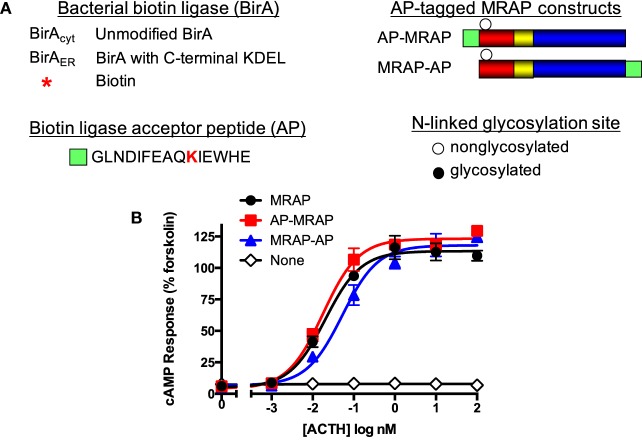
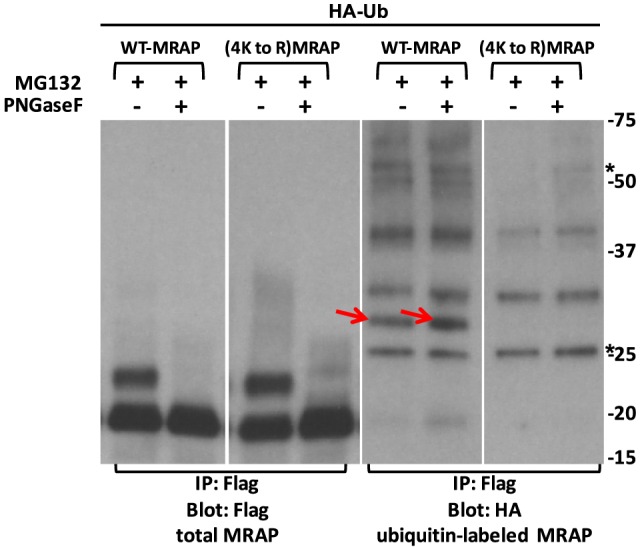
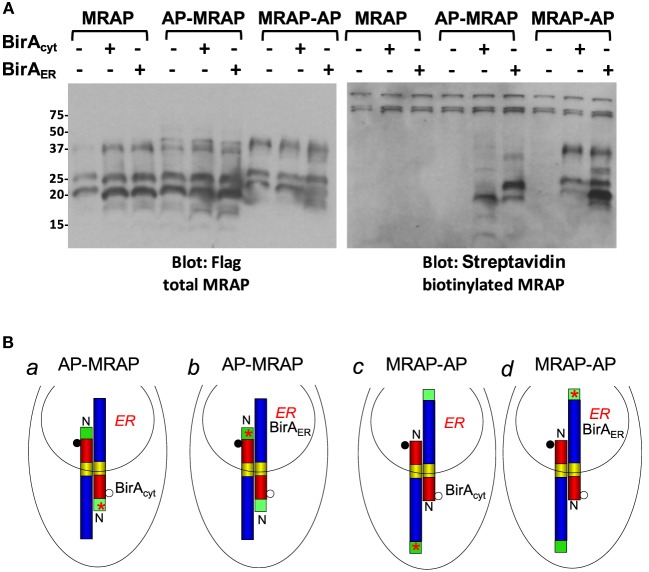
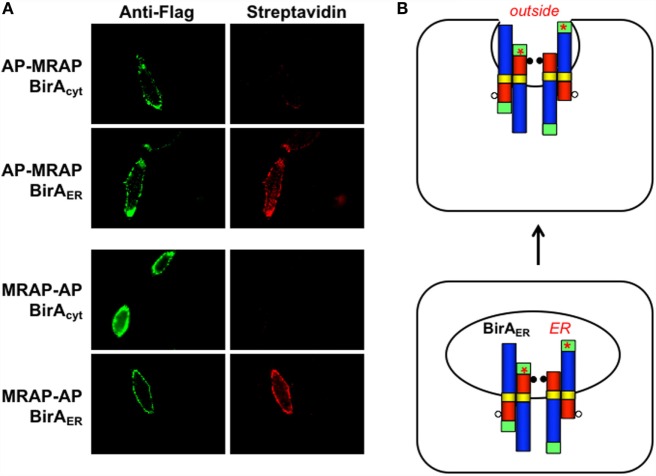
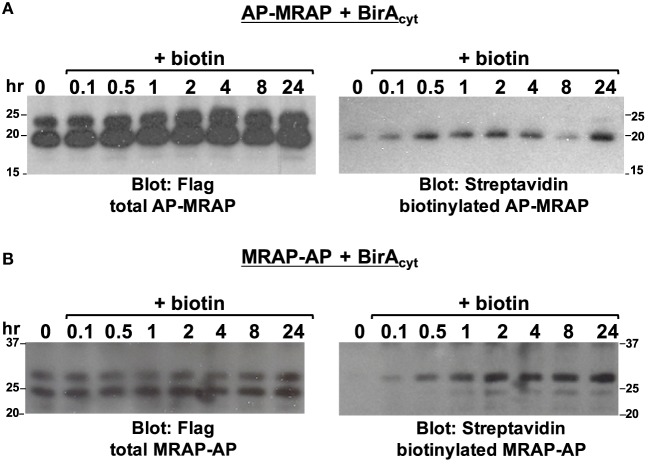
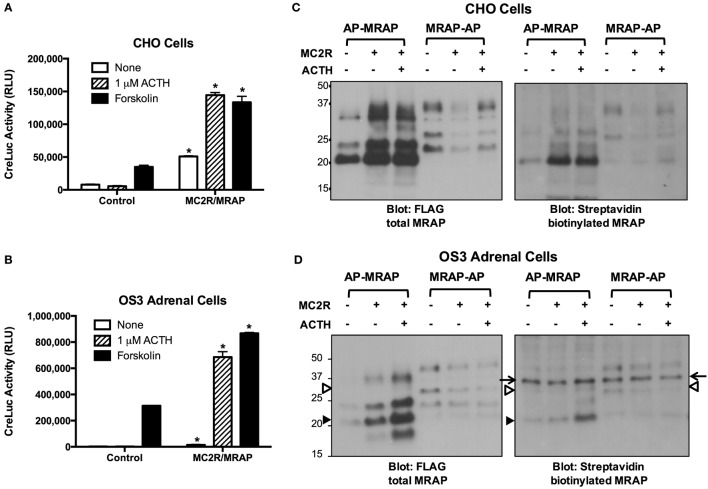
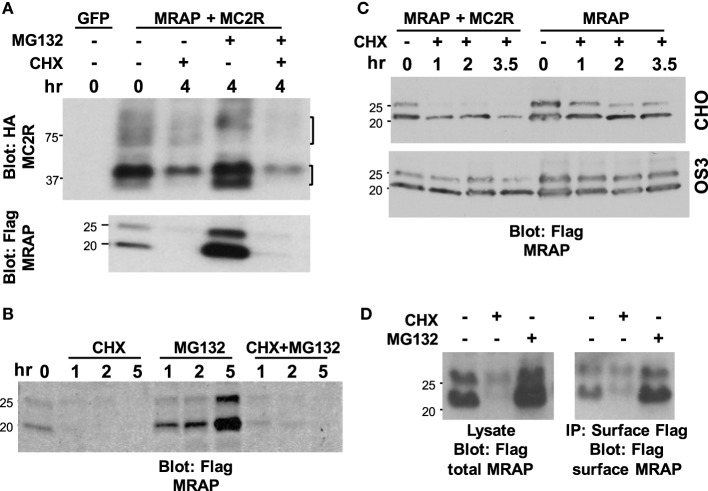
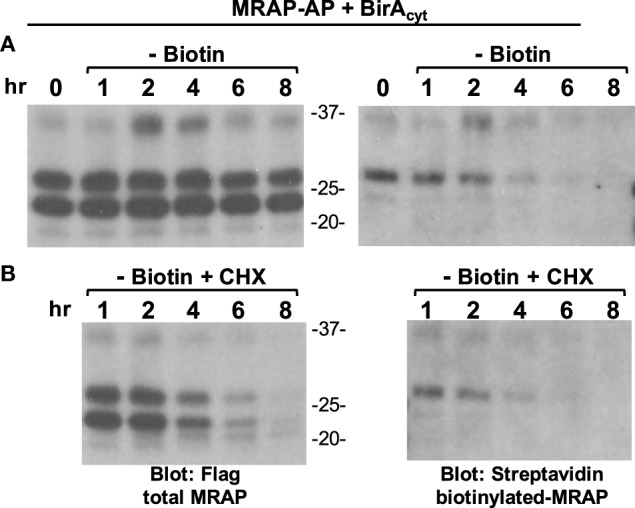
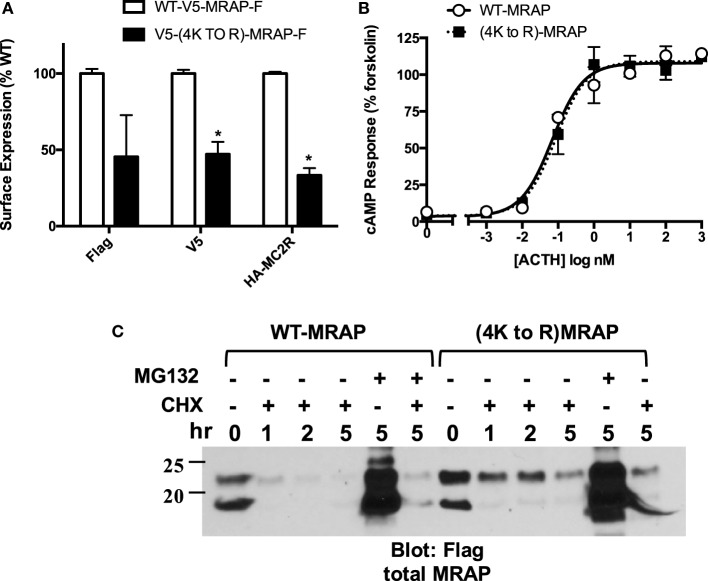
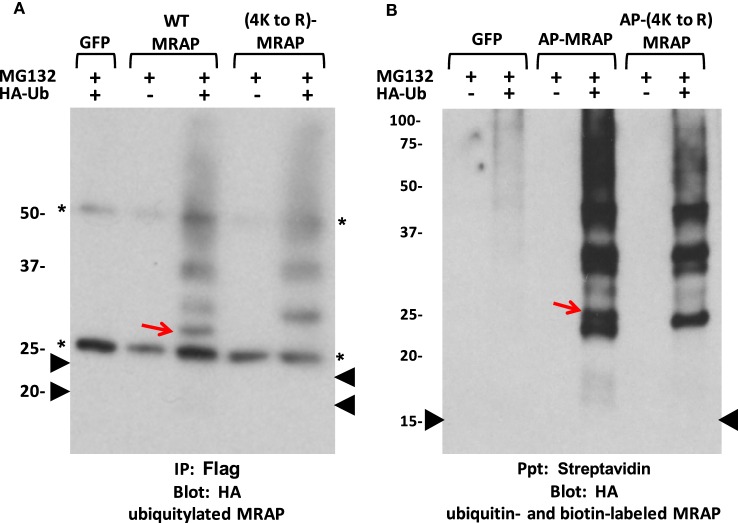
Melanocortin 2 receptor accessory protein (MRAP) facilitates trafficking of melanocortin 2 (MC2) receptors and is essential for ACTH binding and signaling. MRAP is a single transmembrane domain protein that forms antiparallel homodimers. These studies ask when MRAP first acquires this dual topology, whether MRAP architecture is static or stable, and whether the accessory protein undergoes rapid turnover. To answer these questions, we developed an approach that capitalizes on the specificity of bacterial biotin ligase, which adds biotin to lysine in a short acceptor peptide sequence; the distinct mobility of MRAP protomers of opposite orientations based on their N-linked glycosylation; and the ease of identifying biotin-labeled proteins. We inserted biotin ligase acceptor peptides at the N- or C-terminal ends of MRAP and expressed the modified proteins in mammalian cells together with either cytoplasmic or endoplasmic reticulum-targeted biotin ligase. MRAP assumed dual topology early in biosynthesis in both CHO and OS3 adrenal cells. Once established, MRAP orientation was stable. Despite its conformational stability, MRAP displayed a half-life of under 2 h in CHO cells. The amount of MRAP was increased by the proteasome inhibitor MG132 and MRAP underwent ubiquitylation on lysine and other amino acids. Nonetheless, when protein synthesis was blocked with cycloheximide, MRAP was rapidly degraded even when MG132 was included and all lysines were replaced by arginines, implicating non-proteasomal degradation pathways. The results show that although MRAP does not change orientations during trafficking, its synthesis and degradation are dynamically regulated.
黑皮质素2受体辅助蛋白(MRAP)促进黑皮质素2(MC2)受体的转运,对促肾上腺皮质激素(ACTH)的结合和信号传导至关重要。MRAP是一种单跨膜结构域蛋白,可形成反平行同源二聚体。这些研究探讨了MRAP何时首次获得这种双重拓扑结构,MRAP的结构是静态的还是稳定的,以及该辅助蛋白是否经历快速周转。为了回答这些问题,我们开发了一种方法,该方法利用了细菌生物素连接酶的特异性,它能将生物素添加到短受体肽序列中的赖氨酸上;基于其N-连接糖基化的相反方向的MRAP原体具有明显不同的迁移率;以及易于鉴定生物素标记的蛋白质。我们在MRAP的N端或C端插入生物素连接酶受体肽,并在哺乳动物细胞中与细胞质或内质网靶向的生物素连接酶一起表达修饰后的蛋白质。在CHO和OS3肾上腺细胞的生物合成早期,MRAP就呈现出双重拓扑结构。一旦确立,MRAP的方向就是稳定的。尽管其构象稳定,但MRAP在CHO细胞中的半衰期不到2小时。蛋白酶体抑制剂MG132增加了MRAP的量,并且MRAP在赖氨酸和其他氨基酸上发生了泛素化。然而,当用环己酰亚胺阻断蛋白质合成时,即使加入MG132且所有赖氨酸都被精氨酸取代,MRAP仍会迅速降解,这表明存在非蛋白酶体降解途径。结果表明,尽管MRAP在转运过程中方向不变,但其合成和降解受到动态调节。