Division of Public Health Sciences, Wake Forest Baptist Medical Center, Winston-Salem, NC, United States; Center for Clinical and Outcomes Research, Kaiser Permanente, Atlanta, GA, United States.
Division of General Internal Medicine, Department of Medicine, The Johns Hopkins University School of Medicine, Baltimore, MD, United States; Welch Center for Prevention, Epidemiology and Clinical Research, Johns Hopkins University School of Medicine, Baltimore, MD, United States.
Prev Med Rep. 2016 Jun 30;4:296-302. doi: 10.1016/j.pmedr.2016.06.015. eCollection 2016 Dec.
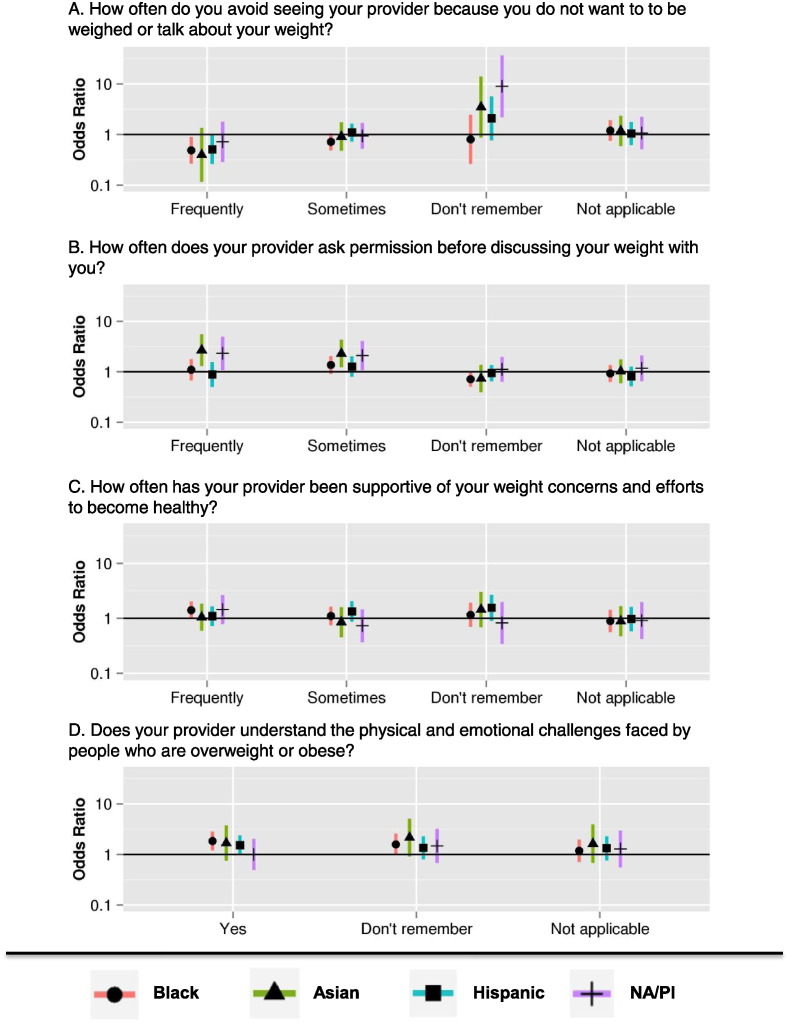
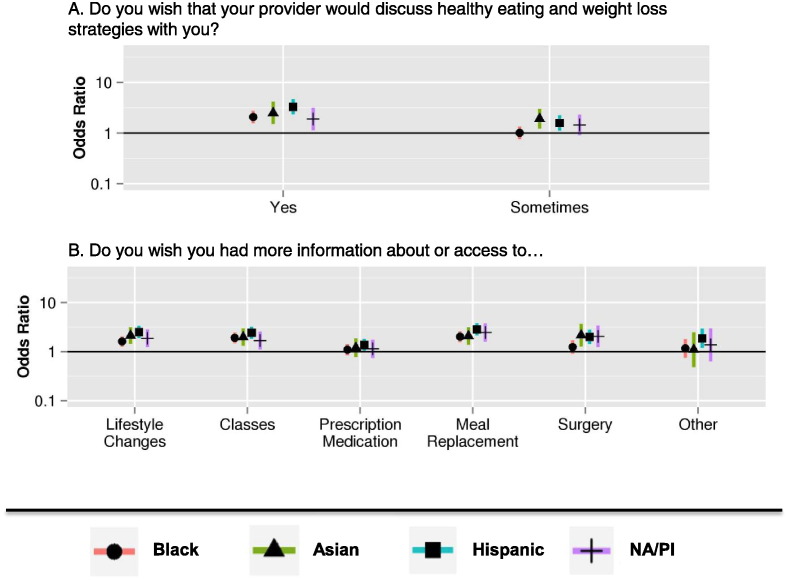
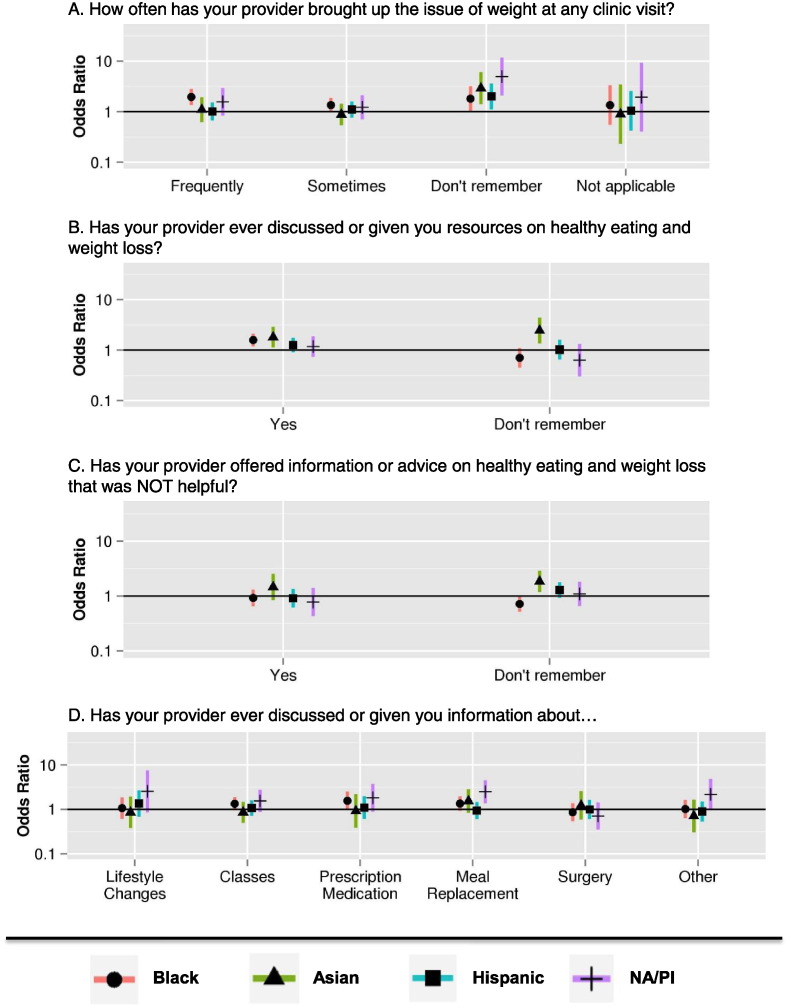
Our objective was to compare patients' health care experiences, related to their weight, across racial and ethnic groups. In Summer 2015, we distributed a written survey with telephone follow-up to a random sample of 5400 racially/ethnically and geographically diverse U.S. adult health plan members with overweight or obesity. The survey assessed members' perceptions of their weight-related healthcare experiences, including their perception of their primary care provider, and the type of weight management services they had been offered, or were interested in. We used multivariable multinomial logistic regression to examine the relationship between race/ethnicity and responses to questions about care experience. Overall, 2811 members (53%) responded to the survey and we included 2725 with complete data in the analysis. Mean age was 52.7 years (SD 15.0), with 61.7% female and 48.3% from minority racial/ethnic groups. Mean BMI was 37.1 kg/m(2) (SD 8.0). Most (68.2%) respondents reported having previous discussions of weight with their provider, but interest in such counseling varied by race/ethnicity. Non-Hispanic blacks were significantly less likely to frequently avoid care (for fear of discussing weight/being weighed) than whites (OR 0.49, 95% CI 0.26-0.90). Relative to whites, respondents of other race/ethnicities were more likely to want weight-related discussions with their providers. Race/ethnicity correlates with patients' perception of discussions of weight in healthcare encounters. Clinicians should capitalize on opportunities to discuss weight loss with high-risk minority patients who may desire these conversations.
我们的目的是比较不同种族和民族群体的患者在与体重相关的医疗保健方面的体验。2015 年夏天,我们向 5400 名具有超重或肥胖问题的美国成年健康计划成员发放了一份基于随机抽样的书面调查问卷,并进行了电话随访。该调查问卷评估了成员对与体重相关的医疗保健体验的看法,包括他们对初级保健提供者的看法,以及他们接受或感兴趣的体重管理服务类型。我们使用多变量多项逻辑回归分析了种族/民族与对护理体验问题的回答之间的关系。共有 2811 名成员(53%)对调查做出了回应,我们在分析中纳入了 2725 名数据完整的成员。平均年龄为 52.7 岁(标准差为 15.0),女性占 61.7%,少数民族占 48.3%。平均 BMI 为 37.1kg/m2(标准差为 8.0)。大多数(68.2%)受访者报告说,他们曾与提供者讨论过体重问题,但对这种咨询的兴趣因种族/民族而异。非西班牙裔黑人与白人相比,更不太可能因为担心讨论体重/称重而频繁避免就医(OR 0.49,95%CI 0.26-0.90)。与白人相比,其他种族/民族的受访者更希望与提供者进行与体重相关的讨论。种族/民族与患者在医疗保健接触中对体重讨论的看法相关。临床医生应该利用与可能希望进行这些对话的高风险少数民族患者讨论减肥的机会。