Kim Kangchon, Kim Yuseob
Interdisciplinary Program of EcoCreative, Ewha Womans University, Ewhayeodae-gil 52, Seodaemun-gu, Seoul, 120-750, South Korea.
Department of Life Sciences, Ewha Womans University, Ewhayeodae-gil 52, Seodaemun-gu, Seoul, 120-750, South Korea.
BMC Evol Biol. 2016 Aug 3;16:156. doi: 10.1186/s12862-016-0727-8.
Human influenza virus A/H3N2 undergoes rapid adaptive evolution in response to host immunity. Positively selected amino acid substitutions have been detected mainly in the hemagglutinin (HA) segment. The genealogical tree of HA sequences sampled over several decades comprises a long trunk and short side branches, which indicates small effective population size. Various studies have reproduced this unique genealogical structure by modeling recurrent positive selection. However, it has not been clearly demonstrated whether recurrent selective sweeps alone can explain the limited level of genetic diversity observed in the HA of H3N2. In addition, the variation-reducing impacts of other evolutionary processes - background selection and complex demography - relative to that of positive selection have never been explicitly evaluated.
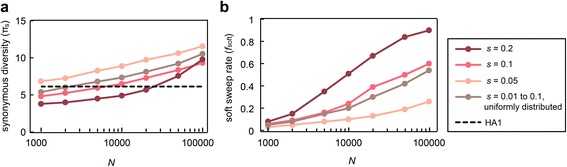
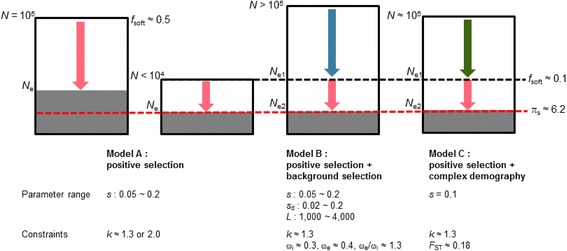
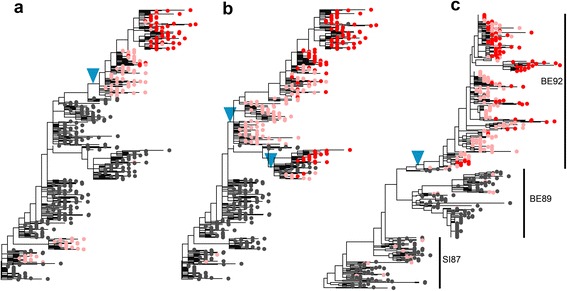
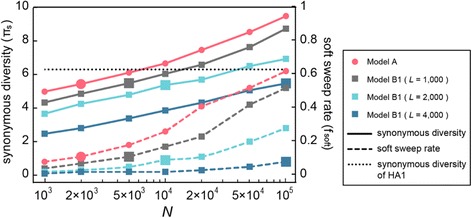
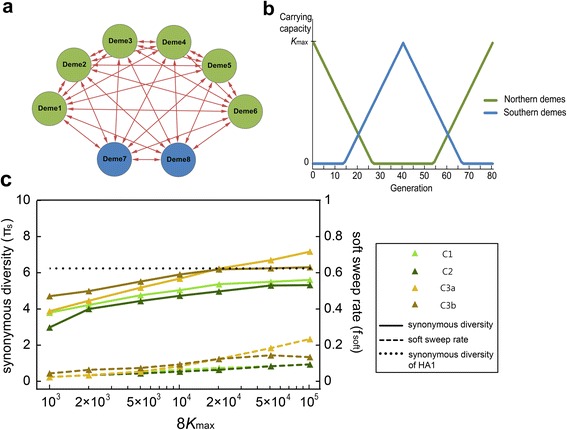
In this paper, using computer simulation of a viral population evolving under recurrent selective sweeps we demonstrate that positive selection alone, if it occurs at a rate estimated by previous studies, cannot lead to such a small effective population size. Genetic hitchhiking fails to completely wipe out pre-existing variation because soft, rather than hard, selective sweeps prevail under realistic parameters of mutation rate and population size. We find that antigenic-cluster-transition substitutions in HA occur as hard sweeps. This indicates that the effective population size under which those mutations arise must be much smaller than the actual population size due to other evolutionary forces before selective sweeps further reduce it. We thus examine the effects of background selection and metapopulation dynamics in reducing the effective population size, using parameter values that reproduce other aspects of molecular evolution in H3N2. When either process is incorporated in recurrent selective sweep simulation, selective sweeps are mostly hard and the observed level of synonymous diversity is obtained with large census population size.
Background selection and metapopulation dynamics have greater variation reducing power than recurrent positive selection under realistic parameters in H3N2. Therefore, these evolutionary processes are likely to play crucial roles in reducing the effective population size of H3N2 viruses and thus explaining the characteristic shape of H3N2 genealogy.
人类甲型H3N2流感病毒会因宿主免疫反应而经历快速适应性进化。主要在血凝素(HA)片段中检测到正选择的氨基酸替换。几十年来采样的HA序列谱系树包括一个长主干和短侧枝,这表明有效种群规模较小。各种研究通过对反复出现的正选择进行建模再现了这种独特的谱系结构。然而,尚未明确证明仅反复出现的选择性清除能否解释H3N2的HA中观察到的有限遗传多样性水平。此外,相对于正选择,其他进化过程——背景选择和复杂种群动态——对变异的减少影响从未得到明确评估。
在本文中,我们通过对在反复出现的选择性清除下进化的病毒种群进行计算机模拟表明,仅正选择(如果以先前研究估计的速率发生)不会导致如此小的有效种群规模。由于在突变率和种群规模的现实参数下软选择性清除而非硬选择性清除占主导,遗传搭便车无法完全消除先前存在的变异。我们发现HA中的抗原簇转变替换以硬清除的形式发生。这表明由于选择性清除进一步降低有效种群规模之前的其他进化力量,这些突变出现时的有效种群规模必定远小于实际种群规模。因此,我们使用能再现H3N2分子进化其他方面的参数值,研究背景选择和集合种群动态在降低有效种群规模方面的影响。当将这两个过程中的任何一个纳入反复出现的选择性清除模拟时,选择性清除大多是硬清除,并且在较大普查种群规模下能获得观察到的同义多样性水平。
在H3N2的现实参数下,背景选择和集合种群动态比反复出现的正选择具有更大的变异减少能力。因此,这些进化过程可能在降低H3N2病毒的有效种群规模从而解释H3N2谱系的特征形状方面发挥关键作用。