Fujiwara Nana, Cave John W
Burke Medical Research Institute White Plains, NY, USA.
Burke Medical Research InstituteWhite Plains, NY, USA; The Feil Family Brain and Mind Research Institute, Weill Cornell MedicineNew York, NY, USA.
Front Neurosci. 2016 Jul 20;10:337. doi: 10.3389/fnins.2016.00337. eCollection 2016.
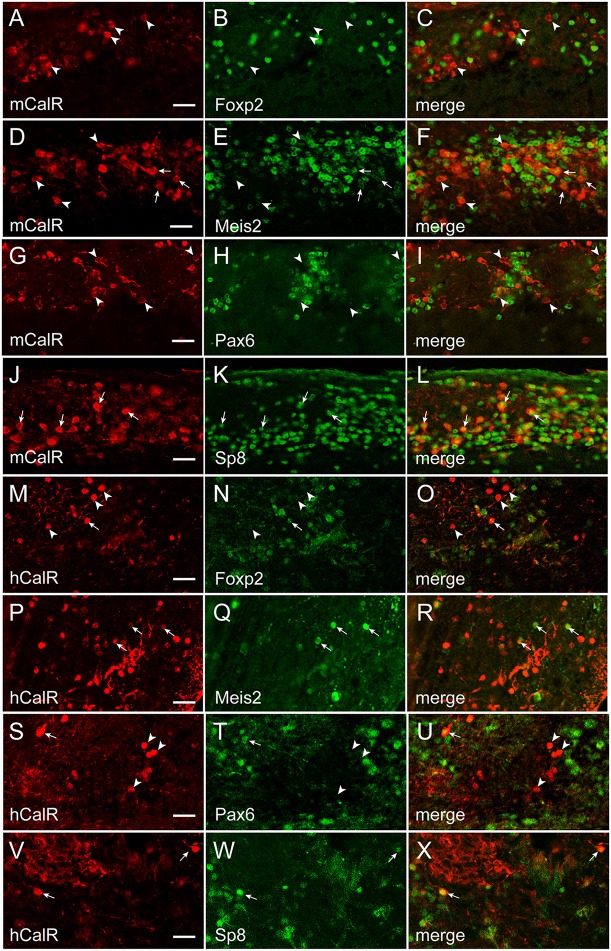
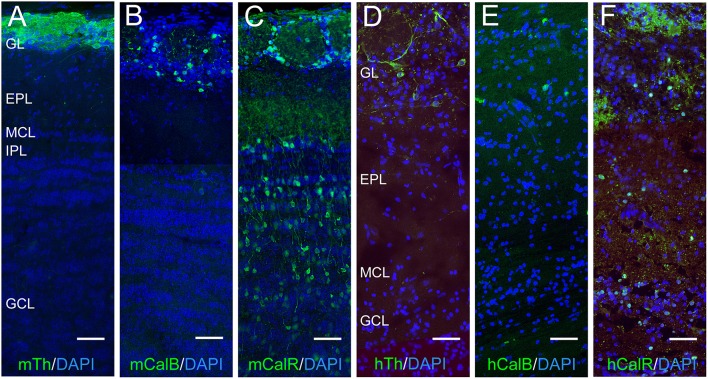
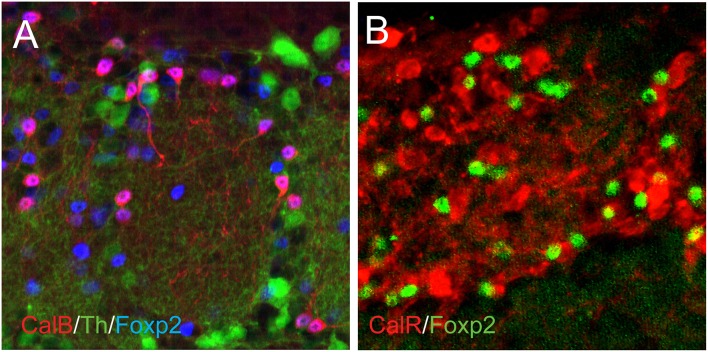
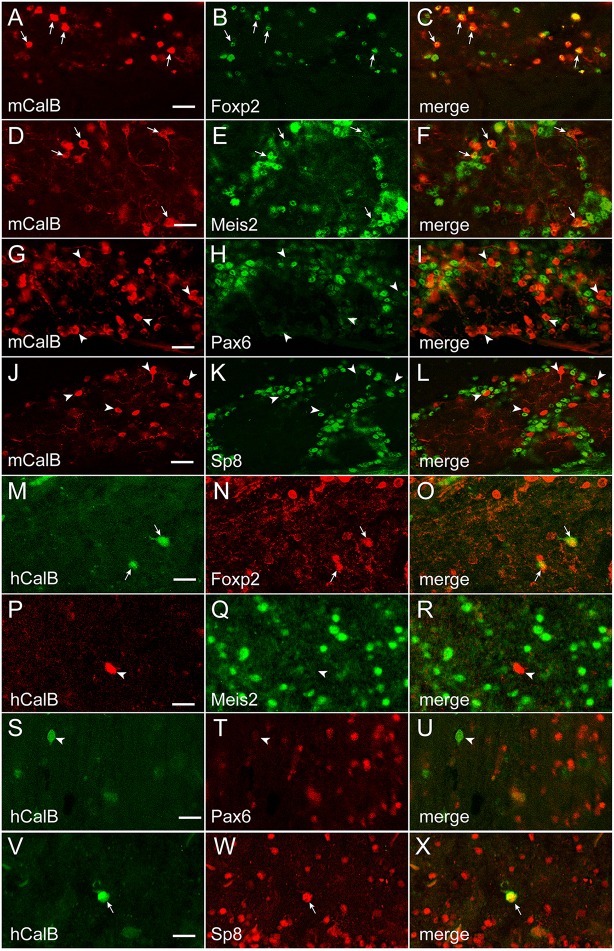
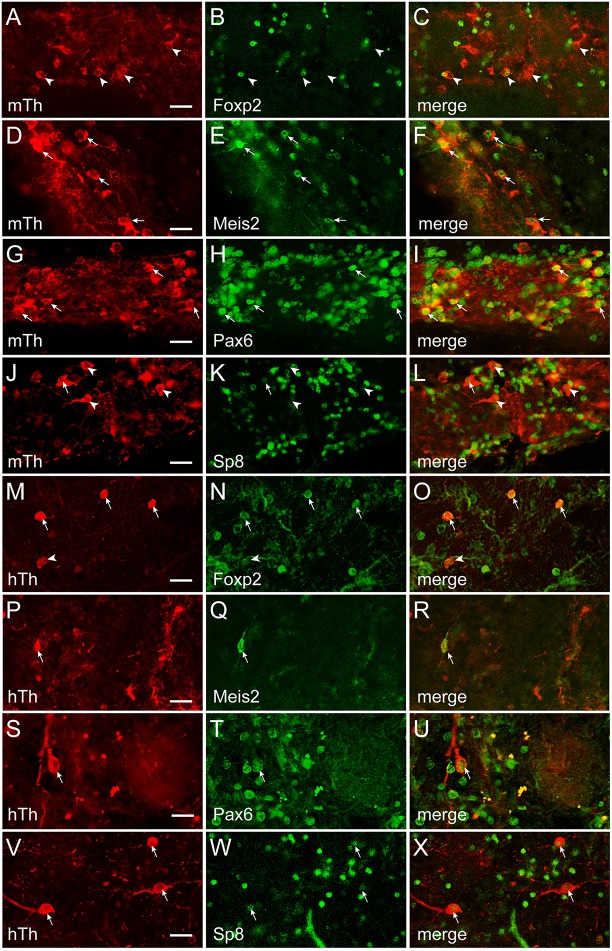
The mammalian main olfactory bulb (OB) has a large population of GABAergic inhibitory interneurons that contains several subtypes defined by the co-expression other neurotransmitters and calcium binding proteins. The three most commonly studied OB interneuron subtypes co-express either Calretinin, Calbindin, or Tyrosine hydroxylase (Th). Combinations of transcription factors used to specify the phenotype of progenitors are referred to as transcription factor codes, and the current understanding of transcription factor codes that specify OB inhibitory neuron phenotypes are largely based on studies in mice. The conservation of these transcription factor codes in the human OB, however, has not been investigated. The aim of this study was to establish whether transcription factor codes in OB interneurons are conserved between mice and humans. This study compared the co-expression of Foxp2, Meis2, Pax6, and Sp8 transcription factors with Calretinin, Calbindin, or Th in human and mouse OB interneurons. This analysis found strong conservation of Calretinin co-expression with Sp8 and Meis2 as well as Th co-expression with Pax6 and Meis2. This analysis also showed that selective Foxp2 co-expression with Calbindin was conserved between mice and humans, which suggests Foxp2 is a novel determinant of the OB Calbindin interneuron phenotype. Together, the findings in this study provide insight into the conservation of transcription codes for OB interneuron phenotypes between humans and mice, as well as reveal some important differences between the species. This advance in our understanding of transcription factor codes in OB interneurons provides an important complement to the codes that have been established for other regions within the mammalian central nervous system, such as the cortex and spinal cord.
哺乳动物的主嗅球(OB)中有大量的γ-氨基丁酸(GABA)能抑制性中间神经元,其中包含几种由其他神经递质和钙结合蛋白的共表达所定义的亚型。三种最常被研究的OB中间神经元亚型分别共表达钙视网膜蛋白、钙结合蛋白或酪氨酸羟化酶(Th)。用于指定祖细胞表型的转录因子组合被称为转录因子编码,目前对指定OB抑制性神经元表型的转录因子编码的理解主要基于对小鼠的研究。然而,这些转录因子编码在人类OB中的保守性尚未得到研究。本研究的目的是确定OB中间神经元中的转录因子编码在小鼠和人类之间是否保守。这项研究比较了人类和小鼠OB中间神经元中Foxp2、Meis2、Pax6和Sp8转录因子与钙视网膜蛋白、钙结合蛋白或Th的共表达情况。该分析发现,钙视网膜蛋白与Sp8和Meis2的共表达以及Th与Pax6和Meis2的共表达具有很强的保守性。该分析还表明,Foxp2与钙结合蛋白的选择性共表达在小鼠和人类之间是保守的,这表明Foxp2是OB钙结合蛋白中间神经元表型的一个新的决定因素。总之,本研究的结果为人类和小鼠之间OB中间神经元表型的转录编码保守性提供了见解,同时也揭示了这两个物种之间的一些重要差异。我们对OB中间神经元转录因子编码理解的这一进展为哺乳动物中枢神经系统其他区域(如皮层和脊髓)已建立的编码提供了重要补充。