Padilla-Buritica Jorge I, Martinez-Vargas Juan D, Castellanos-Dominguez German
Signal Processing and Recognition Group, Department of Electrical and Electronic Engineering, Universidad Nacional de ColombiaManizales, Colombia; Diseño Electrónico y Técnicas de Tratamiento de Señal, Universidad Politecnica de CartagenaCartagena, Spain.
Signal Processing and Recognition Group, Department of Electrical and Electronic Engineering, Universidad Nacional de Colombia Manizales, Colombia.
Front Comput Neurosci. 2016 Jul 20;10:55. doi: 10.3389/fncom.2016.00055. eCollection 2016.
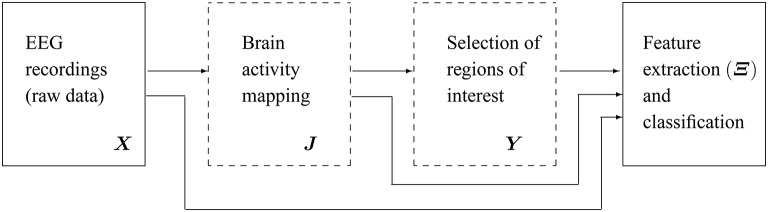
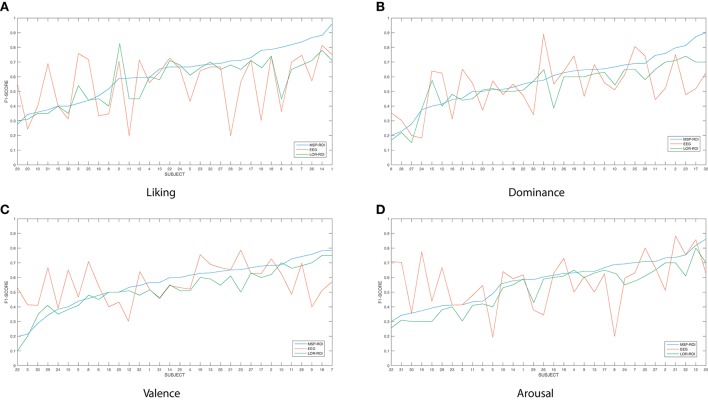
Lately, research on computational models of emotion had been getting much attention due to their potential for understanding the mechanisms of emotions and their promising broad range of applications that potentially bridge the gap between human and machine interactions. We propose a new method for emotion classification that relies on features extracted from those active brain areas that are most likely related to emotions. To this end, we carry out the selection of spatially compact regions of interest that are computed using the brain neural activity reconstructed from Electroencephalography data. Throughout this study, we consider three representative feature extraction methods widely applied to emotion detection tasks, including Power spectral density, Wavelet, and Hjorth parameters. Further feature selection is carried out using principal component analysis. For validation purpose, these features are used to feed a support vector machine classifier that is trained under the leave-one-out cross-validation strategy. Obtained results on real affective data show that incorporation of the proposed training method in combination with the enhanced spatial resolution provided by the source estimation allows improving the performed accuracy of discrimination in most of the considered emotions, namely: dominance, valence, and liking.
最近,由于情感计算模型在理解情感机制方面的潜力以及它们在人机交互之间潜在的广泛应用前景,对情感计算模型的研究受到了广泛关注。我们提出了一种新的情感分类方法,该方法依赖于从那些最有可能与情感相关的活跃脑区提取的特征。为此,我们使用从脑电图数据重建的脑神经元活动来计算空间紧凑的感兴趣区域。在整个研究中,我们考虑了三种广泛应用于情感检测任务的代表性特征提取方法,包括功率谱密度、小波和 Hjorth 参数。进一步使用主成分分析进行特征选择。为了验证目的,这些特征被用于训练一个支持向量机分类器,该分类器采用留一法交叉验证策略进行训练。在真实情感数据上获得的结果表明,将所提出的训练方法与源估计提供的增强空间分辨率相结合,可以提高在大多数所考虑情感(即:支配性、效价和喜好度)方面的辨别准确率。