• 文献检索
  • 文档翻译
  • 深度研究
  • 学术资讯
  • Suppr Zotero 插件Zotero 插件
  • 邀请有礼
  • 套餐&价格
  • 历史记录
应用&插件
Suppr Zotero 插件Zotero 插件浏览器插件Mac 客户端Windows 客户端微信小程序
定价
高级版会员购买积分包购买API积分包
服务
文献检索文档翻译深度研究API 文档MCP 服务
关于我们
关于 Suppr公司介绍联系我们用户协议隐私条款
关注我们

Suppr 超能文献

核心技术专利:CN118964589B侵权必究
粤ICP备2023148730 号-1Suppr @ 2026

文献检索

告别复杂PubMed语法,用中文像聊天一样搜索,搜遍4000万医学文献。AI智能推荐,让科研检索更轻松。

立即免费搜索

文件翻译

保留排版,准确专业,支持PDF/Word/PPT等文件格式,支持 12+语言互译。

免费翻译文档

深度研究

AI帮你快速写综述,25分钟生成高质量综述,智能提取关键信息,辅助科研写作。

立即免费体验

瑞典儿童贫困趋势:父母与儿童的报告。

Trends in Child Poverty in Sweden: Parental and Child Reports.

作者信息

Mood Carina, Jonsson Jan O

机构信息

Institute for Futures Studies (IFFS), Stockholm, 11136 Sweden ; Swedish Institute for Social Research (SOFI), Stockholm, Sweden.

Institute for Futures Studies (IFFS), Stockholm, 11136 Sweden ; Swedish Institute for Social Research (SOFI), Stockholm, Sweden ; Nuffield College, Oxford University, Oxford, OX1 1NF UK.

出版信息

Child Indic Res. 2016;9:825-854. doi: 10.1007/s12187-015-9337-z. Epub 2015 Sep 23.

DOI:10.1007/s12187-015-9337-z
PMID:27489573
原文链接:https://pmc.ncbi.nlm.nih.gov/articles/PMC4958129/
Abstract

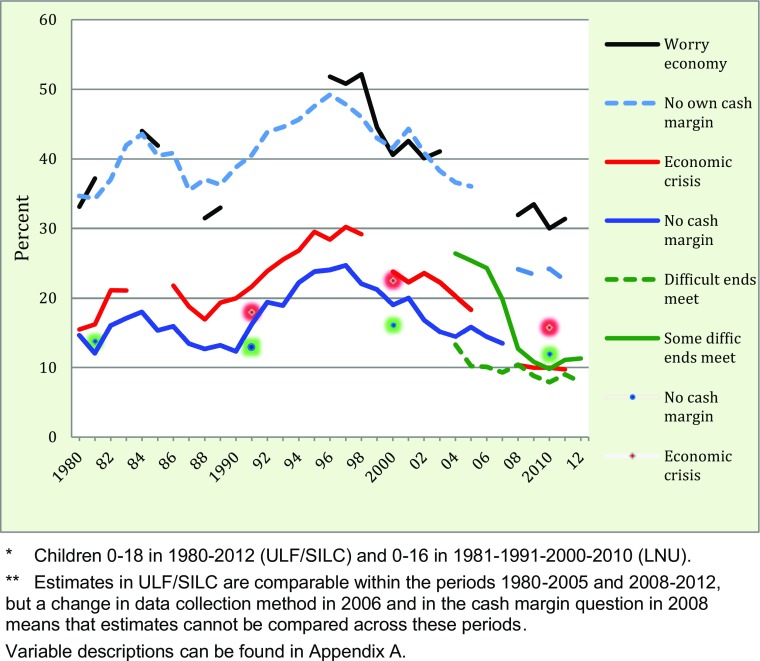
We use several family-based indicators of household poverty as well as child-reported economic resources and problems to unravel child poverty trends in Sweden. Our results show that absolute (bread-line) household income poverty, as well as economic deprivation, increased with the recession 1991-96, then reduced and has remained largely unchanged since 2006. Relative income poverty has however increased since the mid-1990s. When we measure child poverty by young people's own reports, we find few trends between 2000 and 2011. The material conditions appear to have improved and relative poverty has changed very little if at all, contrasting the development of household relative poverty. This contradictory pattern may be a consequence of poor parents distributing relatively more of the household income to their children in times of economic duress, but future studies should scrutinze potentially delayed negative consequences as poor children are lagging behind their non-poor peers. Our methodological conclusion is that although parental and child reports are partly substitutable, they are also complementary, and the simultaneous reporting of different measures is crucial to get a full understanding of trends in child poverty.

摘要

我们使用了几个基于家庭的家庭贫困指标以及儿童报告的经济资源和问题,来梳理瑞典儿童贫困的趋势。我们的结果表明,绝对(维持生计水平)家庭收入贫困以及经济匮乏在1991 - 1996年衰退期间有所增加,随后减少,自2006年以来基本保持不变。然而,相对收入贫困自20世纪90年代中期以来有所增加。当我们根据年轻人自己的报告来衡量儿童贫困时,我们发现在2000年至2011年期间几乎没有什么趋势。物质条件似乎有所改善,相对贫困即使有变化也非常小,这与家庭相对贫困的发展形成对比。这种矛盾的模式可能是由于贫困父母在经济困难时期将相对更多的家庭收入分配给了他们的孩子,但未来的研究应该仔细审查可能存在的延迟负面后果,因为贫困儿童落后于非贫困同龄人。我们的方法学结论是,虽然父母和儿童的报告部分可相互替代,但它们也是互补的,同时报告不同的衡量标准对于全面了解儿童贫困趋势至关重要。
https://cdn.ncbi.nlm.nih.gov/pmc/blobs/242a/4958129/0c43daf87090/12187_2015_9337_Fig7_HTML.jpg
https://cdn.ncbi.nlm.nih.gov/pmc/blobs/242a/4958129/1c0b0768dbb6/12187_2015_9337_Fig1_HTML.jpg
https://cdn.ncbi.nlm.nih.gov/pmc/blobs/242a/4958129/32e6b1a31271/12187_2015_9337_Fig2_HTML.jpg
https://cdn.ncbi.nlm.nih.gov/pmc/blobs/242a/4958129/fc28061e11bf/12187_2015_9337_Fig3_HTML.jpg
https://cdn.ncbi.nlm.nih.gov/pmc/blobs/242a/4958129/f167f42bccfd/12187_2015_9337_Fig4_HTML.jpg
https://cdn.ncbi.nlm.nih.gov/pmc/blobs/242a/4958129/3a314ac51ced/12187_2015_9337_Fig5_HTML.jpg
https://cdn.ncbi.nlm.nih.gov/pmc/blobs/242a/4958129/328b2edd3956/12187_2015_9337_Fig6_HTML.jpg
https://cdn.ncbi.nlm.nih.gov/pmc/blobs/242a/4958129/0c43daf87090/12187_2015_9337_Fig7_HTML.jpg
https://cdn.ncbi.nlm.nih.gov/pmc/blobs/242a/4958129/1c0b0768dbb6/12187_2015_9337_Fig1_HTML.jpg
https://cdn.ncbi.nlm.nih.gov/pmc/blobs/242a/4958129/32e6b1a31271/12187_2015_9337_Fig2_HTML.jpg
https://cdn.ncbi.nlm.nih.gov/pmc/blobs/242a/4958129/fc28061e11bf/12187_2015_9337_Fig3_HTML.jpg
https://cdn.ncbi.nlm.nih.gov/pmc/blobs/242a/4958129/f167f42bccfd/12187_2015_9337_Fig4_HTML.jpg
https://cdn.ncbi.nlm.nih.gov/pmc/blobs/242a/4958129/3a314ac51ced/12187_2015_9337_Fig5_HTML.jpg
https://cdn.ncbi.nlm.nih.gov/pmc/blobs/242a/4958129/328b2edd3956/12187_2015_9337_Fig6_HTML.jpg
https://cdn.ncbi.nlm.nih.gov/pmc/blobs/242a/4958129/0c43daf87090/12187_2015_9337_Fig7_HTML.jpg

相似文献

1
Trends in Child Poverty in Sweden: Parental and Child Reports.瑞典儿童贫困趋势:父母与儿童的报告。
Child Indic Res. 2016;9:825-854. doi: 10.1007/s12187-015-9337-z. Epub 2015 Sep 23.
2
Why poverty remains high: the role of income growth, economic inequality, and changes in family structure, 1949-1999.为何贫困率居高不下:1949 - 1999年期间收入增长、经济不平等及家庭结构变化的作用
Demography. 2003 Aug;40(3):499-519. doi: 10.1353/dem.2003.0025.
3
Short-term trends in China's income inequality and poverty: evidence from a longitudinal household survey.中国收入不平等与贫困的短期趋势:来自一项纵向家庭调查的证据
China Economic J. 2015;8(3):235-251. doi: 10.1080/17538963.2015.1108118. Epub 2015 Dec 1.
4
Effects of short-term exposure to air pollution on hospital admissions of young children for acute lower respiratory infections in Ho Chi Minh City, Vietnam.越南胡志明市短期暴露于空气污染对幼儿急性下呼吸道感染住院率的影响。
Res Rep Health Eff Inst. 2012 Jun(169):5-72; discussion 73-83.
5
Cash Transfers and Child and Adolescent Development现金转移与儿童及青少年发展
6
Increased household financial strain, the Great Recession and child health-findings from the UK Millennium Cohort Study.家庭经济压力增加、大衰退与儿童健康——英国千禧世代研究的结果
BMJ Open. 2017 Mar 9;7(3):e015559. doi: 10.1136/bmjopen-2016-015559.
7
What accounts for the rise of low self-rated health during the recent economic crisis in Europe?在欧洲最近的经济危机期间,低自评健康状况增加的原因是什么?
Int J Equity Health. 2019 Jan 28;18(1):21. doi: 10.1186/s12939-019-0926-1.
8
[Effects of poverty for health and health behavior of children and adolescents : Results from KiGGS Wave 2].[贫困对儿童和青少年健康及健康行为的影响:德国儿童青少年健康访谈与检查调查第二轮(KiGGS Wave 2)结果]
Bundesgesundheitsblatt Gesundheitsforschung Gesundheitsschutz. 2019 Oct;62(10):1263-1274. doi: 10.1007/s00103-019-03009-6.
9
Trends in the association between average income, poverty and income inequality and life expectancy in Spain.西班牙平均收入、贫困和收入不平等与预期寿命之间的关联趋势。
Soc Sci Med. 2003 Mar;56(5):961-71. doi: 10.1016/s0277-9536(02)00107-7.
10
The Social Consequences of Poverty: An Empirical Test on Longitudinal Data.贫困的社会后果:基于纵向数据的实证检验
Soc Indic Res. 2016;127:633-652. doi: 10.1007/s11205-015-0983-9. Epub 2015 May 17.

引用本文的文献

1
Screening for economic hardship at Child Health Care Centres: A qualitative study of stakeholders' perceptions and experiences of the Healthier Wealthier Families model in Sweden.儿童保健中心的经济困难筛查:对瑞典“更健康、更富裕家庭”模式中利益相关者认知与经历的定性研究
Scand J Public Health. 2025 Jun;53(4):406-412. doi: 10.1177/14034948241252227. Epub 2024 May 30.
2
Early Family Life Course Standardization in Sweden: The Role of Compositional Change.瑞典早期家庭生活历程标准化:构成变化的作用。
Eur J Popul. 2020 Jan 13;36(4):765-798. doi: 10.1007/s10680-019-09551-y. eCollection 2020 Sep.
3
The Living Conditions of Children with Shared Residence - the Swedish Example.

本文引用的文献

1
The Social Consequences of Poverty: An Empirical Test on Longitudinal Data.贫困的社会后果:基于纵向数据的实证检验
Soc Indic Res. 2016;127:633-652. doi: 10.1007/s11205-015-0983-9. Epub 2015 May 17.
2
Does money really matter? Estimating impacts of family income on young children's achievement with data from random-assignment experiments.金钱真的重要吗?利用随机分配实验的数据估计家庭收入对幼儿成绩的影响。
Dev Psychol. 2011 Sep;47(5):1263-79. doi: 10.1037/a0023875.
共享居住儿童的生活状况——以瑞典为例。
Child Indic Res. 2018;11(3):861-883. doi: 10.1007/s12187-017-9443-1. Epub 2017 Jan 17.
4
How are Immigrant Children in Sweden Faring? Mean Income, Affluence and Poverty Since the 1980s.瑞典的移民儿童情况如何?自20世纪80年代以来的平均收入、富裕程度和贫困状况。
Child Indic Res. 2018;11(1):329-353. doi: 10.1007/s12187-016-9416-9. Epub 2016 Sep 8.
5
Poor Kids? Economic Resources and Adverse Peer Relations in a Nationally Representative Sample of Swedish Adolescents.贫困儿童?瑞典青少年全国代表性样本中的经济资源与不良同伴关系。
J Youth Adolesc. 2018 Jan;47(1):88-104. doi: 10.1007/s10964-017-0747-8. Epub 2017 Sep 19.
6
Early-life family income and subjective well-being in adolescents.青少年时期的家庭收入与主观幸福感
PLoS One. 2017 Jul 17;12(7):e0179380. doi: 10.1371/journal.pone.0179380. eCollection 2017.
7
Social Exclusion among Peers: The Role of Immigrant Status and Classroom Immigrant Density.同龄人中的社会排斥:移民身份与班级移民密度的作用。
J Youth Adolesc. 2017 Jun;46(6):1275-1288. doi: 10.1007/s10964-016-0564-5. Epub 2016 Sep 12.
8
Money, Peers and Parents: Social and Economic Aspects of Inequality in Youth Wellbeing.金钱、同龄人及父母:青少年幸福不平等的社会与经济因素
J Youth Adolesc. 2016 Jul;45(7):1294-308. doi: 10.1007/s10964-016-0430-5. Epub 2016 Feb 4.