Gustafsson Björn, Österberg Torun
1Department of Social Work, University of Gothenburg, P.O. Box 720, SE 405 30 Gothenburg, Sweden.
2Institute for the Study of Labor (IZA), Bonn, Germany.
Child Indic Res. 2018;11(1):329-353. doi: 10.1007/s12187-016-9416-9. Epub 2016 Sep 8.
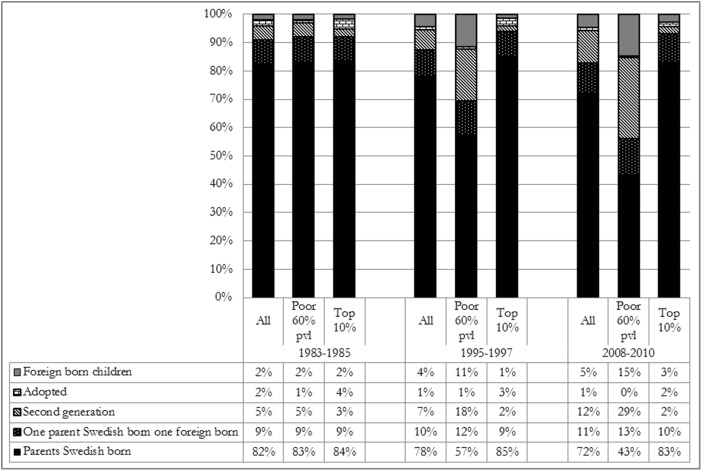
This article presents new research on income-based child indicators for immigrant children from 17 different national backgrounds and children of parents born in Sweden observed during the 3-year periods 1983-85, 1995-97 and 2008-10. This research examines mean household income, representation at the top of the income distribution and relative poverty differ for immigrant children from the corresponding levels among children with native born parents. Most of the analysis is concentrated on the second generation of immigrant children. It is shown that the relative position of immigrant children deteriorated between 1983-85 and 1995-97 when the labour market situation of immigrant parents weakened more than among native born parents. Changes thereafter were more complex. Children born in Sweden to parents from Denmark, Norway or Germany were as likely as children of native born parents to be observed at the top of the income distribution in contrast to children of parents from countries with middle or low human development. Poverty rates among immigrant children were higher among all categories of immigrant children in 2008-10 than among children of native born parents. These cross origin differences in income-based child indicators can be attributed to the reasons and qualifications parents had when they entered Sweden and the number of years since their immigration. A majority of children living in Sweden that are classified as poor in 2008-10 were immigrant children of various categories.
本文展示了关于17种不同国籍背景的移民儿童以及父母出生在瑞典的儿童基于收入的儿童指标的新研究,这些儿童的数据是在1983 - 1985年、1995 - 1997年和2008 - 2010年这三个三年期内观测得到的。这项研究考察了平均家庭收入、收入分配顶端的占比以及相对贫困情况,这些指标在移民儿童和父母为瑞典本土出生的儿童之间存在差异。大部分分析集中在第二代移民儿童身上。研究表明,在1983 - 1985年至1995 - 1997年期间,移民儿童的相对地位恶化,因为移民父母的劳动力市场状况比本土出生的父母恶化得更严重。此后的变化更为复杂。父母来自丹麦、挪威或德国且在瑞典出生的儿童,与本土出生父母的孩子一样,在收入分配顶端被观测到的可能性较大,而父母来自人类发展水平中等或较低国家的儿童则不然。在2008 - 2010年,所有类别的移民儿童中的贫困率都高于本土出生父母的孩子。基于收入的儿童指标的这些跨来源差异可归因于父母进入瑞典时的原因和条件以及他们移民后的年数。在2008 - 2010年被归类为贫困的居住在瑞典的儿童中,大多数是各类移民儿童。