Department for Animal Wealth Development, Faculty of Veterinary Medicine, Benha University, 13736 Moshtohor, Toukh, Egypt.
Department for Animal Husbandry and Animal Wealth Development, Faculty of Veterinary Medicine, Alexandria University, Egypt.
J Adv Res. 2016 Sep;7(5):615-23. doi: 10.1016/j.jare.2016.06.005. Epub 2016 Jun 28.
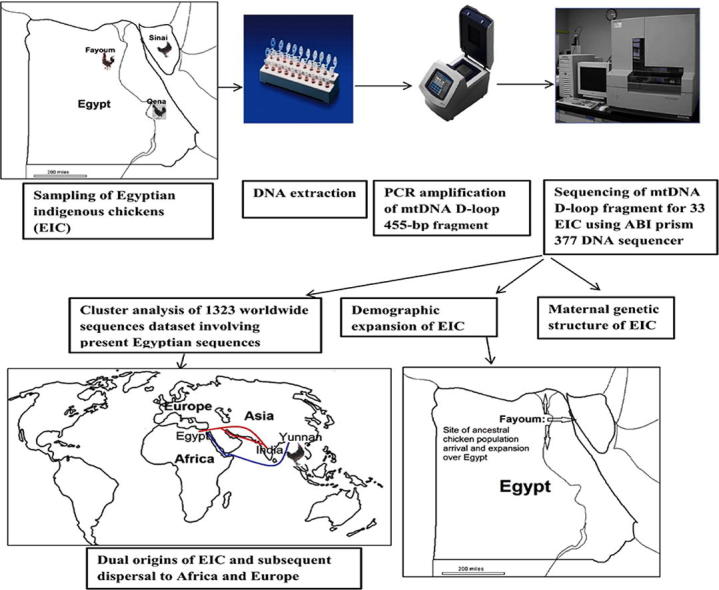
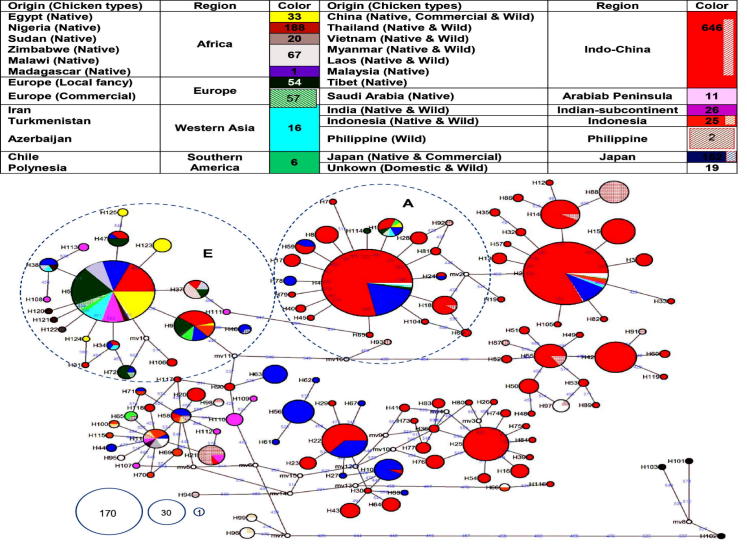
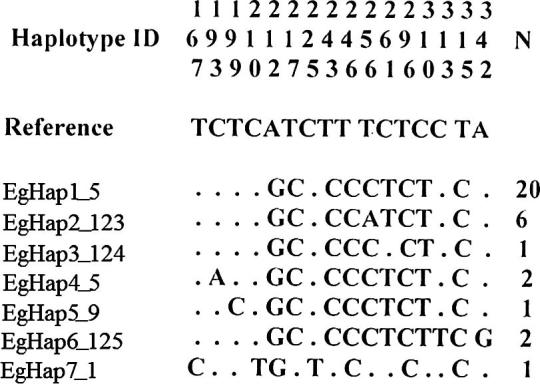
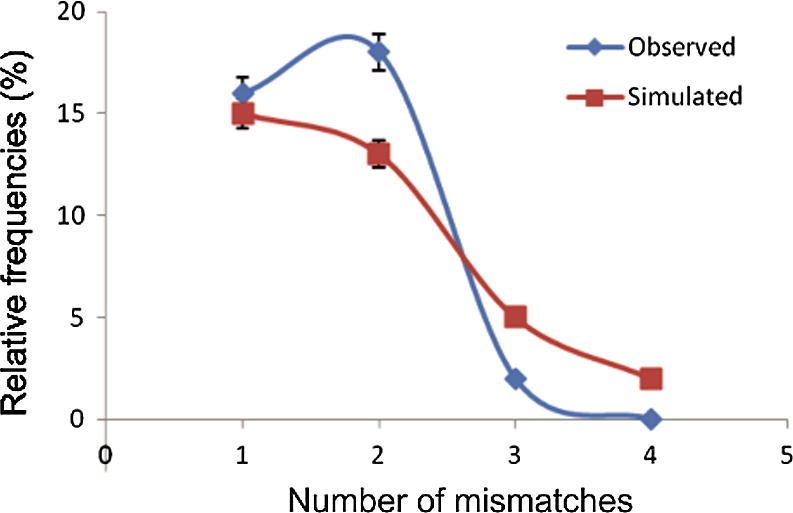
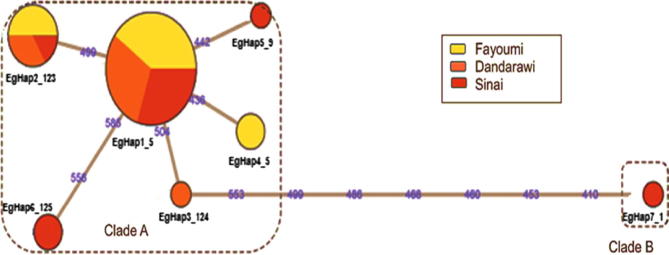
This study principally sought to reveal the demographic expansion of Egyptian indigenous chickens (EIC) using representative breeds: Sinai (North), Fayoumi (Middle) and Dandarawi (South) of Egypt as well as to deeply clarify their genetic diversity, possible matrilineal origin and dispersal routes. A total of 33 partial mitochondrial DNA sequences were generated from EIC and compared with a worldwide reference dataset of 1290 wild and domestic chicken sequences. Study populations had 12 polymorphic variable sites and 7 haplotypes. A lack of maternal substructure between EIC was detected (F ST = 0.003). The unimodal mismatch distribution and negative values of Tajima's D (-0.659) and Fu's Fs (-0.157) indicated demographic expansion among EIC and pointed to Fayoumi as the oldest EIC population. Egyptian haplotypes were clustered phylogenetically into two divergent clades. Their phylogeography revealed an ancient single maternal lineage of Egyptian chickens likely derived from Indian-Subcontinent. Moreover, a recent maternal commercial heritage possibly originated in Yunnan-Province and/or surrounding areas was admixed restrictedly into Sinai. It is implied that Egypt was an entry point for Indian chicken into Africa and its further dispersal route to Europe. This study provides a clue supporting the previous assumption that urged utilizing consistent founder populations having closely related progenitors for synthetizing a stabilized homogenous crossbreed as a sustainable discipline in breeding program.
本研究主要旨在揭示埃及本土鸡(EIC)的人口扩张情况,选用代表性品种:西奈(北部)、法尤米(中部)和丹达拉维(南部),并深入阐明它们的遗传多样性、可能的母系起源和扩散途径。共从 EIC 中生成了 33 个部分线粒体 DNA 序列,并与全球 1290 个野生和家鸡序列的参考数据集进行了比较。研究群体有 12 个多态性可变位点和 7 个单倍型。EIC 之间没有发现母系亚结构(F ST = 0.003)。单峰不匹配分布和 Tajima 的 D(-0.659)和 Fu 的 Fs(-0.157)的负值表明 EIC 之间存在种群扩张,并表明法尤米是最古老的 EIC 群体。埃及单倍型在系统发育上分为两个不同的分支。它们的地理遗传学揭示了埃及鸡可能源自印度次大陆的古老单一母系血统。此外,最近可能起源于云南省及其周边地区的商业母系遗产有限地混入了西奈。这表明埃及是印度鸡进入非洲的入口,也是其进一步向欧洲扩散的途径。本研究提供了一个线索,支持了之前的假设,即强烈要求利用具有密切相关祖先的一致创始群体来合成稳定的同质杂交种,作为一个可持续的学科在繁殖计划中。