Lambert Claude, Wu Yuenv, Aanei Carmen
Immunology Laboratory, Pole de Biologie-Pathologie, University Hospital of St Etienne , St Etienne , France.
Haematology Laboratory, Pole de Biologie-Pathologie, University Hospital of St Etienne , St Etienne , France.
Front Oncol. 2016 Jul 20;6:172. doi: 10.3389/fonc.2016.00172. eCollection 2016.
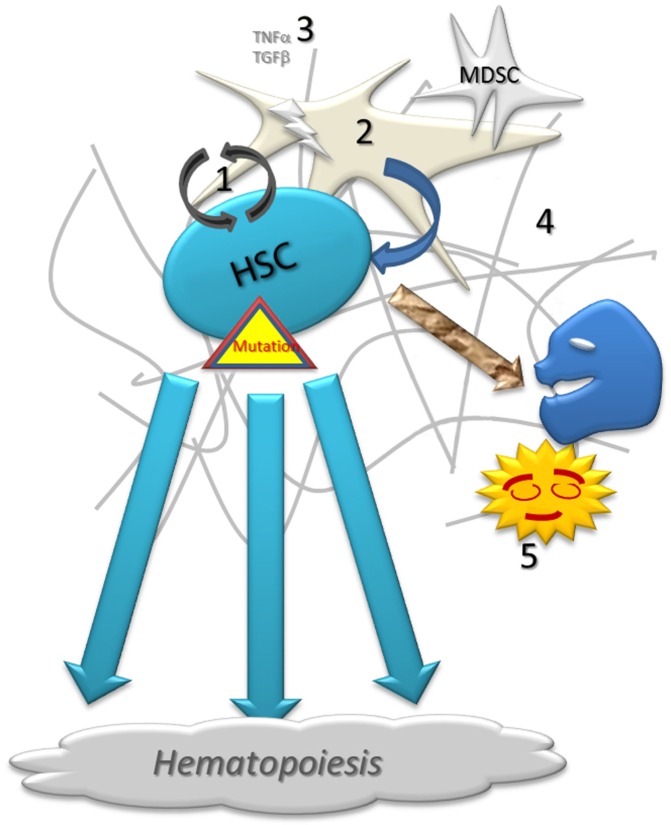
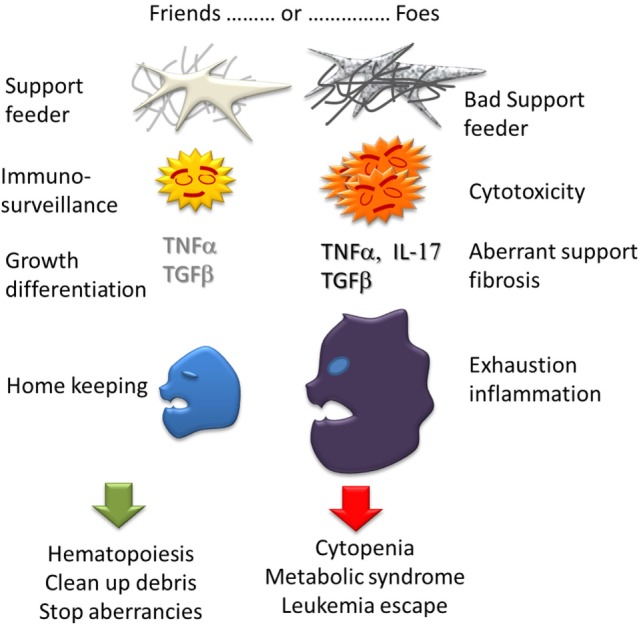
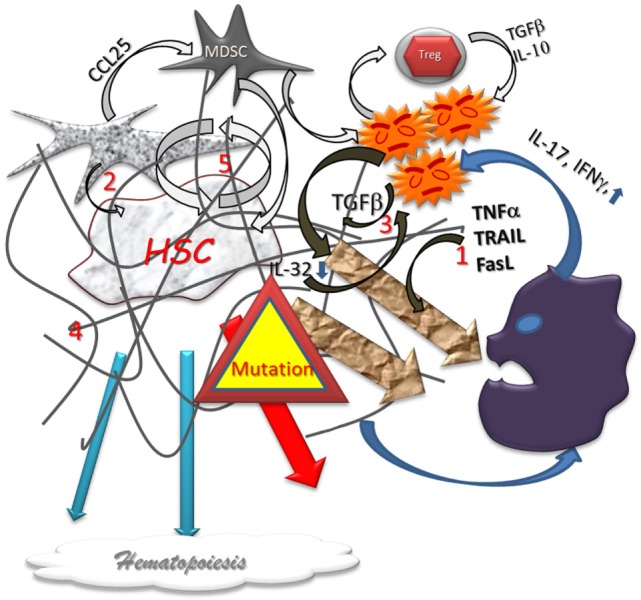
Myelodysplastic syndrome (MDS) is characterized by an ineffective hematopoiesis with production of aberrant clones and a high cell apoptosis rate in bone marrow (BM). Macrophages are in charge of phagocytosis. Innate Immune cells and specific T cells are in charge of immunosurveillance. Little is known on BM cell recruitment and activity as BM aspirate is frequently contaminated with peripheral blood. But evidences suggest an active role of immune cells in protection against MDS and secondary leukemia. BM CD8(+) CD28(-) CD57(+) T cells are directly cytotoxic and have a distinct cytokine signature in MDS, producing TNF-α, IL-6, CCL3, CCL4, IL-1RA, TNFα, FAS-L, TRAIL, and so on. These tools promote apoptosis of aberrant cells. On the other hand, they also increase MDS-related cytopenia and myelofibrosis together with TGFβ. IL-32 produced by stromal cells amplifies NK cytotoxicity but also the vicious circle of TNFα production. Myeloid-derived suppressing cells (MDSC) are increased in MDS and have ambiguous role in protection/progression of the diseases. CD33 is expressed on hematopoietic stem cells on MDS and might be a potential target for biotherapy. MDS also has impact on immunity and can favor chronic inflammation and emergence of autoimmune disorders. BM is the site of hematopoiesis and thus contains a complex population of cells at different stages of differentiation from stem cells and early engaged precursors up to almost mature cells of each lineage including erythrocytes, megakaryocytes, myelo-monocytic cells (monocyte/macrophage and granulocytes), NK cells, and B cells. Monocytes and B cell finalize their maturation in peripheral tissues or lymph nodes after migration through the blood. On the other hand, T cells develop in thymus and are present in BM only as mature cells, just like other well vascularized tissues. BM precursors have a strong proliferative capacity, which is usually associated with a high risk for genetic errors, cell dysfunction, and consequent cell death. Abnormal cells are prone to destruction through spontaneous apoptosis or because of the immunosurveillance that needs to stay highly vigilant. High rates of proliferation or differentiation failures lead to a high rate of cell death and massive release of debris to be captured and destroyed (1). Numerous macrophages reside in BM in charge of home-keeping. They have a high capacity of phagocytosis required for clearing all these debris.
骨髓增生异常综合征(MDS)的特征是造血无效,伴有异常克隆的产生以及骨髓(BM)中细胞凋亡率高。巨噬细胞负责吞噬作用。固有免疫细胞和特异性T细胞负责免疫监视。由于骨髓穿刺液经常被外周血污染,关于骨髓细胞募集和活性的了解甚少。但有证据表明免疫细胞在预防MDS和继发性白血病中发挥积极作用。骨髓CD8(+) CD28(-) CD57(+) T细胞具有直接细胞毒性,并且在MDS中具有独特的细胞因子特征,可产生TNF-α、IL-6、CCL3、CCL4、IL-1RA、TNFα、FAS-L、TRAIL等。这些因子促进异常细胞的凋亡。另一方面,它们还与TGFβ一起增加MDS相关的血细胞减少和骨髓纤维化。基质细胞产生的IL-32增强了NK细胞的细胞毒性,但也加剧了TNFα产生的恶性循环。骨髓来源的抑制细胞(MDSC)在MDS中增多,在疾病的保护/进展中作用不明确。CD33在MDS的造血干细胞上表达,可能是生物治疗的潜在靶点。MDS还会影响免疫,可能促进慢性炎症和自身免疫性疾病的出现。骨髓是造血的场所,因此包含一群复杂的细胞,这些细胞处于从干细胞和早期参与的前体细胞到每个谱系几乎成熟的细胞的不同分化阶段,包括红细胞、巨核细胞、髓单核细胞(单核细胞/巨噬细胞和粒细胞)、NK细胞和B细胞。单核细胞和B细胞在通过血液迁移后在周围组织或淋巴结中完成其成熟。另一方面,T细胞在胸腺中发育,仅作为成熟细胞存在于骨髓中,就像其他血管丰富的组织一样。骨髓前体细胞具有很强的增殖能力,这通常与遗传错误、细胞功能障碍以及随之而来的细胞死亡的高风险相关。异常细胞容易通过自发凋亡或由于需要保持高度警惕的免疫监视而被破坏。高增殖率或分化失败导致高细胞死亡率和大量碎片释放,这些碎片需要被捕获和破坏(1)。许多巨噬细胞存在于骨髓中负责维持内环境稳定。它们具有清除所有这些碎片所需的高吞噬能力。