Gill Amanda L, Green Samantha A, Abdullah Shahed, Le Saout Cecile, Pittaluga Stefania, Chen Hui, Turnier Refika, Lifson Jeffrey, Godin Steven, Qin Jing, Sneller Michael C, Cuillerot Jean-Marie, Sabzevari Helen, Lane H Clifford, Catalfamo Marta
aCMRS/Laboratory of Immunoregulation, NIAID bLaboratory of Pathology, NCI, NIH, Bethesda cClinical Support Laboratory, Leidos Biomedical Research, Inc. dAIDS and Cancer Virus Program, Retroviral Pathogenesis Section, Leidos Biomedical Research, Frederick National Laboratory, Frederick eSmithers Avanza Toxicology Services, Gaithersburg fBiostatistics Research Branch, DCR, NIAID, NIH, Bethesda, Maryland gEMD-Serono, Inc., Rockland hCompass Therapeutics, Cambridge, Massachusetts, USA. *Amanda L. Gill and Samantha A. Green contributed equally to the article.
AIDS. 2016 Oct 23;30(16):2487-2493. doi: 10.1097/QAD.0000000000001217.
The programed death-1 (PD1)/programed death-ligand 1 (PD-L1) pathway plays a critical role in balancing immunity and host immunopathology. During chronic HIV/SIV infection, there is persistent immune activation accompanied by accumulation of virus-specific cells with terminally differentiated phenotypes and expression of regulatory receptors such as PD1. These observations led us to hypothesize that the PD1/PD-L1 pathway contributes to the functional dysregulation and ineffective viral control, and its blockade may be a potential immunotherapeutic target.
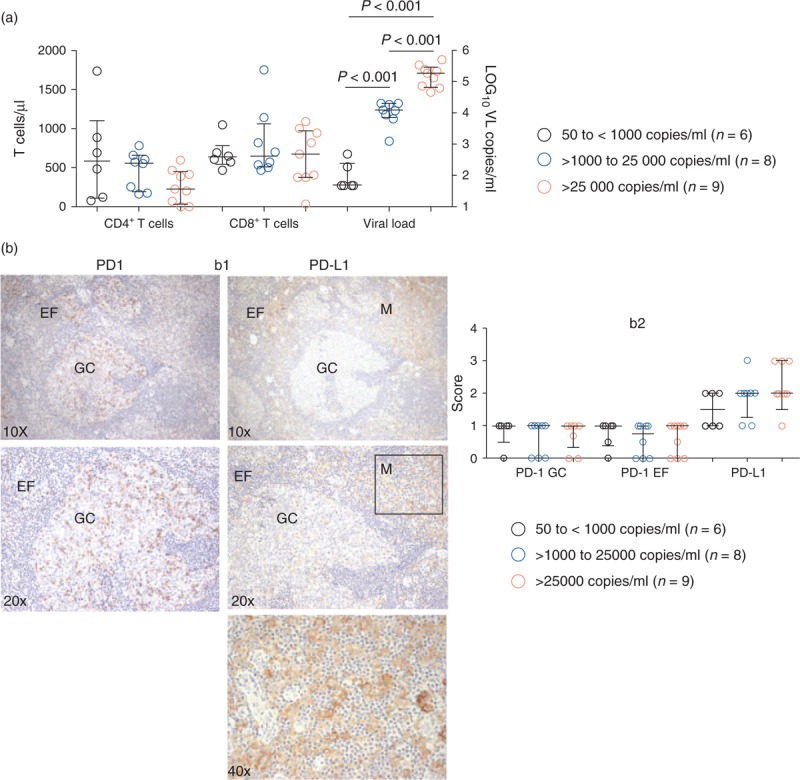
Lymph node biopsies from HIV-infected patients (n = 23) were studied for expression of PD1 and PD-L1. In addition, we assessed the safety and biological activity of a human anti-PD-L1 antibody (Avelumab) in chronically SIV-infected rhesus macaques.
PD-L1 expression was observed in cells with myloid/macrophage morphology in HIV-infected lymph nodes. Administration of anti-PD-L1 was well tolerated, and no changes in body weights, hematologic, or chemistry parameters were observed during the study. Blockade of PD-L1 led to a trend of transient viral control after discontinuation of treatment.
Administration of anti-PD-L1 in chronic SIV-infected rhesus macaques was well tolerated. Overall, these data warrant further investigation to assess the efficacy of anti-PD-L1 treatment on viral control in chronic SIV infection as a prelude to such therapy in humans.
程序性死亡蛋白1(PD1)/程序性死亡配体1(PD-L1)通路在平衡免疫和宿主免疫病理学方面发挥着关键作用。在慢性HIV/SIV感染期间,存在持续的免疫激活,伴随着具有终末分化表型的病毒特异性细胞的积累以及调节性受体如PD1的表达。这些观察结果使我们推测,PD1/PD-L1通路导致功能失调和病毒控制无效,其阻断可能是一个潜在的免疫治疗靶点。
研究了23例HIV感染患者的淋巴结活检组织中PD1和PD-L1的表达。此外,我们评估了一种人抗PD-L1抗体(阿维鲁单抗)在慢性SIV感染的恒河猴中的安全性和生物学活性。
在HIV感染淋巴结中,PD-L1在具有髓样/巨噬细胞形态的细胞中表达。抗PD-L1的给药耐受性良好,在研究期间未观察到体重、血液学或化学参数的变化。阻断PD-L1导致治疗中断后出现短暂病毒控制的趋势。
在慢性SIV感染的恒河猴中给予抗PD-L1耐受性良好。总体而言,这些数据值得进一步研究,以评估抗PD-L1治疗对慢性SIV感染中病毒控制的疗效,作为人类此类治疗的前奏。