Farr Alex, Kiss Herbert, Hagmann Michael, Holzer Iris, Kueronya Verena, Husslein Peter W, Petricevic Ljubomir
Department of Obstetrics and Gynaecology, Division of Obstetrics and Fetomaternal Medicine, Medical University of Vienna, Waehringer Guertel 18-20, A-1090, Vienna, Austria.
Section for Medical Statistics, Centre of Medical Statistics, Informatics and Intelligent Systems, Medical University of Vienna, Vienna, Austria.
BMC Pregnancy Childbirth. 2016 Aug 5;16(1):206. doi: 10.1186/s12884-016-1003-z.
Vaginal infections are a risk factor for preterm delivery. In this study, we sought to evaluate the vaginal flora of pregnant women receiving opioid maintenance therapy (OMT) in comparison to non-dependent, non-maintained controls.
A total of 3763 women with singleton pregnancies who underwent routine screening for asymptomatic vaginal infections between 10 + 0 and 16 + 0 gestational weeks were examined. Vaginal smears were Gram-stained, and microscopically evaluated for bacterial vaginosis, candidiasis, and trichomoniasis. In a retrospective manner, data of 132 women receiving OMT (cases) were matched for age, ethnicity, parity, education, previous preterm delivery, and smoking status to the data of 3631 controls. The vaginal flora at antenatal screening served as the primary outcome measure. Secondary outcome measures were gestational age and birth weight.
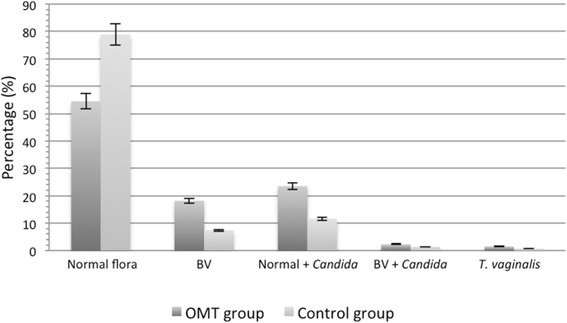
In the OMT group, 62/132 (47 %) pregnant women received methadone, 39/132 (29.5 %) buprenorphine, and 31/132 (23.5 %) slow-release oral morphine. Normal or intermediate flora was found in 72/132 OMT women (54.5 %) and 2865/3631 controls [78.9 %; OR 0.49 (95 % CI, 0.33-0.71); p < 0.001]. Candidiasis occurred more frequently in OMT women than in controls [OR 2.11 (95 % CI, 1.26-3.27); p < 0.001]. Findings were inconclusive regarding bacterial vaginosis (± candidiasis) and trichomoniasis. Compared to infants of the control group, those of women with OMT had a lower mean birth weight [MD -165.3 g (95 % CI, -283.6 to -46.9); p = 0.006].
Pregnant women with OMT are at risk for asymptomatic vaginal infections. As recurrent candidiasis is associated with preterm delivery, the vulnerability of this patient population should lead to consequent antenatal infection screening at early gestation.
阴道感染是早产的一个危险因素。在本研究中,我们试图评估接受阿片类药物维持治疗(OMT)的孕妇的阴道菌群,并与非依赖、非维持治疗的对照组进行比较。
对总共3763名单胎妊娠妇女进行了检查,这些妇女在妊娠10 + 0至16 + 0周期间接受了无症状阴道感染的常规筛查。阴道涂片进行革兰氏染色,并在显微镜下评估是否存在细菌性阴道病、念珠菌病和滴虫病。以回顾性方式,将132名接受OMT的妇女(病例)的年龄、种族、产次、教育程度、既往早产情况和吸烟状况与3631名对照组的数据进行匹配。产前筛查时的阴道菌群作为主要结局指标。次要结局指标为孕周和出生体重。
在OMT组中,62/132(47%)的孕妇接受美沙酮治疗,39/132(29.5%)接受丁丙诺啡治疗,31/132(23.5%)接受缓释口服吗啡治疗。72/132名接受OMT的妇女(54.5%)以及2865/3631名对照组妇女(78.9%)发现有正常或中间型菌群[比值比(OR)0.49(95%置信区间,0.33 - 0.71);p < 0.001]。念珠菌病在接受OMT的妇女中比对照组更频繁发生[OR 2.11(95%置信区间,1.26 - 3.27);p < 0.001]。关于细菌性阴道病(±念珠菌病)和滴虫病的研究结果尚无定论。与对照组婴儿相比,接受OMT的妇女所生婴儿的平均出生体重较低[平均差(MD)-165.3 g(95%置信区间,-283.6至-46.9);p = 0.006]。
接受OMT的孕妇有发生无症状阴道感染的风险。由于复发性念珠菌病与早产相关,该患者群体的易感性应导致在妊娠早期进行相应的产前感染筛查。