Shi Dong-Liang, Shi Gui-Rong, Xie Jing, Du Xu-Zhao, Yang Hao
No. 1 Department of Osteopathy, Henan Province Hospital of TCM, Zhengzhou, Henan, 450002, China.
Shangqiu Medical College, Shangqiu, Henan, 456000, China.
Mol Cells. 2016 Aug 31;39(8):611-8. doi: 10.14348/molcells.2016.0103. Epub 2016 Aug 8.
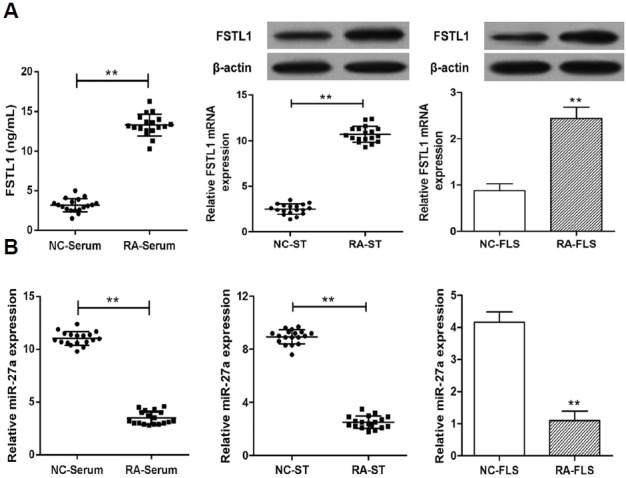
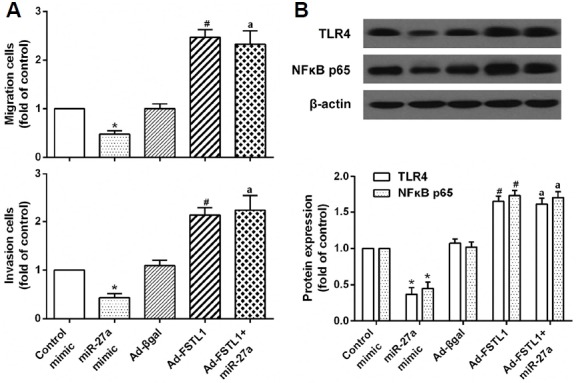
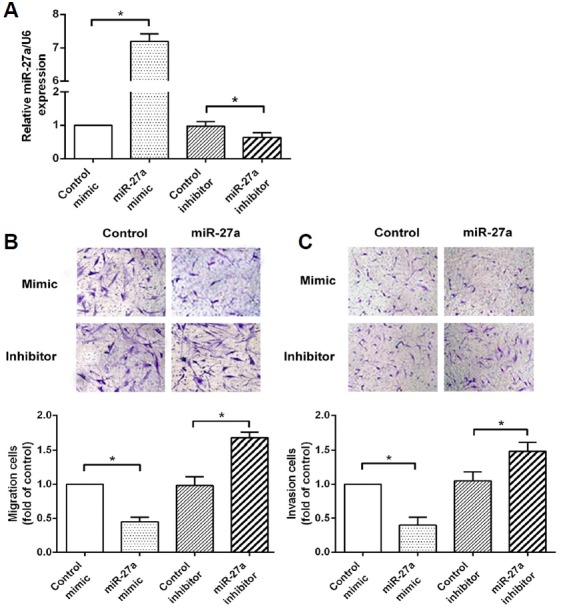
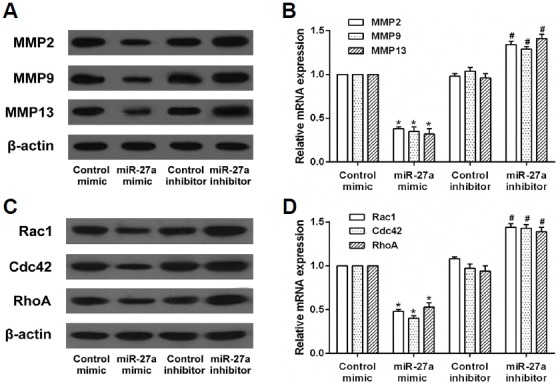
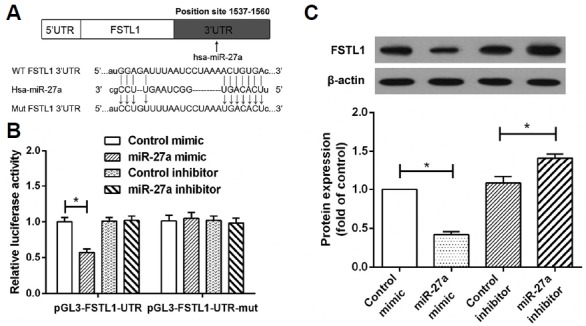
Fibroblast-like synoviocytes (FLS) with aberrant expression of microRNA (miRNA) are critical pathogenic regulators in rheumatoid arthritis (RA). Previous studies have found that overexpression or silencing of miRNA can contribute to the development of miRNA-based therapeutics in arthritis models. In this study, we explored the effects of miR-27a on cell migration and invasion in cultured FLS from RA patients. We found that miR-27a was markedly downregulated in the serum, synovial tissue, and FLS of RA patients. Meanwhile, the expression of follistatin-like protein 1 (FSTL1) was upregulated, which suggests that FSTL1 plays a key role in RA development. The results of a Transwell assay showed that miR-27a inhibited FLS migration and invasion. However, miR-27a inhibition promoted the migration and invasion of FLS. In addition, the down-regulated expression of matrix metalloproteinases (MMP2, MMP9, and MMP13) and Rho family proteins (Rac1, Cdc42, and RhoA) was detected after treatment with miR-27a in RA-FLS by quantitative reverse transcription-PCR and western blot analysis. Then, a luciferase reporter assay validated that miR-27a targeted the 3-untranslated region (3'-UTR) of FSTL1. Moreover, miR-27a caused a significant decrease of FSTL1. In addition, the expression of TLR4 and NFκB was inhibited by miR-27a but increased by FSTL1 overexpression. In conclusion, we found that miR-27a inhibited cell migration and invasion of RA-FLS by targeting FSTL1 and restraining the TLR4/NFκB pathway.
微小RNA(miRNA)表达异常的成纤维样滑膜细胞(FLS)是类风湿关节炎(RA)的关键致病调节因子。先前的研究发现,miRNA的过表达或沉默有助于在关节炎模型中开发基于miRNA的疗法。在本研究中,我们探讨了miR-27a对RA患者培养的FLS细胞迁移和侵袭的影响。我们发现,RA患者的血清、滑膜组织和FLS中miR-27a明显下调。同时,卵泡抑素样蛋白1(FSTL1)的表达上调,这表明FSTL1在RA发展中起关键作用。Transwell实验结果表明,miR-27a抑制FLS的迁移和侵袭。然而,抑制miR-27a可促进FLS的迁移和侵袭。此外,通过定量逆转录-PCR和蛋白质印迹分析检测到,用miR-27a处理RA-FLS后,基质金属蛋白酶(MMP2、MMP9和MMP13)和Rho家族蛋白(Rac1、Cdc42和RhoA)的表达下调。然后,荧光素酶报告基因实验验证miR-27a靶向FSTL1的3'-非翻译区(3'-UTR)。此外,miR-27a导致FSTL1显著降低。此外,miR-27a抑制TLR4和NFκB的表达,但FSTL1过表达则使其增加。总之,我们发现miR-27a通过靶向FSTL1并抑制TLR4/NFκB途径来抑制RA-FLS的细胞迁移和侵袭。