Howden Sara E, McColl Bradley, Glaser Astrid, Vadolas Jim, Petrou Steven, Little Melissa H, Elefanty Andrew G, Stanley Edouard G
Murdoch Childrens Research Institute, The Royal Children's Hospital, Flemington Road, Parkville, VIC 3052, Australia; Department of Paediatrics, Faculty of Medicine, Dentistry and Health Sciences, University of Melbourne, Parkville, VIC 3052, Australia.
Murdoch Childrens Research Institute, The Royal Children's Hospital, Flemington Road, Parkville, VIC 3052, Australia.
Stem Cell Reports. 2016 Sep 13;7(3):508-517. doi: 10.1016/j.stemcr.2016.07.001. Epub 2016 Aug 4.
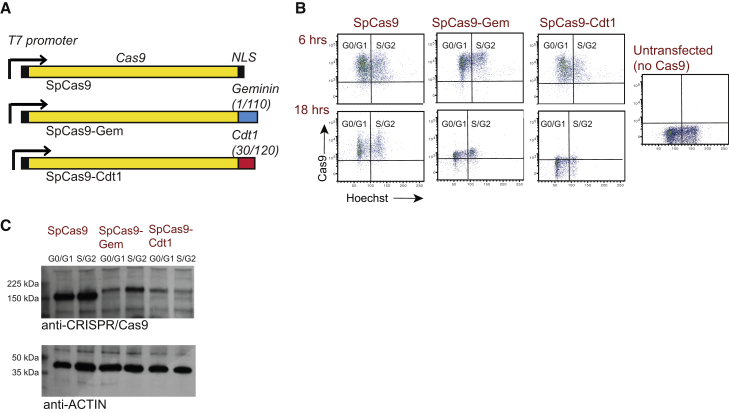
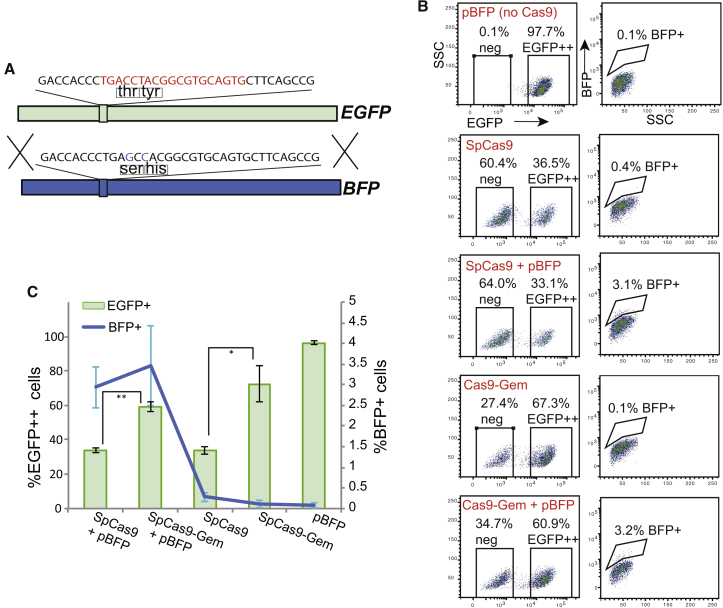
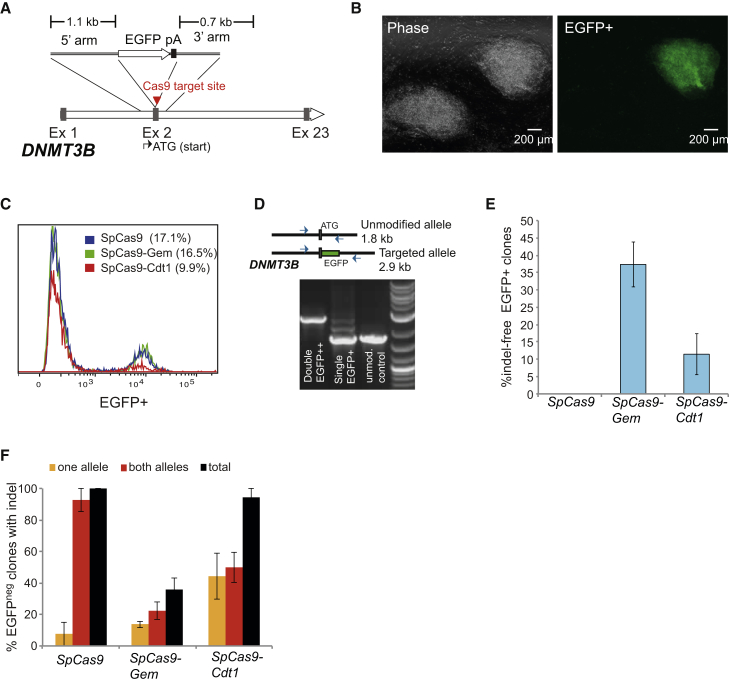
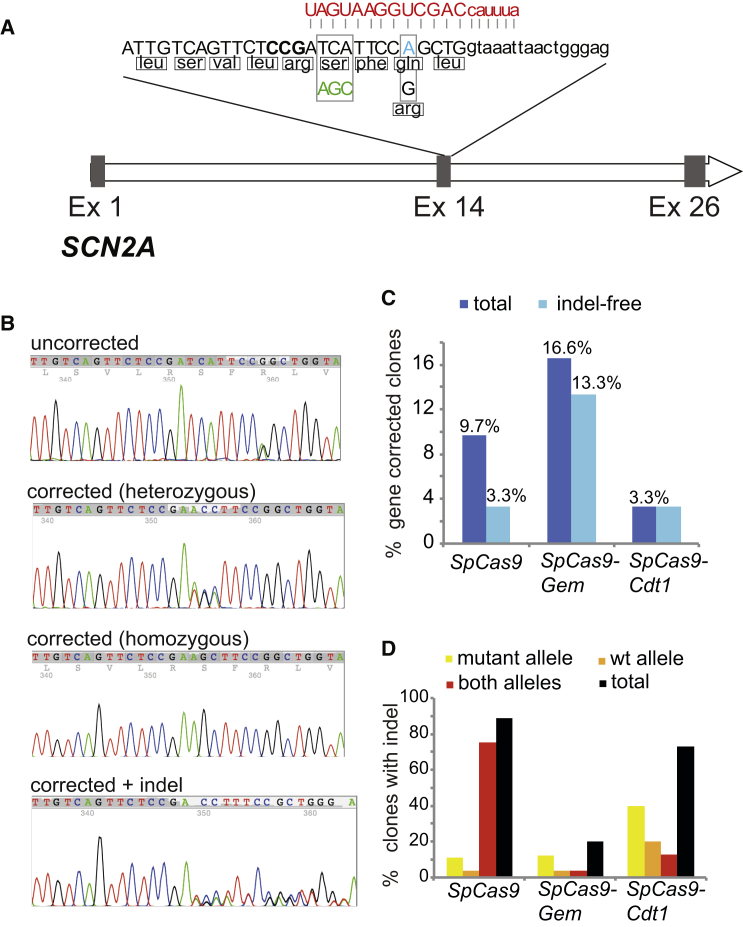
While Cas9 nucleases permit rapid and efficient generation of gene-edited cell lines, the CRISPR-Cas9 system can introduce undesirable "on-target" mutations within the second allele of successfully modified cells via non-homologous end joining (NHEJ). To address this, we fused the Streptococcus pyogenes Cas9 (SpCas9) nuclease to a peptide derived from the human Geminin protein (SpCas9-Gem) to facilitate its degradation during the G1 phase of the cell cycle, when DNA repair by NHEJ predominates. We also use mRNA transfection to facilitate low and transient expression of modified and unmodified versions of Cas9. Although the frequency of homologous recombination was similar for SpCas9-Gem and SpCas9, we observed a marked reduction in the capacity for SpCas9-Gem to induce NHEJ-mediated indels at the target locus. Moreover, in contrast to native SpCas9, we demonstrate that transient SpCas9-Gem expression enables reliable generation of both knockin reporter cell lines and genetically repaired patient-specific induced pluripotent stem cell lines free of unwanted mutations at the targeted locus.
虽然Cas9核酸酶可快速高效地生成基因编辑细胞系,但CRISPR-Cas9系统可通过非同源末端连接(NHEJ)在成功修饰细胞的第二个等位基因内引入不良的“脱靶”突变。为了解决这一问题,我们将化脓性链球菌Cas9(SpCas9)核酸酶与人Geminin蛋白衍生的肽融合(SpCas9-Gem),以便在细胞周期的G1期(此时NHEJ介导的DNA修复占主导)促进其降解。我们还使用mRNA转染来促进Cas9修饰和未修饰版本的低水平瞬时表达。虽然SpCas9-Gem和SpCas所介导的同源重组频率相似,但我们观察到SpCas9-Gem在靶位点诱导NHEJ介导的插入缺失的能力显著降低。此外,与天然SpCas9不同,我们证明瞬时SpCas9-Gem表达能够可靠地生成敲入报告细胞系和基因修复的患者特异性诱导多能干细胞系,且在靶位点没有不需要的突变。