Broad Institute of MIT and Harvard, Cambridge, Massachusetts 02142, USA.
Analytic and Translational Genetics Unit, Massachusetts General Hospital, Harvard Medical School, Boston, Massachusetts 02114, USA.
Nat Commun. 2016 Aug 9;7:12342. doi: 10.1038/ncomms12342.
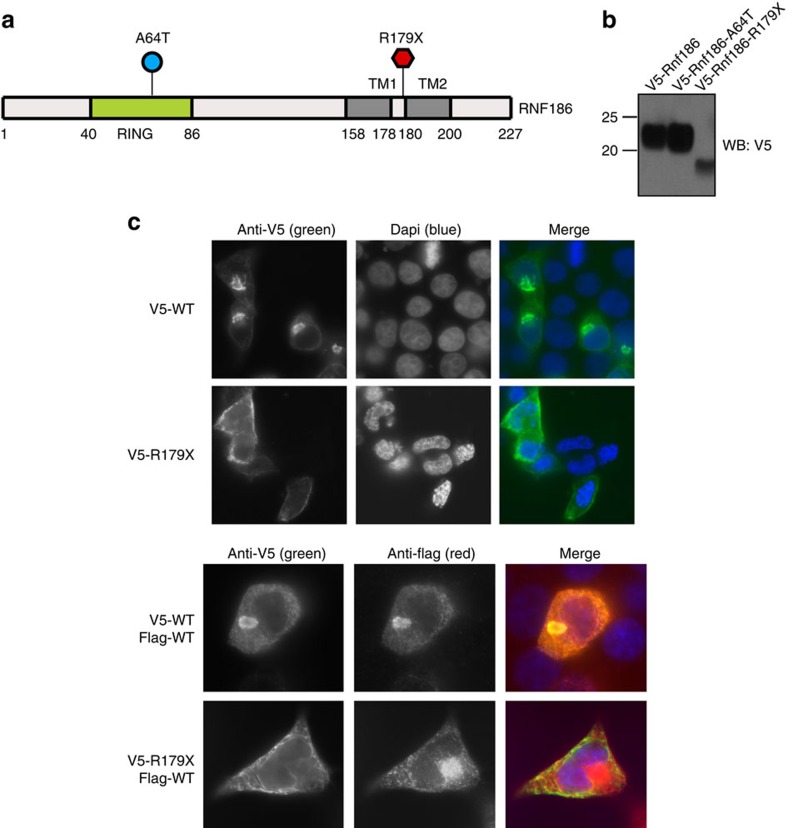
Protein-truncating variants protective against human disease provide in vivo validation of therapeutic targets. Here we used targeted sequencing to conduct a search for protein-truncating variants conferring protection against inflammatory bowel disease exploiting knowledge of common variants associated with the same disease. Through replication genotyping and imputation we found that a predicted protein-truncating variant (rs36095412, p.R179X, genotyped in 11,148 ulcerative colitis patients and 295,446 controls, MAF=up to 0.78%) in RNF186, a single-exon ring finger E3 ligase with strong colonic expression, protects against ulcerative colitis (overall P=6.89 × 10(-7), odds ratio=0.30). We further demonstrate that the truncated protein exhibits reduced expression and altered subcellular localization, suggesting the protective mechanism may reside in the loss of an interaction or function via mislocalization and/or loss of an essential transmembrane domain.
靶向测序发现可预防炎症性肠病的蛋白截断变异,为治疗靶点提供体内验证。本研究利用与同种疾病相关的常见变异信息,对可预防炎症性肠病的蛋白截断变异进行了探索。通过复制基因分型和内插,我们发现 RNF186 中的一个预测蛋白截断变异(rs36095412,p.R179X,在 11148 例溃疡性结肠炎患者和 295446 例对照中进行了基因分型,MAF 高达 0.78%),是一种具有强结肠表达的单外显子环指 E3 连接酶,可预防溃疡性结肠炎(总体 P=6.89×10(-7),比值比=0.30)。我们进一步证明,截断蛋白表达降低,亚细胞定位改变,提示该保护机制可能通过错误定位和/或丧失必需跨膜结构域,导致相互作用或功能丧失。