Ziehm Jeanette, Farin Erik, Schäfer Jonas, Woitha Kathrin, Becker Gerhild, Köberich Stefan
Section of Health Care Research and Rehabilitation Research, Medical Center - University of Freiburg, Faculty of Medicine, University of Freiburg, Engelbergerstr. 21, 79106, Freiburg, Germany.
Department of Thoracic Surgery, Medical Center - University of Freiburg, Faculty of Medicine, University of Freiburg, Hugstetter Str. 55, 79106, Freiburg, Germany.
BMC Health Serv Res. 2016 Aug 8;16(a):361. doi: 10.1186/s12913-016-1609-x.
Compared to patients with cancer, heart failure patients are seldom candidates for palliative care. Numerous studies have investigated reasons why heart failure patients do not receive palliative care; however, none of these studies have ever evaluated the situation in the German health care setting. This study aims to identify German healthcare providers' (HCP) perception of barriers and facilitators to palliative care of patients with chronic heart failure.
We conducted an online-survey with 315 nurses and physicians of different medical disciplines.
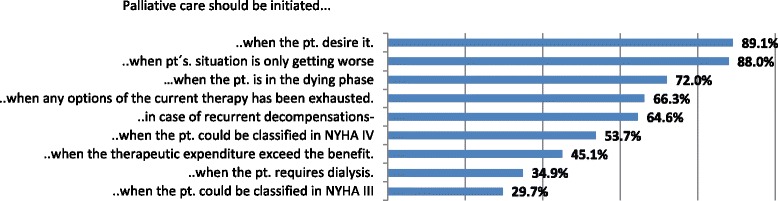
Even though heart failure patients' need of palliative care and its advantages has been recognized, HCP see potential for development and improvement. A lack of knowledge about the content and measures of palliative care, poor communication and unclear responsibilities between medical disciplines, difficulties to determine the right time to initiate palliative care, and the feeling not to be prepared to discuss end-of-life issues with the patient has been identified as barriers. Further, HCP believe that patients and relatives do not possess adequate knowledge about the disease and its progression and are therefore unprepared in asking questions regarding palliative care. They rather tend to demand everything possible to be done in order prolong life, and are reluctant to accept that life is limited. Overall, HCP perceive that dying is a taboo subject within our society placing palliative care on the same level as assisted dying. In addition, results indicate that HCP have an inappropriate notion of ideal medicine fearing to lose patient and are worried about the appropriateness of PC remuneration.
In order to overcome the described barriers, HCP, patients, and relatives need to be educated in palliative care. Information and education encompassing the aim, content and measures of palliative care needs to be provided for all parties in order to optimize patient care, to foster communication between healthcare professionals, patients, and relatives, and to overcome perceived barriers.
DRKS00007119.
与癌症患者相比,心力衰竭患者很少成为姑息治疗的对象。众多研究调查了心力衰竭患者未接受姑息治疗的原因;然而,这些研究均未评估德国医疗环境下的情况。本研究旨在确定德国医疗服务提供者(HCP)对慢性心力衰竭患者姑息治疗的障碍和促进因素的看法。
我们对315名不同医学学科的护士和医生进行了在线调查。
尽管心力衰竭患者对姑息治疗的需求及其优势已得到认可,但医疗服务提供者认为仍有发展和改进的空间。对姑息治疗的内容和措施缺乏了解、医学学科之间沟通不畅和职责不明确、难以确定启动姑息治疗的正确时机,以及感觉没有准备好与患者讨论临终问题,这些都被确定为障碍。此外,医疗服务提供者认为患者及其亲属对疾病及其进展没有足够的了解,因此在询问有关姑息治疗的问题时没有准备。他们更倾向于要求尽一切可能延长生命,并且不愿意接受生命是有限的。总体而言,医疗服务提供者认为死亡在我们的社会中是一个禁忌话题,将姑息治疗与协助死亡相提并论。此外,结果表明医疗服务提供者对理想医学有不恰当的观念,担心失去患者,并担心姑息治疗的薪酬是否合理。
为了克服上述障碍,需要对医疗服务提供者、患者及其亲属进行姑息治疗方面的教育。需要为所有各方提供包括姑息治疗的目标、内容和措施的信息和教育,以优化患者护理,促进医疗专业人员、患者及其亲属之间的沟通,并克服感知到的障碍。
DRKS00007119。