Klindtworth Katharina, Oster Peter, Hager Klaus, Krause Olaf, Bleidorn Jutta, Schneider Nils
Institute for General Practice, Hannover Medical School, Carl-Neuberg-Str. 1, 30625, Hanover, Germany.
AGAPLESION Bethanien Hospital, Geriatric Centre at the University, Heidelberg, Germany.
BMC Geriatr. 2015 Oct 15;15:125. doi: 10.1186/s12877-015-0124-y.
Heart failure (HF) is a life-limiting illness and patients with advanced heart failure often suffer from severe physical and psychosocial symptoms. Particularly in older patients, HF often occurs in conjunction with other chronic diseases, resulting in complex co-morbidity. This study aims to understand how old and very old patients with advanced HF perceive their disease and to identify their medical, psychosocial and information needs, focusing on the last phase of life.
Qualitative longitudinal interview study with old and very old patients (≥70 years) with severe HF (NYHA III-IV). Interviews were conducted at three-month intervals over a period of up to 18 months and were analysed using qualitative methods in relation to Grounded Theory.
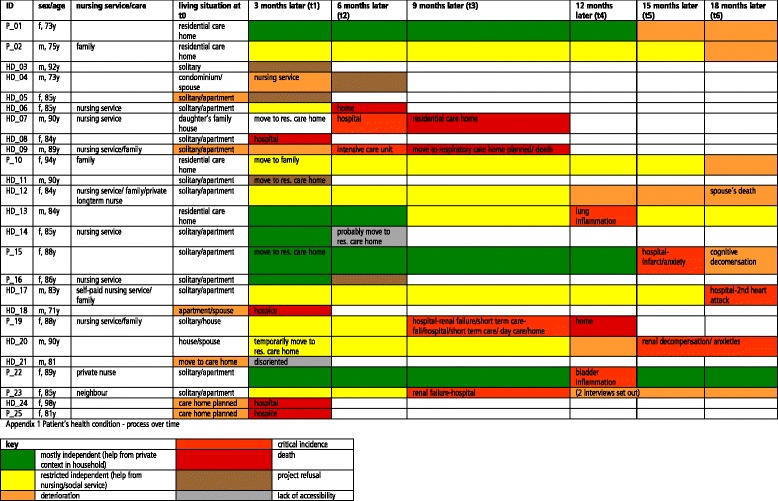
A total of 95 qualitative interviews with 25 patients were conducted and analysed. The following key categories were developed: (1a) dealing with advanced heart failure and ageing, (1b) dealing with end of life; (2a) perceptions regarding care, and (2b) interpersonal relations. Overall, our data show that older patients do not experience HF as a life-limiting disease. Functional restrictions and changed conditions leading to problems in daily life activities were often their prime concerns. The needs and priorities of older HF patients vary depending on their disease status and individual preferences. Pain resulting in reduced quality of life is an example of a major symptom requiring treatment. Many older HF patients lack sufficient knowledge about their condition and its prognosis, particularly concerning emergency situations and end of life issues, and many expressed a wish for open discussions. From the patients' perspective, there is a need for improvement in interaction with health care professionals, and limits in treatment and medical care are not openly discussed.
Old and very old patients with advanced HF often do not acknowledge the seriousness and severity of the disease. Their communication with physicians predominantly focuses on curative treatment. Therefore, aspects such as self-management of the disease, dealing with emergency situations and end-of-life issues should be addressed more prominently. An advanced care planning (ACP) programme for heart disease in older people could be an option to improve patient-centred care.
心力衰竭(HF)是一种危及生命的疾病,晚期心力衰竭患者常常遭受严重的身体和心理社会症状。尤其是老年患者,HF常与其他慢性疾病并发,导致复杂的合并症。本研究旨在了解老年和高龄晚期HF患者如何看待他们的疾病,并确定他们在医疗、心理社会和信息方面的需求,重点关注生命的最后阶段。
对老年和高龄(≥70岁)重度HF(纽约心脏协会III-IV级)患者进行定性纵向访谈研究。访谈每隔三个月进行一次,为期最长18个月,并采用与扎根理论相关的定性方法进行分析。
共对25名患者进行了95次定性访谈并进行分析。确定了以下关键类别:(1a)应对晚期心力衰竭和衰老,(1b)应对生命末期;(2a)对护理的看法,以及(2b)人际关系。总体而言,我们的数据表明老年患者并不将HF视为一种危及生命的疾病。功能受限以及导致日常生活活动出现问题的状况变化往往是他们最主要的担忧。老年HF患者的需求和优先事项因其疾病状况和个人偏好而异。导致生活质量下降的疼痛是需要治疗的主要症状之一。许多老年HF患者对自己的病情及其预后了解不足,尤其是在紧急情况和生命末期问题方面,许多人表示希望进行坦诚的讨论。从患者的角度来看,与医护人员的互动需要改进,并且治疗和医疗护理的局限性并未得到公开讨论。
老年和高龄晚期HF患者往往不承认该疾病的严重性。他们与医生的沟通主要集中在治愈性治疗上。因此,疾病的自我管理、应对紧急情况和生命末期问题等方面应得到更突出的关注。针对老年人的心脏病晚期护理计划(ACP)方案可能是改善以患者为中心的护理的一种选择。