Cottam William J, Condon Laura, Alshuft Hamza, Reckziegel Diane, Auer Dorothee P
Arthritis Research UK Pain Centre, University of Nottingham, Nottingham, UK; Sir Peter Mansfield Imaging Centre, University of Nottingham, Nottingham, UK; Division of Clinical Neuroscience, Radiological Sciences, University of Nottingham, Queen's Medical Centre, Nottingham, UK.
Arthritis Research UK Pain Centre, University of Nottingham, Nottingham, UK; Division of Clinical Neuroscience, Radiological Sciences, University of Nottingham, Queen's Medical Centre, Nottingham, UK.
Neuroimage Clin. 2016 Jul 1;12:269-76. doi: 10.1016/j.nicl.2016.06.022. eCollection 2016.
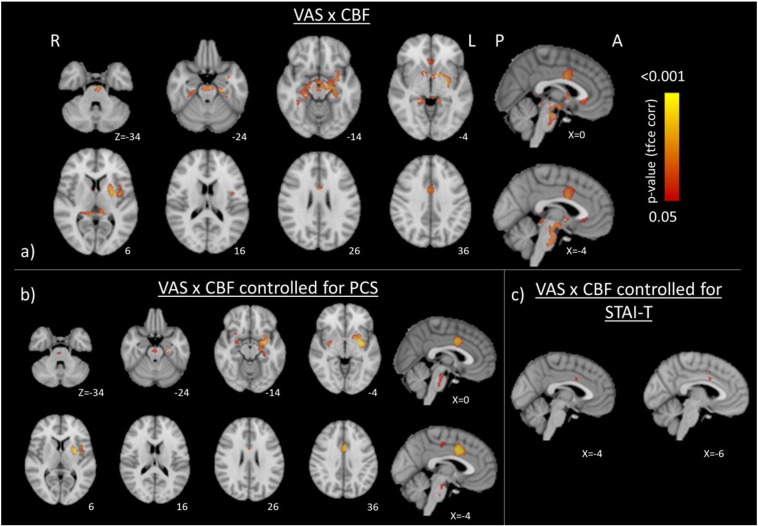
Functional magnetic resonance imaging studies (fMRI) have transformed our understanding of central processing of evoked pain but the typically used block and event-related designs are not best suited to the study of ongoing pain. Here we used arterial spin labelling (ASL) for cerebral blood flow mapping to characterise the neural correlates of perceived intensity of osteoarthritis (OA) pain and its interrelation with negative affect. Twenty-six patients with painful knee OA and twenty-seven healthy controls underwent pain phenotyping and ASL MRI at 3T. Intensity of OA pain correlated positively with blood flow in the anterior mid-cingulate cortex (aMCC), subgenual cingulate cortex (sgACC), bilateral hippocampi, bilateral amygdala, left central operculum, mid-insula, putamen and the brainstem. Additional control for trait anxiety scores reduced the pain-CBF association to the aMCC, whilst pain catastrophizing scores only explained some of the limbic correlations. In conclusion, we found that neural correlates of reported intensity of ongoing chronic pain intensity mapped to limbic-affective circuits, and that the association pattern apart from aMCC was explained by trait anxiety thus highlighting the importance of aversiveness in the experience of clinical pain.
功能磁共振成像研究(fMRI)改变了我们对诱发疼痛中枢处理的理解,但通常使用的组块设计和事件相关设计并不最适合于持续性疼痛的研究。在此,我们使用动脉自旋标记(ASL)进行脑血流图谱分析,以表征骨关节炎(OA)疼痛感知强度的神经关联及其与消极情绪的相互关系。26例膝关节疼痛性OA患者和27名健康对照者在3T条件下接受疼痛表型分析和ASL MRI检查。OA疼痛强度与前扣带回中部皮质(aMCC)、膝下扣带回皮质(sgACC)、双侧海马、双侧杏仁核、左侧中央岛盖、岛叶中部、壳核和脑干的血流呈正相关。对特质焦虑评分进行额外控制后,疼痛与脑血流的关联仅存在于aMCC,而疼痛灾难化评分仅解释了部分边缘系统的相关性。总之,我们发现,持续性慢性疼痛强度报告的神经关联映射到边缘-情感回路,除aMCC外的关联模式由特质焦虑解释,从而突出了厌恶感在临床疼痛体验中的重要性。