Yin Shuai, Zhang Zhen-Hua, Chang Yi-Niu, Huang Jin, Wu Ming-Li, Li Qi, Qiu Jin-Qi, Feng Xiao-Dong, Wu Nan
Rehabilitation Center, The First Affiliated Hospital of Henan University of Chinese Medicine, Zhengzhou, Henan, 450000, People's Republic of China.
School of Rehabilitation Medicine, Henan University of Chinese Medicine, Zhengzhou, Henan, 450046, People's Republic of China.
J Pain Res. 2022 May 18;15:1443-1455. doi: 10.2147/JPR.S356044. eCollection 2022.
Abnormal central nervous system function is the key central pathological factor leading to chronic pain in patients with knee osteoarthritis (KOA). Acupuncture can effectively relieve the pain of KOA patients. However, the central nervous mechanism of acupuncture treating KOA is not fully understood. This trial will use functional magnetic resonance imaging (fMRI) analysis techniques to investigate the potential central nervous mechanism of acupuncture treatment of KOA.
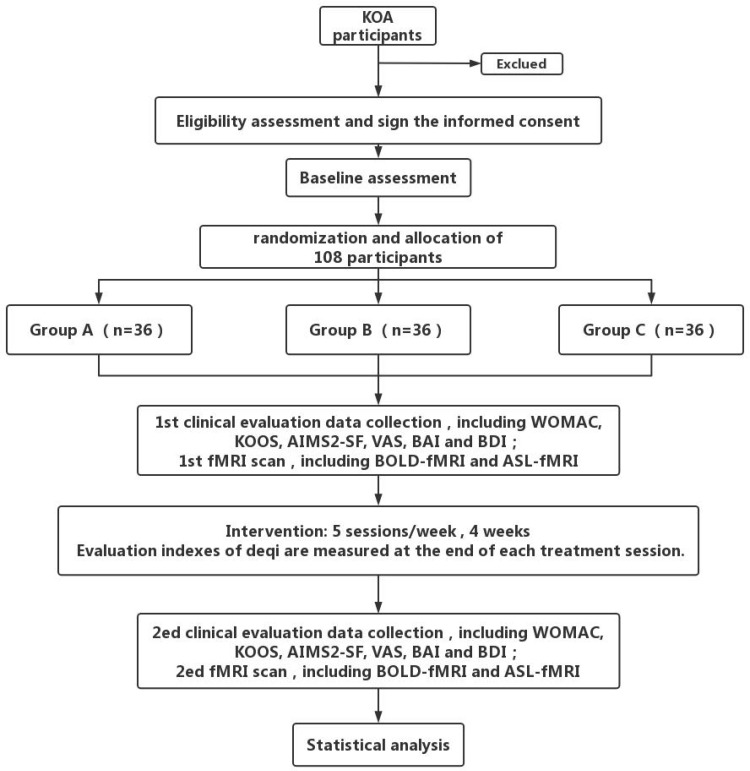
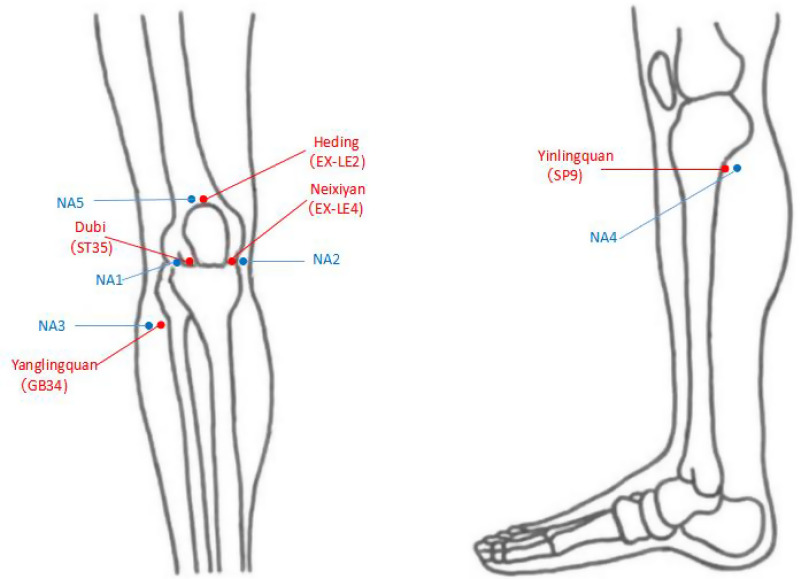
A total of 108 patients will be randomized (in a 1:1:1 ratio) into three groups, this trial will include 4-week treatment, patients in groups A and B will receive 20 acupuncture and sham acupuncture sessions, respectively, patients in group C will not receive any intervention, and all patients will receive fMRI scans before and after the intervention. The Western Ontario and McMaster Universities Osteoarthritis Index score (WOMAC) will be the primary clinical outcome. Then, we will explore the functional changes of the cognitive control network (CCN) in the brains of KOA patients through whole brain functional connectivity (FC) analysis and seed-based functional connectivity (sFC) analysis. Pearson correlation coefficient will be used to analyze the relationship between the improved value of the clinical correlation scale and the change of fMRI data.
This trial will analyze the efficacy of verum acupuncture, sham acupuncture and the waiting-list for KOA and explore the activity of the CCN in three groups of patients by fMRI, so as to reveal the central nervous mechanisms of acupuncture in the treatment of KOA.
This study is approved by the Ethics Committee of the First Affiliated Hospital of Henan University of Traditional Chinese Medicine (No: 2019HL-133-01) and registered in the Chinese Clinical Trial Registry, ChiCTR2000038554.
中枢神经系统功能异常是导致膝关节骨关节炎(KOA)患者慢性疼痛的关键中枢病理因素。针灸可有效缓解KOA患者的疼痛。然而,针灸治疗KOA的中枢神经机制尚未完全明确。本试验将采用功能磁共振成像(fMRI)分析技术,探讨针灸治疗KOA的潜在中枢神经机制。
总共108例患者将被随机(按1:1:1比例)分为三组,本试验为期4周,A组和B组患者将分别接受20次真针灸和假针灸治疗,C组患者不接受任何干预,所有患者在干预前后均接受fMRI扫描。西安大略和麦克马斯特大学骨关节炎指数评分(WOMAC)将作为主要临床结局。然后,我们将通过全脑功能连接(FC)分析和基于种子点的功能连接(sFC)分析,探索KOA患者大脑中认知控制网络(CCN)的功能变化。采用Pearson相关系数分析临床相关量表改善值与fMRI数据变化之间的关系。
本试验将分析真针灸、假针灸及等待组对KOA的疗效,并通过fMRI探索三组患者CCN的活动情况,以揭示针灸治疗KOA的中枢神经机制。
本研究已获河南中医药大学第一附属医院伦理委员会批准(编号:2019HL-133-01),并在中国临床试验注册中心注册,注册号为ChiCTR2000038554。