Fennell Vernard S, Kalani M Yashar S, Atwal Gursant, Martirosyan Nikolay L, Spetzler Robert F
Department of Neurosurgery, Barrow Neurological Institute, St. Joseph's Hospital and Medical Center , Phoenix, AZ , USA.
Front Surg. 2016 Jul 25;3:43. doi: 10.3389/fsurg.2016.00043. eCollection 2016.
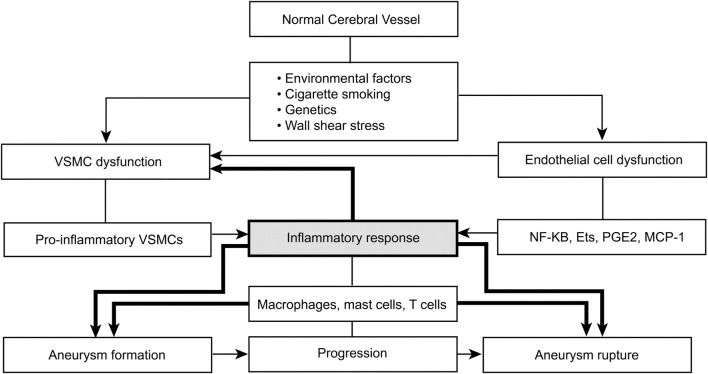
Understanding the biology of intracranial aneurysms is a clinical quandary. How these aneurysms form, progress, and rupture is poorly understood. Evidence indicates that well-established risk factors play a critical role, along with immunologic factors, in their development and clinical outcomes. Much of the expanding knowledge of the inception, progression, and rupture of intracranial aneurysms implicates inflammation as a critical mediator of aneurysm pathogenesis. Thus, therapeutic targets exploiting this arm of aneurysm pathogenesis have been implemented, often with promising outcomes.
了解颅内动脉瘤的生物学特性是一个临床难题。这些动脉瘤如何形成、发展和破裂,目前还知之甚少。有证据表明,公认的风险因素以及免疫因素在其发展和临床结果中起着关键作用。关于颅内动脉瘤的起始、发展和破裂的知识不断扩展,其中很多都表明炎症是动脉瘤发病机制的关键介质。因此,针对动脉瘤发病机制的这一方面已实施了治疗靶点,且往往取得了令人鼓舞的成果。