Biadgilign Sibhatu, Shumetie Arega, Yesigat Habtamu
Public Health Nutrition Research, Addis Ababa, Ethiopia.
Department of Economics, Haramaya University of Ethiopia and Makerere University of Uganda, Harar, Ethiopia.
PLoS One. 2016 Aug 10;11(8):e0160050. doi: 10.1371/journal.pone.0160050. eCollection 2016.
Policy discussions and debates in the last couple of decades emphasized efficiency of development policies for translating economic growth to development. One of the key aspects in this regard in the developing world is achieving improved nutrition through economic development. Nonetheless, there is a dearth of literature that empirically verifies the association between economic growth and reduction of childhood undernutrition in low- and middle-income countries. Thus, the aim of the study is to assess the interplay between economic growth and reduction of childhood undernutrition in Ethiopia.
The study used pooled data of three rounds (2000, 2005 and 2010) from the Demographic and Health Surveys (DHS) of Ethiopia. A multilevel mixed logistic regression model with robust standard errors was utilized in order to account for the hierarchical nature of the data. The dependent variables were stunting, underweight, and wasting in children in the household. The main independent variable was real per capita income (PCI) that was adjusted for purchasing power parity. This information was obtained from World Bank.
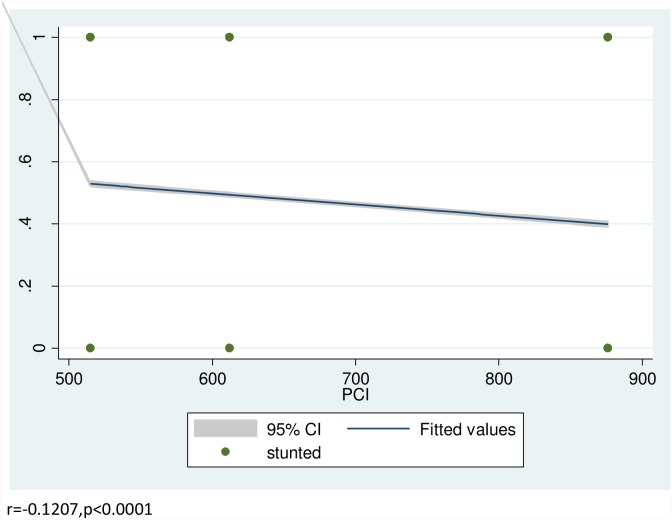
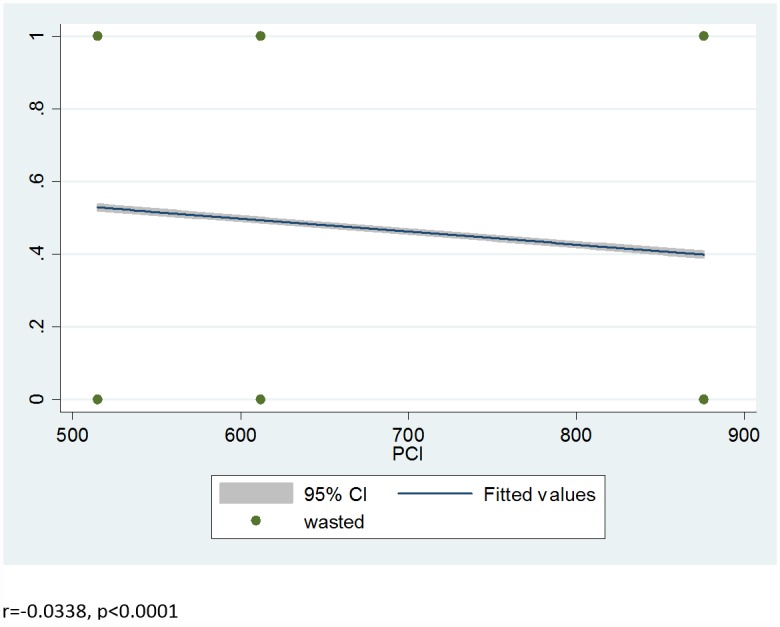
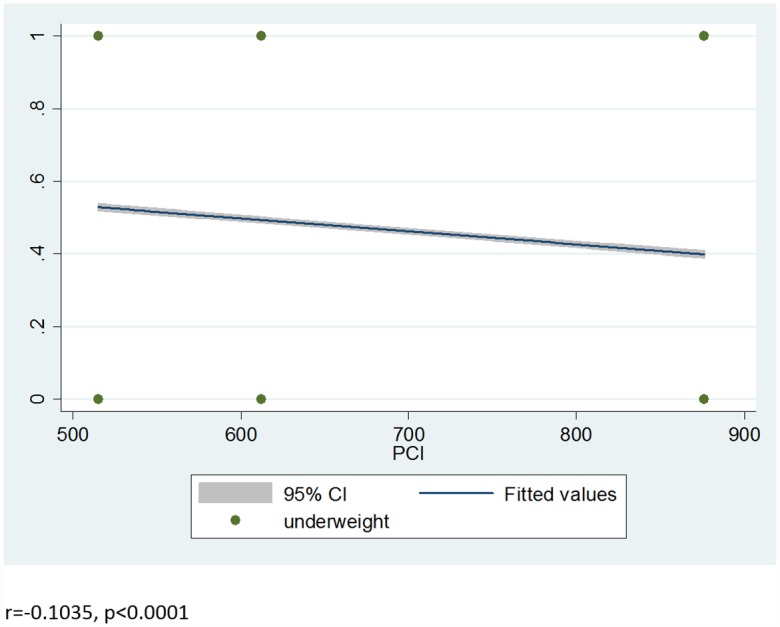
A total of 32,610 children were included in the pooled analysis. Overall, 11,296 (46.7%) [46.0%-47.3%], 8,197(33.8%) [33.2%-34.4%] and 3,175(13.1%) [12.7%-13.5%] were stunted, underweight, and wasted, respectively. We found a strong correlation between prevalence of early childhood undernutrition outcomes and real per capita income (PCI). The proportions of stunting (r = -0.1207, p<0.0001), wasting (r = -0.0338, p<0.0001) and underweight (r = -0.1035, p<0.0001) from the total children in the household were negatively correlated with the PCI. In the final model adjustment with all the covariates, economic growth substantially reduced stunting [β = -0.0016, SE = 0.00013, p<0.0001], underweight [β = -0.0014, SE = 0.0002, p<0.0001] and wasting [β = -0.0008, SE = 0.0002, p<0.0001] in Ethiopia over a decade.
Economic growth reduces child undernutrition in Ethiopia. This verifies the fact that the economic growth of the country accompanied with socio-economic development and improvement of the livelihood of the poor. Direct nutrition specific and nutrition sensitive interventions could also be recommended in order to have an impact on the massive reduction of childhood undernutrition in the country.
在过去几十年中,政策讨论和辩论强调了发展政策将经济增长转化为发展的效率。在发展中世界,这方面的一个关键因素是通过经济发展实现营养状况的改善。然而,在低收入和中等收入国家,缺乏实证验证经济增长与儿童营养不良减少之间关联的文献。因此,本研究的目的是评估埃塞俄比亚经济增长与儿童营养不良减少之间的相互作用。
本研究使用了埃塞俄比亚人口与健康调查(DHS)三轮(2000年、2005年和2010年)的汇总数据。为了考虑数据的层次结构,采用了具有稳健标准误差的多层次混合逻辑回归模型。因变量是家庭中儿童的发育迟缓、体重不足和消瘦情况。主要自变量是经购买力平价调整后的实际人均收入(PCI)。该信息来自世界银行。
汇总分析共纳入32,610名儿童。总体而言,发育迟缓、体重不足和消瘦的儿童分别有11,296名(46.7%)[46.0%-47.3%]、8,197名(33.8%)[33.2%-34.4%]和3,175名(13.1%)[12.7%-13.5%]。我们发现幼儿营养不良结果的患病率与实际人均收入(PCI)之间存在很强的相关性。家庭中儿童发育迟缓(r = -0.1207,p<0.0001)、消瘦(r = -0.0338,p<0.0001)和体重不足(r = -0.1035,p<0.0001)的比例与PCI呈负相关。在对所有协变量进行最终模型调整后,经济增长在十年间大幅降低了埃塞俄比亚儿童的发育迟缓[β = -0.0016,SE = 0.00013,p<0.0001]、体重不足[β = -0.0014,SE = 0.0002,p<0.0001]和消瘦[β = -0.0008,SE = 0.0002,p<0.0001]情况。
经济增长降低了埃塞俄比亚儿童的营养不良状况。这证实了该国经济增长伴随着社会经济发展和贫困人口生活水平提高这一事实。为了对该国儿童营养不良状况的大幅减少产生影响,还可推荐直接针对营养和对营养敏感的干预措施。